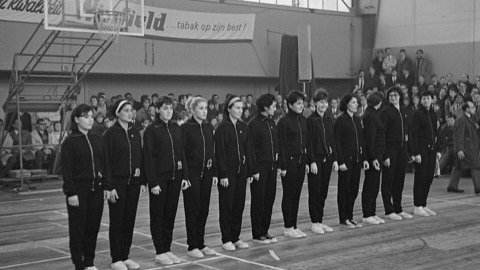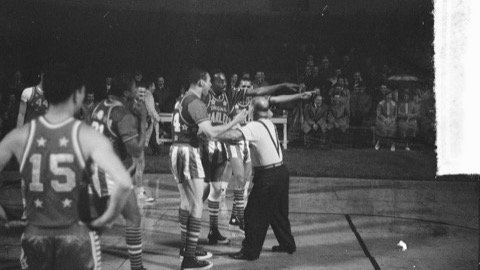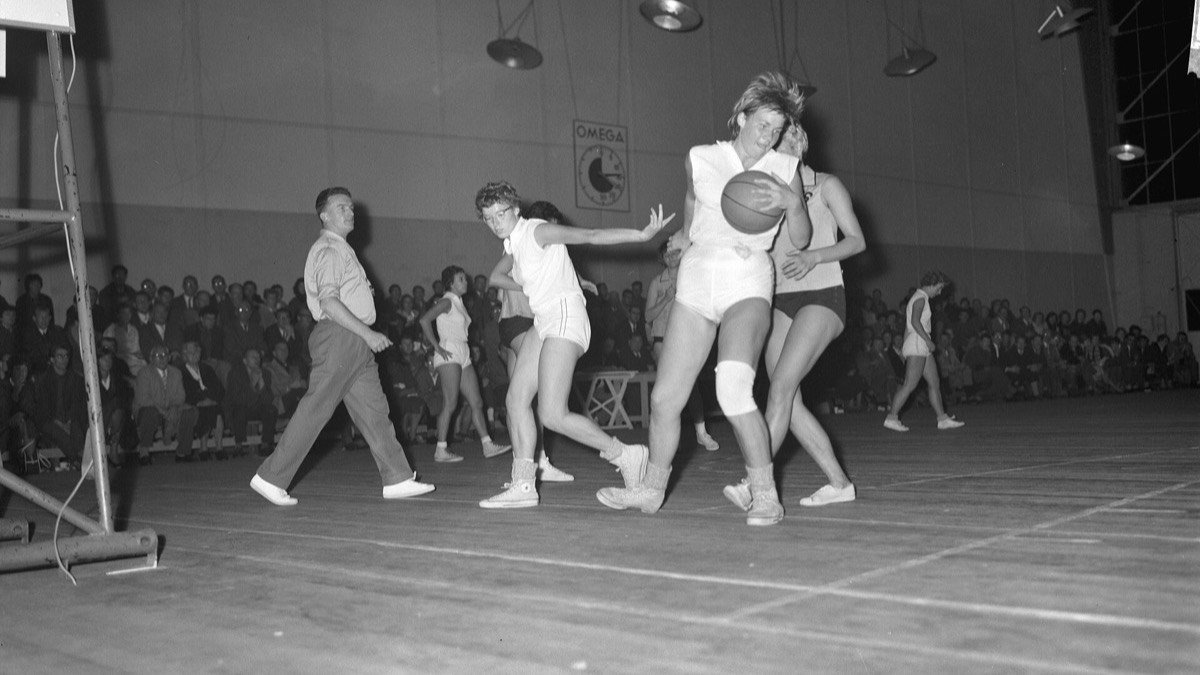

Basketball is unusual among major sports in that women began playing it almost immediately. The rules were adapted for female students within a year of the game's invention, which sounds progressive until you read the adaptations: the court was divided into zones, players could not cross the lines, and dribbling was limited. It took a hundred years to undo most of that.
Senda Berenson, a physical education instructor at Smith College in Massachusetts, introduced the game to her students in 1892, the year after it was invented a short distance away. She wrote her own version of the rules, designed to limit running and physical contact in line with the medical opinion of the day about what women's bodies could withstand.
A game played behind closed doors
The first intercollegiate women's game, between Stanford and Berkeley in 1896, was played with men barred from the building. That was normal: women's sport was considered a private matter of health and education rather than a public spectacle, and the restriction was presented as propriety rather than exclusion.
The zoned court survived in various forms for decades. Players were assigned to a third of the floor and could not leave it, which produced a game of passing and positioning rather than running. Generations of women learned basketball without ever being allowed to take the ball the length of the court.
The Edmonton Grads
The most remarkable team of the early era came from Canada. The Edmonton Grads, formed from a girls' high school side, played for a quarter of a century from 1915 and won an overwhelming majority of the games they contested, touring Europe and taking on all comers. Their record is among the most dominant in the history of any team sport.
James Naismith, who invented the game, watched them play and was unreserved in his praise. They folded at the outbreak of the Second World War, and for a long time their achievements sat almost unremembered outside Alberta.
The rules catch up
The zoned court was gradually abandoned through the middle of the twentieth century, and by the 1970s women were playing the full-court, five-a-side game that men played. Legislation in the United States requiring equal provision for women's sport in schools and universities transformed participation, and the number of girls playing organised basketball rose by an order of magnitude within a decade.
International competition grew in parallel. Women's basketball became an Olympic sport in 1976, and the national programmes of the United States, the Soviet Union, Australia, Brazil and others began producing players of a standard that had never had a stage before.
The court was divided into zones because doctors of the day believed women could not run its full length. The rule outlived the belief by decades.- On the original women's rules
A professional league, eventually
Several attempts at a professional women's league in the United States failed before the WNBA was founded in 1996 with the backing of the established men's league, playing its first season the following summer. It has survived where others did not, through difficult years of low salaries and thin coverage, and it is now a genuine career path rather than a brief postscript to college.
Many of its players still spend their off-seasons competing in Europe, Asia or Australia, where strong domestic leagues have existed for years. The best women's basketball in the world is genuinely global in a way the men's professional game, concentrated in one league, is not.
Women's college basketball introduced a shot clock before the men's game did in the United States, one of several rule changes the women's version adopted first.
College basketball changes everything
In the United States the college game has been the engine of the women's sport for fifty years. It provides the scholarships, the coaching, the television exposure and the rivalries, and for a long period it was the only level at which women's basketball was watched by large numbers of people.
Recent seasons have seen audiences for the women's college championship rise to levels that would have been unthinkable a decade earlier, and the players arriving in the professional league now come with established public profiles. That is new, and it has changed the economics of the sport faster than any rule ever did.
A genuinely global game
Outside the United States the structure is different. Strong club competitions in Spain, France, Turkey, Hungary and Australia have operated for decades, and national programmes in Brazil, China, Japan, Nigeria and across Europe produce players who compete at the highest level without ever setting foot in an American college.
The result is a sport where the best competition is spread across several continents and several calendars. Players move between them constantly, which is exhausting and also means that ideas about tactics and training circulate faster in the women's game than in the men's.
Where it stands
Attendance and television audiences for women's basketball have risen sharply in recent years, particularly at college level, and the arguments about pay and investment that follow are the arguments of a sport being taken seriously rather than ignored.
It is worth remembering how recent all of this is. Players now in their thirties grew up with no professional league in their own country to aspire to. The sport Senda Berenson adapted for her students in 1892 has only been allowed to be itself for about fifty years.
Still an argument worth having
The disputes that surround women's basketball now - over pay, over charter flights, over how much television coverage a league deserves - are the disputes of a sport that has an audience and expects more. They are a great deal more productive than the questions it faced for most of its history, which were about whether it should be played at all.
The players who settled that older question did so in half-empty halls, under rules written to protect them from exercise, and usually without being paid at all. The modern game owes them a debt it has only recently begun to acknowledge.