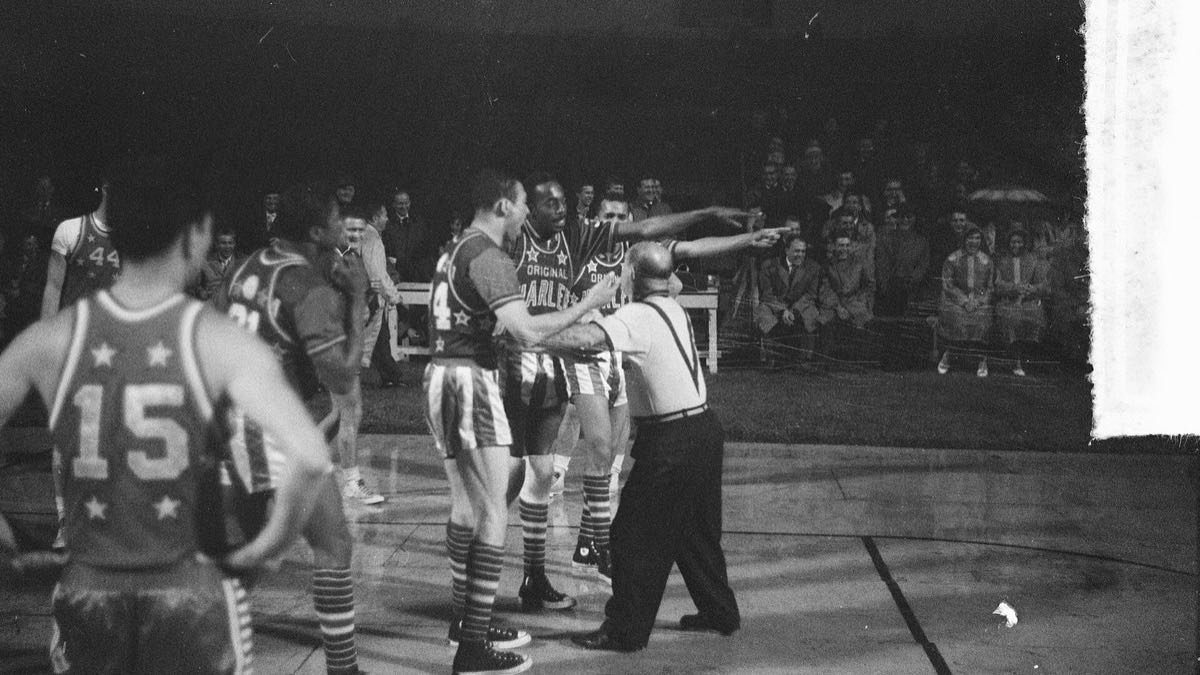

Most people know the Harlem Globetrotters as a comedy routine with a basketball: the spinning ball on a finger, the bucket of confetti, the whistling theme tune. That version is real and it is also the second half of the story. Before the show, they were one of the strongest teams in the country, and the games they won helped force professional basketball to integrate.
The team came together in Chicago in the late 1920s under Abe Saperstein, a promoter who booked them into small towns across the American Midwest. The name was marketing. They were not from Harlem, but Harlem was then the best-known Black neighbourhood in the United States, and the word told audiences in advance who would be playing.
A team that travelled to survive
In their early years they drove enormous distances to play in school halls, dance floors and barns, often for small purses and sometimes in places where they could not find a hotel or a restaurant that would serve them. The comedy came out of those conditions. When a team is far better than its opponent and the crowd has paid to be entertained, clowning keeps the evening alive and keeps you invited back.
Underneath it they were formidable. The routines required ball handling of a standard nobody else was practising, and the players who performed them, including the great dribbler Marques Haynes, were genuinely among the best in the sport.
Beating the champions
In 1948 the Globetrotters played the Minneapolis Lakers, the dominant professional team of the moment, and won. They beat them again the following year. These were not exhibitions with routines; they were straight competitive games, and they settled an argument that had been conducted mostly through assumption.
The professional league was still closed to Black players at that point. The results made the exclusion look exactly as indefensible as it was, and within a couple of years the colour line was broken, with several of the first Black players in the league arriving by way of the Globetrotters.
The show takes over
Once the professional league was open, the best Black players had somewhere better to go, and the Globetrotters' competitive role faded. Saperstein leaned fully into entertainment, and the team became a global touring operation, playing in dozens of countries and introducing basketball to audiences who had never seen it played at all.
The familiar elements date from that era: the whistled theme tune, the weaving warm-up circle, the bucket that turns out to be full of paper rather than water, and a permanent opponent whose job is to lose with dignity.
A travelling show that happened to contain one of the best basketball teams in the country.- How the early Globetrotters are best described
The players who passed through
The roster list over the decades is remarkable. Wilt Chamberlain spent a season with the team before beginning his professional career. Meadowlark Lemon became one of the most recognisable figures in American entertainment. Lynette Woodard, an Olympic champion, signed in 1985 and became the first woman to play for the team.
Several Globetrotters alumni went on to coach, and the ball-handling drills the team invented out of necessity are now standard warm-up material for youth teams everywhere.
The Globetrotters have played in well over a hundred countries, including games staged in places where basketball had no organised presence at all before they arrived.
The routines, and the skill behind them
The famous warm-up circle, with the ball moving between players faster than the eye follows, is rehearsed the way a dance is rehearsed. So is the sequence of fake passes, hidden balls and sleight of hand that fills the middle of a show. None of it is improvised, and all of it requires handling skills well beyond what a competitive game demands.
That is the paradox of the act. To clown convincingly with a basketball you have to be better with it than the people playing seriously, and the Globetrotters' best performers spent hours each day on drills that no coach in a league would have thought to assign.
The team that always loses
Every touring show needs an opponent, and for most of the Globetrotters' history that role has been filled by a travelling side whose job is to provide a real but losing contest. The arrangement is openly theatrical, which has not stopped the occasional genuine upset over the decades - an event rare enough to make news when it happens.
The opponents are professional players, often former college athletes, and the games are played at a real pace. What is scripted is the outcome and the comedy, not the basketball in between.
Exporting the game
Long before any league thought about international expansion, the Globetrotters were playing in Europe, Asia, Africa and South America. For millions of people, the first basketball they ever saw was a Globetrotters exhibition in a local arena, and several national federations trace their founding to the interest those visits generated.
That is an odd legacy for a comedy act and a considerable one. The global sport that now draws players from every continent into professional leagues was, in many places, introduced by a bus full of entertainers who had been turned away from hotels at home.
What the act actually did
It is easy to be sniffy about the comedy, and plenty of basketball purists have been. But the Globetrotters spent decades doing two things no one else was doing: proving that Black players belonged at the highest level, and carrying the sport to audiences far outside the United States at a time when no league had any interest in doing so.
A great deal of the global popularity that basketball now enjoys was built by a team driving between small towns in a crowded car, making people laugh so that they would come back and watch again.