
In the autumn of 1924 a sportswriter opened a match report with a sentence about horsemen and a grey October sky. Four Notre Dame players spent the rest of their lives being described by it, and American sport learned how much a piece of writing could be worth.
They were Harry Stuhldreher at quarterback, Jim Crowley and Don Miller at halfback and Elmer Layden at fullback, and they were not physically impressive. None of them was heavy even by the standards of the 1920s. What they had was timing. Knute Rockne's Notre Dame ran a shift - the backfield moved into position in unison just before the snap - and the whole thing depended on four players starting and stopping together, precisely, every time.
The sentence
On 18 October 1924 Notre Dame played Army at the Polo Grounds in New York and won. Grantland Rice, covering it for the New York Herald Tribune, began his report with an image of four horsemen riding against a blue-grey sky, then named the backfield. It was florid, it was borrowed from scripture, and it worked completely.
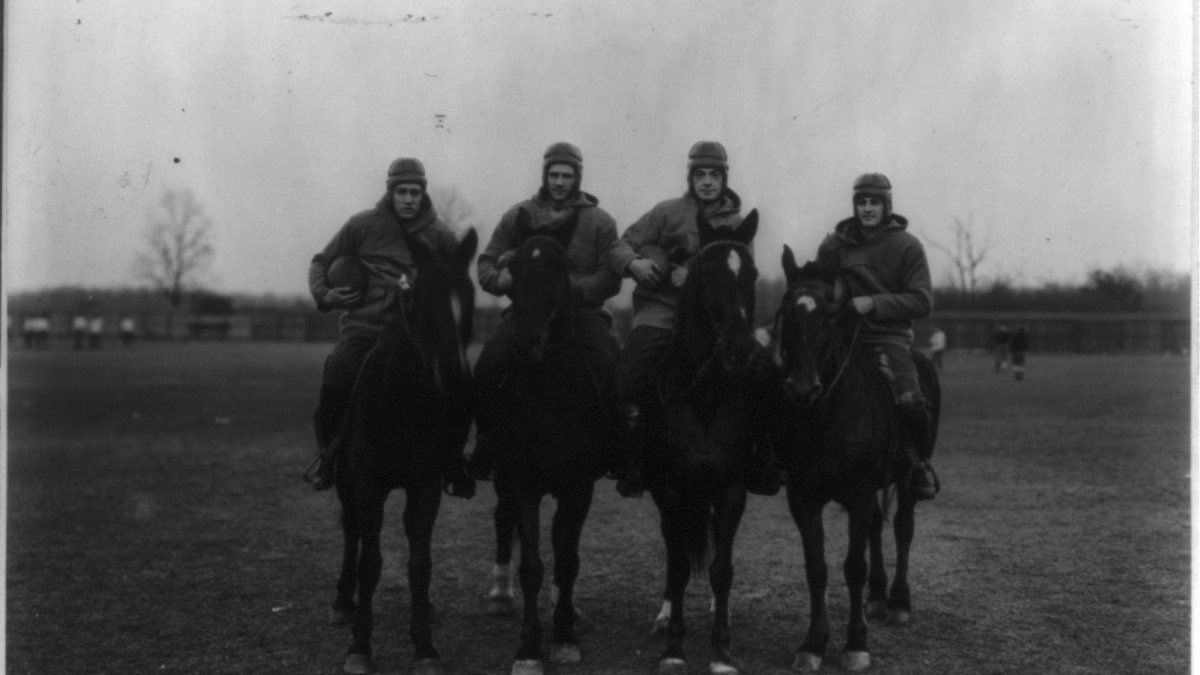
A Notre Dame student publicity assistant named George Strickler read it and did something clever: he arranged for the four players to be photographed in uniform, sitting on borrowed horses, and sent the picture out. The photograph is why the nickname survived the week. Thousands of people who never read the column have seen the image.
The season behind the legend
The myth has a habit of swallowing the football, which is unfair, because the 1924 team was genuinely excellent. Notre Dame went through the season unbeaten and finished it in Pasadena on New Year's Day 1925, beating a Stanford side coached by Pop Warner in the Rose Bowl. Layden's performance in that game is the one the old reports dwell on.
It was also the high point of Rockne's method. His teams were not bigger or stronger than their opponents; they were better drilled and faster off the mark, and he scheduled them across the country against the best programmes available, which built a national following for a small Catholic university in Indiana.
"Outlined against a blue-gray October sky the Four Horsemen rode again."- Grantland Rice, New York Herald Tribune, 1924
Why the 1920s mattered
College football in that decade was the dominant American spectator sport, and the professional league was a provincial curiosity by comparison. Three things drove it: newspapers with large sports sections and writers who were celebrities in their own right; radio, which made a Saturday game audible a thousand miles away; and a building boom in concrete stadiums that gave universities the capacity to seat crowds in the tens of thousands.
That combination produced a set of national figures - coaches as much as players - and an appetite for narrative that the press was happy to supply. The Four Horsemen are the clearest example, but the decade generated a steady stream of nicknames, legends and set-piece rivalries that still shape how the American game talks about itself.
The line in front of the Four Horsemen was nicknamed the Seven Mules, by the linemen themselves, who pointed out that the backfield only looked quick because somebody was clearing the way. It is the oldest joke in football and it was, on the evidence, largely accurate.
Rockne's actual method
Underneath the publicity there was a serious coach doing something specific. Rockne's teams used a shift - the backfield lined up one way, then moved as a unit into a different formation immediately before the ball was snapped. Done correctly it forced the defence to react a fraction late on every play, which is where the Horsemen's reputation for speed largely came from.
It was so effective that the rules were eventually changed to require a full stop before the snap, which blunted it. That is a recurring pattern in American football: a coach finds an advantage inside the rules, the advantage becomes unanswerable, and the rules committee removes it. Rockne spent the rest of his career finding the next one.
What became of them
All four graduated and went into respectable careers, which was the point of Rockne's programme as much as the winning. Layden later became athletic director at Notre Dame and then commissioner of the professional league. Stuhldreher coached at college level and went into business. Crowley coached and worked in broadcasting; Miller became a lawyer and a federal prosecutor.
Rockne did not get a long career. He was killed in a plane crash in 1931, at the height of his fame, and the shock of it was national news. He remains the coach every Notre Dame appointment is unfairly measured against.
The legacy of a good paragraph
There is a slightly uncomfortable truth in this story, which is that the Four Horsemen are famous out of proportion to what they achieved. Notre Dame has had better teams. American college football has had many better individual players. What those four had was the right writer at the right game, and a publicity man with an idea about horses.
That is not a criticism of them. It is a description of how sporting fame has always worked, and 1924 is the moment it became obvious. The modern machinery of highlight packages, nicknames and narrative is doing exactly what Grantland Rice did with one sentence, at considerably greater expense.