
College football in the 1920s was a national obsession. The professional game was a curiosity played in small industrial towns for small crowds. One halfback from Illinois, and the manager who saw what he was worth, closed that gap in a single winter.
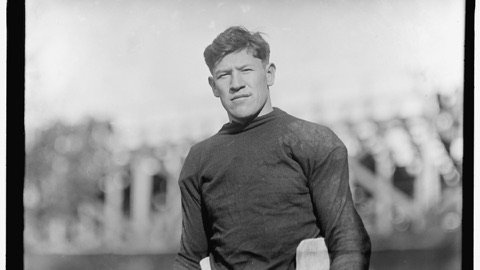
Harold Grange was born in Pennsylvania in 1903 and raised in Wheaton, Illinois, where his father was the police chief. He spent his summers hauling blocks of ice for a local company, a job that later gave sportswriters the nickname they used when they got tired of the other one: the Wheaton Iceman. He was not recruited in any modern sense. He went to the University of Illinois, nearly did not try out for football at all, and ended up wearing number 77 because it was handed to him.
The afternoon that made him famous
On 18 October 1924 Illinois opened its new stadium against Michigan, who had not lost in years. Grange took the opening kickoff and ran it back the length of the field. Before the first quarter was over he had scored four touchdowns. He added another later, and threw a pass for one more. Sixty-seven thousand people watched it, and the men writing about it reached for language that sounded ridiculous until you looked at the box score.
Grantland Rice, the most widely read sportswriter in the country, produced the lines that stuck. He called Grange a phantom, a streak of fire, something that could not be caught or blocked. The phrase people kept was the Galloping Ghost, and Grange spent the rest of his life being introduced with it.
C. C. Pyle and an idea nobody had tried
Grange's college career ended in November 1925. Within days he had signed a professional contract with George Halas and the Chicago Bears, brokered by a Champaign cinema owner named Charles C. Pyle, who understood something the football world did not: that the value of a famous athlete was not limited to the team he played for.
The reaction was close to scandal. Turning professional was widely regarded as a betrayal of the college game; Grange's own coach was publicly unhappy about it. Pyle did not care. He had arranged a schedule of exhibition games, and the plan was to play them back to back across the country before the public lost interest.
The tour
What followed was brutal and extremely effective. The Bears played a run of games in a matter of weeks, travelling by train, in cities that had never seen professional football and had no reason to care about it. They cared about Grange. In New York the crowd at the Polo Grounds was far beyond anything the professional game had drawn, and the money from that single afternoon is generally credited with keeping the New York Giants in business.
Grange played hurt through most of it, because the tour only worked if he was on the field. Newspapers that had never covered the professional league sent reporters. For the first time the question "why would anyone watch paid football?" had an answer that did not require an argument.
Pro football did not slowly win the American public over. It was handed an audience in the space of a few weeks, by one player and one manager who refused to wait.- PuroGoal
A fight with the league, and a knee
Pyle's next move was less successful. Denied a franchise in New York, he and Grange started a rival league in 1926 and put their own team in the city. It lasted a single season. Grange went back to the established league, and then, in 1927, wrecked his knee.
He was twenty-four. The thing he had been - a runner who could change direction faster than anyone could commit to a tackle - was gone, and he knew it immediately. What is unusual is what he did next. He stayed in the game for years as a reliable two-way player, a solid defensive back and a dependable blocker, and he never pretended he was still the Galloping Ghost.
Grange's manager also pioneered the idea of selling an athlete's name separately from his sport. There were Grange endorsements, a Grange film and a Grange doll, at a time when most professional players took off-season jobs in factories to get through the winter.
After the knee
He retired in the mid-1930s and became a broadcaster, calling games on radio and then on television, which meant he narrated the sport's second transformation after having caused the first. He died in 1991, long enough to see the league he had legitimised become the largest sporting business in the country.
When the Pro Football Hall of Fame opened in Canton he was in the first group inducted, alongside Jim Thorpe and George Halas. The company is appropriate. Thorpe gave the professional game a name worth printing; Halas gave it an organisation that survived; Grange gave it the week in which the American public finally looked up.
The part that gets forgotten
It is tempting to tell this as a story about marketing, and the marketing was real. But the reason any of it worked is that the football was genuinely extraordinary. Film of him is scratchy and short, and it still shows what the reports describe: a runner who seemed to decide late, who ran at angles that made defenders turn the wrong way, and who never looked hurried. Teams could not scheme for him because the thing he did was not a scheme.