
American football did not evolve slowly out of rugby. It was argued into existence, rule by rule, in committee rooms, mostly by one person. Walter Camp spent nearly fifty years deciding what the game was, and almost everything distinctive about it is his doing.
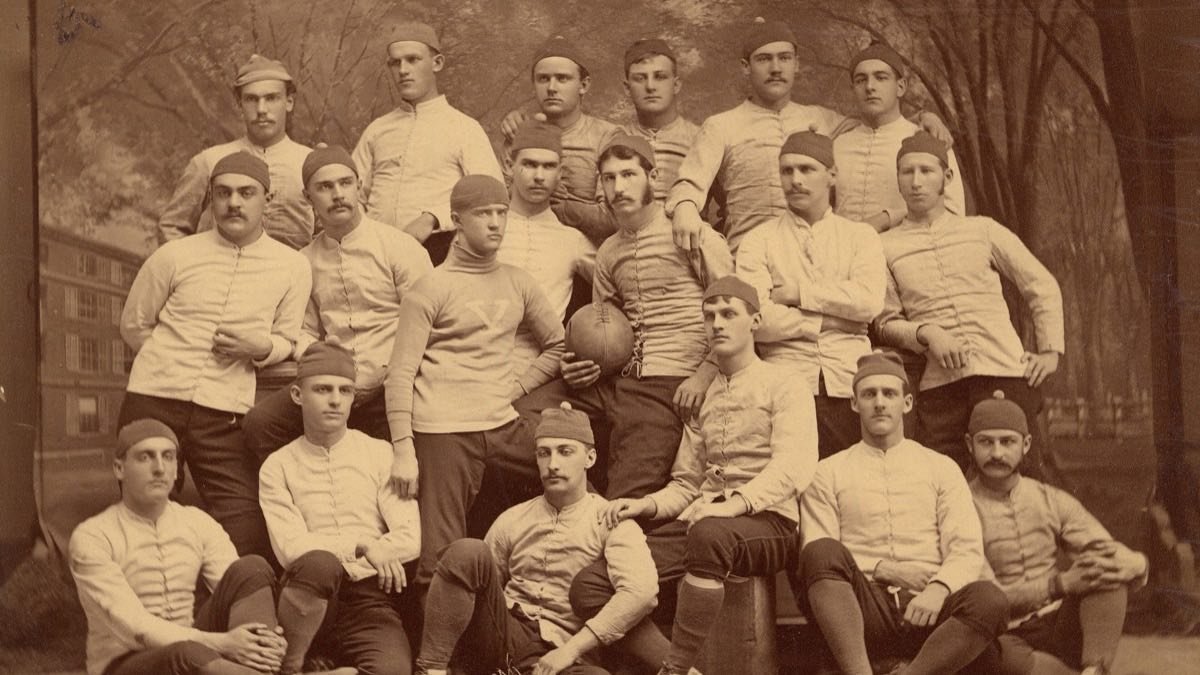
Camp was born in Connecticut in 1859 and went to Yale, which in the 1870s meant going to the centre of American football as it then existed: a handful of eastern colleges playing a version of rugby under rules they renegotiated every year. He played for Yale, stayed on as an unpaid adviser to the team, built a career at a watch company in New Haven, and never stopped attending the meetings where the rules were set.
Taking the scrum out of the game
The first change was the most important. In rugby, possession after a stoppage is contested: the ball goes into a scrum and either side may come out with it. In 1880 Camp persuaded the rules committee to replace that with the scrimmage - one team in clear possession, putting the ball into play on its own terms.
It solved one problem and created a worse one. If a team owned the ball and was never obliged to give it up, the sensible tactic was to hold it. Yale and Princeton duly played a championship game in which neither side did anything at all, on the reasonable grounds that losing the ball was the only way to lose. Spectators were not impressed.
The invention that defines the sport
Camp's answer, adopted in 1882, is the single idea that separates American football from every other code. A team in possession must advance the ball a set distance within a set number of attempts, or hand it over. The original terms were three attempts to gain five yards; the modern four attempts to gain ten came later, as scoring and defences changed.
Everything the game is now follows from that rule. Downs create the pause between plays, and the pause creates the huddle, the play call, the specialist formations and the coaching. They produce fourth-down decisions, punts, two-minute drives and the whole strategic vocabulary that makes the sport feel more like a sequence of problems than a flow. They are also why the field is marked with lines every five yards: without the measurement, the rule cannot be enforced.
Take the system of downs out of American football and what is left is rugby. Almost everything else in the sport is built on top of that single rule.- PuroGoal
The rest of the furniture
Camp pushed the roster down from fifteen players to eleven, which thinned out the crowd around the ball and made space the central resource of the sport. He defined the position of quarterback - the player who receives the ball from the centre and decides what happens to it. He established a scoring system in which different achievements were worth different numbers of points, replacing earlier arrangements where a goal was simply a goal. He wrote the signal-calling conventions, the rules on tackling below the waist, and the dimensions of the field.
He also wrote, constantly. He produced instructional books, edited the annual football guides, and published articles explaining the game to a public that was learning it as it went. For decades, if an American wanted to know what the rules were, the answer came from Walter Camp.
Camp also started the practice of naming an annual All-America team, picking the best player at each position across the whole country. Every modern all-star selection, in every American sport, is a descendant of a list one man compiled from newspaper reports and his own travelling.
Selling the game to a sceptical public
Camp's other long campaign was persuading Americans that football was worth having. He wrote for general magazines, argued that the sport built character and organisational ability, and framed it in the language of business and leadership that his readers already respected. It is not a coincidence that American football became the game of universities and then of the armed forces.
During the First World War he was involved in physical training programmes for the services, and afterwards promoted a short daily exercise routine to the general public. The man who designed the sport also spent a good deal of his life designing the argument for it.
The part he got wrong
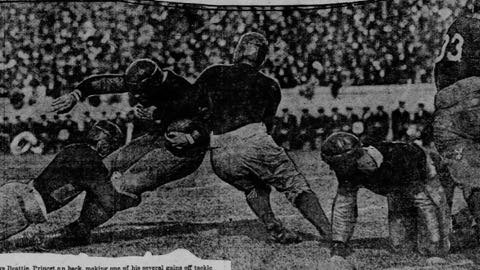
His conservatism nearly killed the sport. Because possession was secure and the field could be attacked in concentrated bursts, teams developed mass formations - packs of players moving together behind interlocked arms, driving into a defensive line. It was effective, extremely dangerous, and Camp defended it longer than he should have.
By the middle of the 1900s the injury reports had become a national scandal and the pressure for reform came from outside the committee, including from the White House. The forward pass was legalised, the mass plays were restricted, and a new body was founded to oversee college sport. Camp remained involved, but he no longer set the agenda alone.
What he left
He died in 1925, in a hotel room in New York, during a rules committee meeting. The detail is almost too neat. By then the game he had assembled was the biggest sport on American campuses and had just produced a professional league; the stadium at Yale that carries his name was already standing.
He is usually called the father of American football, which overstates and understates the case at the same time. He did not invent the sport, and plenty of the ideas he adopted came from other people in the room. What he did was decide, repeatedly, over half a century, which of those ideas survived. The result is a game that looks nothing like the one he started playing, and is built entirely on his decisions.