
The most valuable club competition in world sport began as a reply to a boast. In the mid-1950s an English newspaper declared its country's champions the best team on earth, and a French editor decided the only honest way to settle it was to make them prove it.
Club football before the 1950s was almost entirely a domestic affair. Teams met across borders in friendlies and small regional tournaments, but there was no continental competition and no agreed way of comparing a Spanish champion with a Hungarian one. Travel was slow, floodlights were new, and the idea of flying a squad across Europe midweek was closer to an adventure than a fixture.
The boast
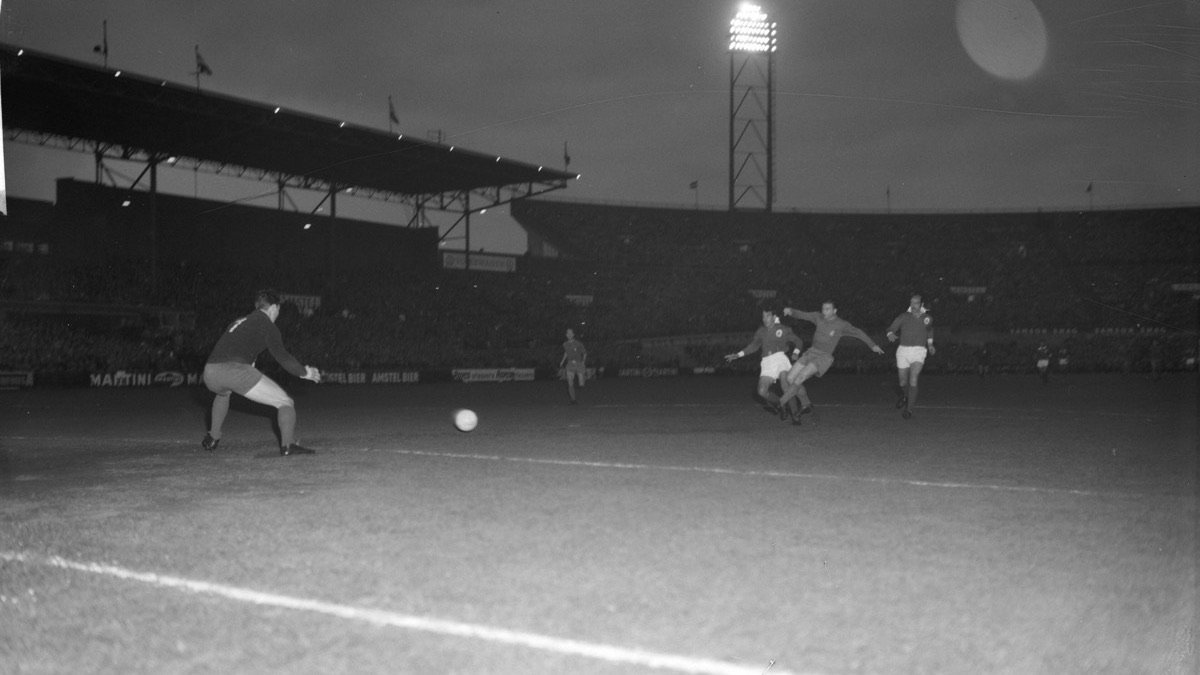
The spark came when Wolverhampton Wanderers, then one of England's strongest sides, beat a series of foreign opponents in prestigious midweek floodlit friendlies, including the celebrated Hungarian army team Honved. English newspapers announced that Wolves were champions of the world. Gabriel Hanot, editor of the French sports daily L'Equipe and a former international himself, replied in print that beating two teams at home in front of your own crowd proved nothing, and proposed a proper tournament of national champions played home and away.
Hanot and his colleagues did the organising themselves, inviting clubs directly before European football's governing body had agreed to anything. The governing body took over once the plan clearly worked.
Madrid take ownership
The first edition began in 1955, and one club turned it into their own property. Real Madrid won the first five competitions in succession, a run that has never been approached since. The fifth of them, at Hampden Park in Glasgow in 1960, is still cited as the finest final ever played: Real Madrid beat Eintracht Frankfurt 7-3, with Ferenc Puskas scoring four and Alfredo Di Stefano three, in front of a crowd that stayed to applaud both teams off.
That match did more for the competition's reputation than any amount of organisation. It was broadcast widely, it was played at a pace that astonished those who saw it, and a generation of British coaches later said it changed what they thought football could look like.
A tournament invented to settle a newspaper argument became the thing clubs organise their entire season around.
Britain, late but loud
English clubs were slow to take part - the Football League initially discouraged it, viewing midweek European travel as a distraction - and the first British winner came from Scotland. In 1967 Celtic beat Internazionale in Lisbon with a team composed almost entirely of players born within a short distance of the club's ground, a detail that is unimaginable now and was remarkable even then. Manchester United won it the following year, ten years after the air crash that had destroyed their previous great side.
The 1970s and early 1980s brought long periods of national dominance - Dutch, then German, then English - and the competition settled into its familiar rhythm of floodlit midweek nights and long away trips.
For most of its history the European Cup was open only to the champions of each country plus the holders. A club could win its domestic league, lose in the first round, and have no European football at all the following season.
The reinvention
In 1992 the tournament was restructured and renamed the Champions League. A group stage replaced the early knockout rounds, guaranteeing clubs a minimum number of matches and, more to the point, a minimum amount of television money. Entry was gradually widened so that the strongest leagues could send several clubs, which meant the competition quietly stopped being a tournament of champions while keeping the name.
The commercial effect was enormous. Broadcast revenue reshaped club budgets across the continent, transfer fees rose to match, and qualification for the group stage became the financial dividing line in most domestic leagues - sometimes mattering more to a club's accounts than winning the league itself.
Two legs, and the rule that shaped them
The home-and-away format created a tactical problem the competition had to solve: what happens when the aggregate score is level. The answer, introduced in the 1960s, was the away goals rule - goals scored away from home counted double in the event of a tie. For more than half a century it shaped how teams approached European ties, encouraging visitors to attack and making a 0-0 away result genuinely valuable.
It also produced strange incentives. Teams defending a first-leg lead at home sometimes played as if a single concession would end them, because it often did. The rule was finally scrapped in 2021, on the reasoning that travel and pitch conditions no longer disadvantage away teams the way they did in 1965, and ties level after two legs now simply go to extra time.
What it costs and what it gives
The criticisms are familiar and largely fair. The format favours the wealthy, the same handful of clubs reach the latter stages, and periodic attempts to create a closed competition for the biggest names have had to be beaten back by supporters. The gap between those who qualify regularly and those who do not has widened every decade.
And yet the thing Hanot wanted still happens. Once a season a club from one country travels to another and finds out, in public, whether it is as good as it believes. The anthem, the midweek evening kick-off, the away end high in the corner of an unfamiliar stadium - all of it grew out of a French editor refusing to let an English newspaper award itself a title nobody had played for.