
A pitcher's job is to make a ball arrive somewhere other than where the batter expects. Everything else - the grips, the arm angles, the changes of speed, the rules written to keep the contest fair - is detail built on top of that single idea, and it has been evolving for a hundred and fifty years.
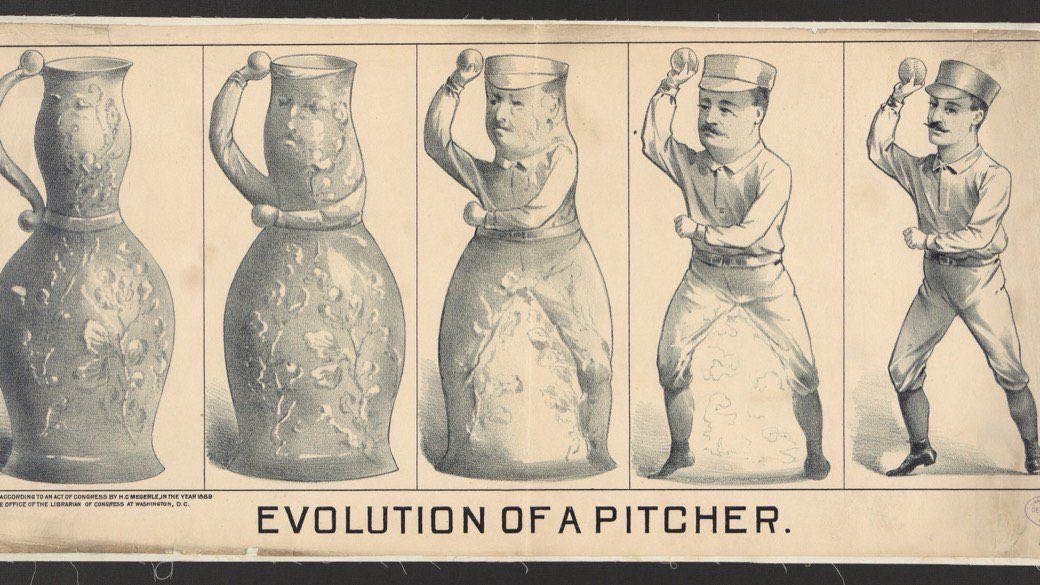
At the beginning, pitching was not a contest at all. The pitcher's role was to deliver the ball underhand so the batter could hit it, rather like a bowler feeding a net session. The entire history of pitching is the story of that polite arrangement breaking down.
Sixty feet six inches
The distance from the pitching rubber to home plate was moved back repeatedly in the nineteenth century as pitchers grew more dangerous, settling in 1893 at sixty feet six inches. Offence jumped immediately, and the figure has never been changed since.
The mound itself has been adjusted. After a season in the late 1960s in which scoring collapsed and pitchers dominated completely, the rules were changed to lower the mound, on the straightforward reasoning that a pitcher throwing downhill from a greater height has too much of an advantage.
The fastball is not one pitch
Gripping the ball across the wide part of the seams produces backspin and a ball that resists gravity slightly, so it appears to rise. Gripping it along the narrow seams produces a ball that runs and sinks. Both are called fastballs, and hitters have perhaps four tenths of a second to tell them apart.
Velocity has risen steadily, and the modern sport is full of pitchers throwing harder than anyone in the dead-ball era could have imagined. The trade-off is injury: the elbow ligament that absorbs the strain fails regularly, and surgery to replace it has become a routine part of a pitching career.
Making it break
The curveball works by spin. Rotation creates a pressure difference across the ball's surface, and the ball moves towards the lower pressure, which is why a well-thrown curve drops out of the strike zone. Tradition credits its invention to a player in the 1860s who claimed the idea came from throwing clam shells on a beach.
For years people argued that the break was an optical illusion, and the question was only settled by photography. The slider is a later refinement, thrown harder with a tighter spin and a shorter, sideways break that is more difficult for a batter to identify early.
Everything a pitcher throws is an attempt to look like the pitch it is not.- The principle underneath every grip
Taking speed off
The changeup is the subtlest weapon in the set. It is thrown with the same arm speed and the same body language as a fastball, but gripped deep in the hand so it arrives noticeably slower. A hitter who has committed to swinging at the fast one is left swinging early at nothing.
Pitchers describe the changeup as the hardest pitch to learn, because every instinct tells the arm to slow down and the deception depends entirely on not doing so. It is also the pitch that keeps ageing pitchers in work long after their velocity is gone.
The knuckleball
The knuckleball is the strange one. It is thrown with the fingertips dug into the leather so the ball leaves the hand with almost no spin at all, and an unspinning ball is pushed around unpredictably by the air flowing over its raised seams. Nobody, including the pitcher, knows where it will go.
It is slow, it is bizarre to watch, and when it works it is almost unhittable. The pitch puts so little strain on the arm that knuckleball specialists have pitched into their forties and beyond. Very few master it, and catchers who work with one are usually issued an oversized mitt.
The pitches that were banned
Before 1920 it was legal to alter the surface of the ball. Pitchers applied saliva, grease, tobacco juice, mud and sandpaper, all of which changed how the ball moved through the air. The spitball was outlawed after the 1919 season, with a group of existing practitioners permitted to keep throwing it until they retired.
Attempts to get round the ban have never stopped, and the sport periodically catches someone with a foreign substance on their fingers. Recent enforcement has focused on grip-enhancing compounds, which increase spin rate and therefore movement, and umpires now inspect pitchers during games.
The name knuckleball is a misnomer. Almost nobody throws it with the knuckles. The standard grip digs the fingernails into the leather, and the original knuckle grip survives mainly in the name.
Reading the hitter
Grips and velocity are only half the job. A pitcher works through a lineup three times in an afternoon, and the batter who was fooled in the second inning has seen everything by the sixth. Sequencing - what you throw, in what order, and what you have deliberately shown earlier - is where experienced pitchers earn their living.
The catcher is a full partner in this. He tracks what has worked, what the hitter has swung through and where the umpire is calling strikes that day, and he conceals all of it in a set of signs. Modern teams have added electronic signalling to stop opponents stealing those signs, which has been a problem for as long as the signs have existed.
From complete games to the bullpen
The biggest change of all is in how pitchers are used. A starter of the early twentieth century expected to finish what he began, and a relief appearance was a mild embarrassment. Modern clubs treat the staff as a sequence of specialists, each used for a short burst at maximum effort.
The logic is sound: hitters perform better each time they see a pitcher in a game, and a fresh arm throwing at full speed is harder to face. The cost is that the duel between one pitcher and one lineup over nine innings, which is what the sport looked like for most of its history, has quietly disappeared.