He was the most feared man in the game and, by the plain arithmetic of the record book, one of the greatest hitters who ever lived. Ty Cobb played baseball as though every base were a personal debt owed to him, and he spent twenty-four seasons collecting.
Tyrus Raymond Cobb arrived in the major leagues from rural Georgia in 1905, a thin teenager with a country accent and no interest in being liked. He left more than two decades later holding the highest career batting average in major league history, a mark no one has approached since. Between those two points he turned the ordinary business of reaching first base into something closer to warfare.
A debut shadowed by tragedy
Cobb was eighteen when the Detroit Tigers called him up, and the timing could hardly have been crueller. Only weeks earlier his father had been shot dead at home by his mother, who said she had mistaken him for a prowler. The case went to trial and she was acquitted, but the young player stepped onto a major league field carrying something no team-mate could help him with.
He never spoke about it easily, and those who knew him best came to believe that the loss shaped everything that followed. His father had been a schoolteacher and state senator who doubted that baseball was a respectable life. Cobb spent the rest of his career, by his own admission, trying to prove a point to a man who was no longer there to hear it.
Hitting in the dead-ball era
To understand Cobb you have to understand the game he played. The ball was soft, discoloured and kept in play until it came apart. Outfield fences were distant. Home runs were rare accidents rather than a strategy. Scoring came from singles, bunts, stolen bases and errors, and the men who thrived were the ones who could place a ball where no fielder stood.
Cobb was the perfect product of those conditions. He held the bat with his hands apart, a grip that looks wrong to modern eyes but gave him extraordinary control, and he could slap the ball to any field almost at will. He won batting titles year after year and treated a hitless afternoon as a personal insult worth brooding over for days.
The spikes
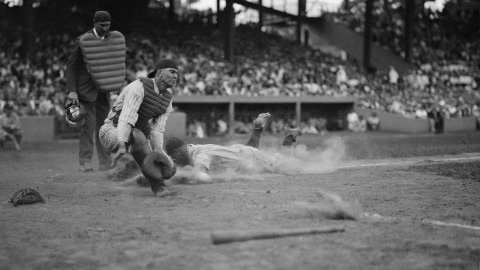
The image that followed Cobb everywhere was of a runner sliding into a base with his metal spikes raised. Opponents swore he sharpened them before games. Cobb never denied the story with much conviction, and that was the point. A fielder who hesitated for a fraction of a second was a fielder who dropped the ball, and the fear did as much work as the slide itself.
He stole bases the same way he hit, by study rather than pure speed. He learned which pitchers were slow to the plate, which catchers had weak arms, which infielders would flinch. Then he ran, often in situations where no one expected it, including the rare and audacious theft of home.
Baseball in his era was not a pastime so much as an argument, settled daily, with spikes.- On the dead-ball game Cobb mastered
A difficult man
Cobb fought with team-mates, opponents, umpires and spectators. He was suspended for climbing into the stands after a heckler. He feuded for years with men who had done little more than beat him in an argument. Teams that acquired him discovered they had bought a batting title and a permanent crisis in the clubhouse at the same price.
Some of the darkest stories told about him in later decades came from a biography whose sourcing has since been seriously questioned, and careful researchers have spent years separating what is documented from what was invented. What survives that scrutiny is still the portrait of a hard, combative man, if a more complicated one than the caricature.
The rivalry that defined him
Then Babe Ruth arrived, and the sport Cobb had mastered began to disappear underneath him. Ruth hit the ball out of the park, crowds adored him for it, and the lively ball of the 1920s made the bunt-and-steal game look like a museum piece. Cobb was publicly contemptuous of the new style and privately furious that it was working.
The story goes that he once announced he would show everyone how easy slugging was, and proceeded to hit home runs in consecutive games before returning to his usual approach. Whatever the precise details, the gesture was pure Cobb: he could not simply dislike an idea, he had to defeat it first.
The first ballot
When the Baseball Hall of Fame held its first election in 1936, Cobb received more votes than any other player on the ballot, including Ruth. The writers who had spent decades describing his temper were in no doubt about his standing as a ballplayer. He was inducted alongside Ruth, Honus Wagner, Christy Mathewson and Walter Johnson.
He had also, unusually for an athlete of his time, become wealthy. Cobb invested early in companies that grew into giants, and he left much of that money to a foundation that still helps Georgia students through university, along with a hospital he funded in his home town.
Cobb's split-hands grip, with the lower hand several inches up the handle, let him change his swing in mid-flight. He could start out looking as though he would drive the ball and finish with a bunt, which is one reason infielders played him shallow and still could not stop him.
What he left behind
Cobb died in 1961, and the obituaries struggled with the same problem every writer since has faced: how to describe a career that magnificent attached to a personality that unpleasant. The compromise most of them reached was to let the record book speak and leave the man to history.
That record book still speaks. The highest career average in the game's history belongs to a player who last swung a bat in the 1920s, which tells you something about how thoroughly he solved the conditions he was given. The Georgia Peach was not a nice man. He was, by the standards of his own era, very nearly a perfect hitter.