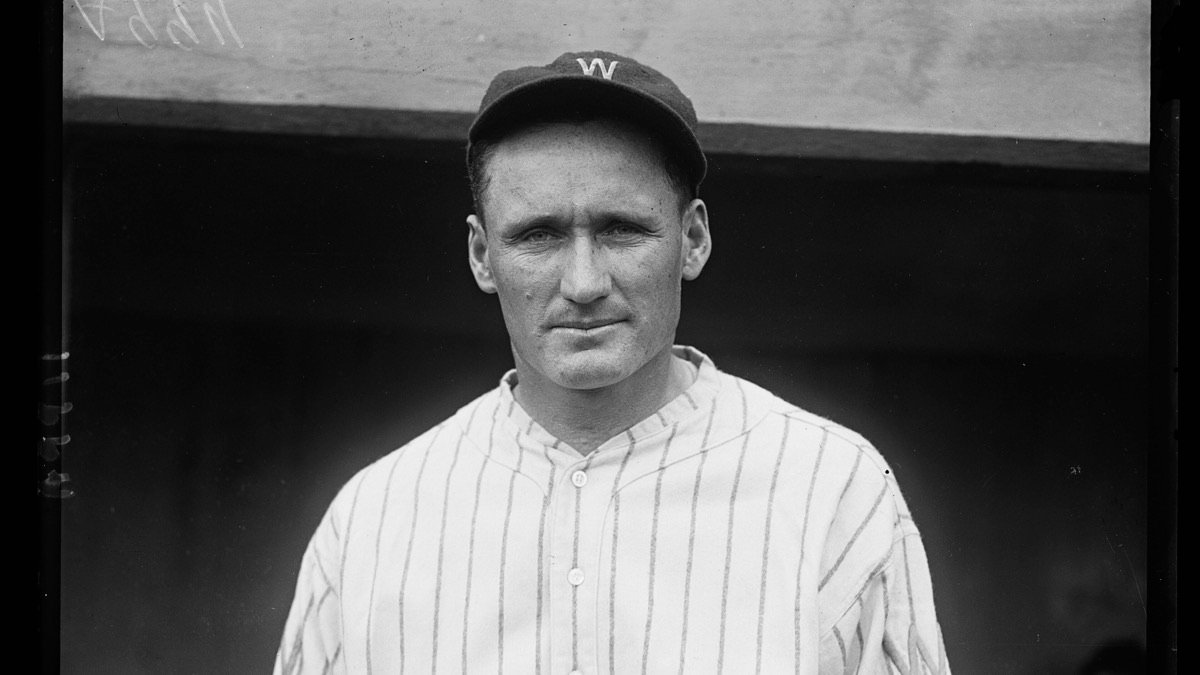

Batters who faced Walter Johnson agreed on one thing: by the time you decided to swing, the ball was already in the catcher's mitt. He threw harder than anyone of his generation, pitched his entire career for a team that rarely gave him runs, and was remembered above all for being kind.
He was discovered on a dusty semi-professional field in Idaho, where a travelling salesman wrote to the Washington club to say there was a teenager out west throwing a ball nobody could hit. The club sent a scout largely to stop the letters. Walter Perry Johnson joined the major leagues in 1907 and never pitched for another organisation.
The motion
What made him extraordinary was not visible effort. Johnson threw with a long, easy sidearm sweep, his arm coming through almost parallel to the ground, and from the stands it looked relaxed to the point of laziness. The ball then arrived at a speed no one in the dead-ball era had seen, which is how he came to be called the Big Train, after the fastest thing most Americans could picture.
There were no radar guns to settle the question of how hard he actually threw. What exists instead is the unanimous testimony of hitters who had faced everyone else and said Johnson was in a separate category, and the record books, which show him striking out batters at a rate the era considered impossible.
The gentlest fast pitcher who ever lived
Johnson was terrified of hurting someone. He refused to pitch inside, which every manager he had considered a tactical disaster, because he knew what his fastball would do to a man's skull. Hitters worked out quickly that they could crowd the plate against him with no fear at all, and they did it for twenty-one years.
The restraint became famous. Opponents called him the most decent man in the game. On the days when a hitter did get hit, Johnson was reportedly more shaken than the batter, and in one well-known instance he walked down to check on the man before the trainer reached him.
Pitching for a team that could not hit
The Washington club of Johnson's prime was, for long stretches, dreadful. The joke in the capital was that the city was first in war, first in peace and last in the American League. He lost a startling number of games in which his side scored no runs at all, and he threw an enormous number of shutouts partly because a shutout was often the only way to win.
Pitchers of that era were also expected to finish what they started. Johnson completed hundreds of games, pitched both ends of doubleheaders, and came out of the bullpen between starts when the team needed him. The modern practice of protecting an arm by counting pitches would have struck his managers as an eccentric joke.
He threw the hardest ball of his generation and spent his career afraid of what it might do.- The paradox of the Big Train
The series he waited his whole career for
By 1924 Johnson was in his late thirties and generally considered finished, and Washington reached the World Series for the first time. He lost his first two starts, and the city braced for the cruellest possible ending to the story. Then the deciding game went to extra innings, and the manager sent the old man out of the bullpen.
He pitched four scoreless innings on short rest, Washington scored in the twelfth, and the championship was his. It remains one of the few moments in the sport's history where the sentimental ending and the actual result were the same thing, and the crowd at Griffith Stadium reportedly refused to leave.
Life after the mound
Johnson managed in the majors after he retired, with mixed results, and found that a quality which made him beloved as a player, his unwillingness to be hard on anyone, worked less well from the bench. He later ran for public office in Maryland, farmed, and raised his children largely out of the spotlight.
His standing never faded. When the Hall of Fame chose its first five members in 1936, Johnson was among them, the only pitcher in the group besides Christy Mathewson. The writers who voted had watched him lose games for a bad team for two decades and understood exactly what they had seen.
Johnson's record for career shutouts has stood for a century and is effectively untouchable. Modern starting pitchers rarely finish a game at all, so a figure built on complete games in the dead-ball era now belongs to a kind of baseball that no longer exists.
A rotation of three and a rubber arm
Pitching in Johnson's day bore almost no resemblance to the modern job. Staffs were small, rest was short, and a front-line starter was expected to take the ball whenever the schedule demanded it, including both halves of a doubleheader when the team was short.
Johnson did all of it without the arm trouble that ended most of his contemporaries early. Why some arms survive that workload and others fail has never been satisfactorily explained, and his durability is studied by people who would dearly like to know the answer. His delivery, long and smooth rather than violent, is the usual explanation offered.
Why he still matters
Every argument about the hardest thrower in history eventually comes back to him, and it cannot be settled, because the measurements did not exist. What can be settled is the shape of his career: two decades of excellence on teams that did not deserve him, achieved without once using the intimidation that was freely available to him.
Johnson died in 1946. The tributes dwelt less on the strikeouts than on the fact that in a rough, often vicious era of the sport, the man with the most dangerous weapon on the field had been the one who refused to use it as a threat.