
Some players win trophies. A much smaller number change the way the sport is imagined. Johan Cruyff did both - first as the thin, restless centre of the greatest Ajax side ever assembled, and then as the coach whose ideas still run through every team that tries to win by keeping the ball.
Hendrik Johannes Cruijff was born in Amsterdam in 1947, in a working-class district a short walk from the old Ajax ground. His father, a greengrocer, died when Johan was twelve, and the club became something close to a second home: his mother took a job there as a cleaner, and the boy was always somewhere near the pitch, fetching balls, watching training, arguing with adults about football. He joined the youth system at ten and never really left its orbit.
The Ajax years
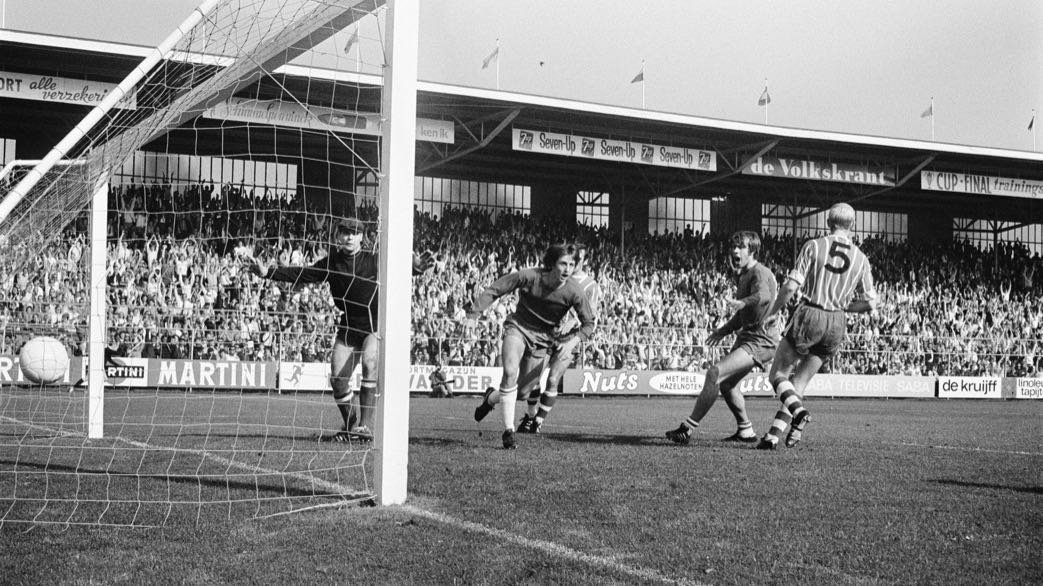
By the end of the 1960s Ajax had stopped being a quietly respected Dutch club and become the most feared team on the continent. Under coach Rinus Michels, and with Cruyff wearing the number 14 he made famous, they won the European Cup three seasons in a row in the early 1970s. On the team sheet Cruyff was a centre-forward, but the description barely applies. He drifted to the wings, dropped into midfield, appeared on the overlap, and the players around him simply filled whatever space he had vacated. That constant, disciplined rotation is what the world came to call Total Football.
It was not improvisation. It was a set of rules about distance and position, repeated until it looked like instinct. Make the pitch big when you have the ball, make it small when you do not. Pass to the foot that lets the next player turn. Cruyff spent his whole life explaining these things in short, blunt sentences that sounded like riddles and turned out to be instructions.
The final he lost and the tournament he won
The Netherlands arrived at the 1974 World Cup playing football nobody had seen at that level, and they left it as the most admired losing team in the history of the competition. In the opening seconds of the final against West Germany the Dutch kept the ball from the kick-off, Cruyff accelerated through the middle, was brought down, and Johan Neeskens scored from the penalty spot before a German player had touched it. The hosts recovered and won the match. The tournament, in every other sense, belonged to the Dutch.
It also gave the game one of its few genuinely new moves. Facing a Swedish defender near the touchline, Cruyff shaped to cross, then dragged the ball back behind his standing leg and spun away in one motion. The defender was still turning the wrong way. Fifty years later children learn it in training sessions and it is still called the Cruyff turn.
"Playing football is very simple, but playing simple football is the hardest thing there is."- Johan Cruyff
Barcelona, twice over
He joined Barcelona in 1973 and the effect was immediate: a club that had spent more than a decade without a Spanish league title won one in his first season, including a win at the Santiago Bernabeu that is still talked about in Catalonia. He gave his son a Catalan name. He became, almost accidentally, a political symbol in a city that was looking for one.
The second act mattered even more. Cruyff returned as coach in 1988 and built the side Barcelona supporters named the Dream Team, winning four consecutive league titles and, at Wembley in 1992, the club's first European Cup. More lasting than the trophies was what he changed underneath them. He rebuilt the youth academy around his principles, insisted that small, technical players be trusted, and promoted a slight local midfielder named Pep Guardiola into the first team. Everything Barcelona became over the following twenty years can be traced to those decisions.
At the 1974 World Cup Cruyff played in a Netherlands shirt carrying two stripes on the sleeve instead of the three worn by his team-mates. He had a personal agreement with a rival sportswear company and refused to advertise another one, so the kit was altered just for him.
A thin man in a hard era
It is easy to forget how physically unforgiving the football of his time was. Pitches turned to mud by November, tackles from behind that would now bring an immediate red card, and defenders who were openly instructed to kick him early and often. Cruyff was slight, smoked, and complained loudly about all of it. He survived by being quicker in the head than anyone else on the field - taking the ball on the half-turn, releasing it a beat before contact, and choosing angles that made the foul pointless.
He was also, famously, difficult to coach. He rearranged his own team during matches, moved team-mates by shouting and pointing, and treated instructions from the bench as opening offers in a negotiation. Michels tolerated it because the results were better when Cruyff was allowed to think. Later, as a manager himself, he expected his own players to argue back.
The idea that outlived him
Cruyff was not an easy man. He argued with directors, walked out of clubs, fell out with old friends and held grudges for years. He was also, by common consent, the most influential European footballer who ever lived, because what he left behind was not a highlight reel but a method - one that coaches could study, copy and pass on.
He died in March 2016, and the tributes came from people who had never seen him play. By then his ideas had been carried into Germany, Spain, England and beyond by coaches who had either worked with him or studied those who had. Watch any modern side build patiently from the goalkeeper, squeeze the pitch after losing the ball, or ask a full-back to step into midfield, and you are watching an argument that Johan Cruyff started.