He came from one of the poorest corners of Buenos Aires and carried a nation on his shoulders. Diego Armando Maradona was football's most gifted left foot and its most human story — a genius who could win a World Cup almost alone, and a rebel who never stopped fighting the world or himself.
Diego Armando Maradona was born on 30 October 1960 in Lanús, on the southern edge of Buenos Aires, and grew up in Villa Fiorito, a poor shantytown where a ball was a way out and a way to dream. From the start there was something different about him: a low centre of gravity, impossible balance, and a left foot that seemed to keep the ball glued to his boot. By his early teens he was already a local sensation, juggling at half-time of professional matches to entertain the crowd.
From Fiorito to the world's most expensive player
He made his professional debut for Argentinos Juniors as a teenager before joining Boca Juniors, the club he had supported as a boy, and winning a domestic title. In 1982 Barcelona signed him for what was reported at the time as a world-record transfer fee. His spell in Catalonia was turbulent — illness, a brutal injury and clashes on and off the pitch — but it set the stage for the move that would define him. In 1984 he signed for Napoli, an unfashionable club in the south of Italy that had never won the league.
A king in Naples
What followed in Naples was close to mythology. Maradona led Napoli to the only two Serie A titles in the club's history, in 1986-87 and 1989-90, and added the 1989 UEFA Cup. For a long-overlooked city in Italy's poorer south, he became far more than a footballer — murals of his face still cover the walls, and to this day he is treated with an almost religious devotion. He gave a place that often felt forgotten a reason to feel like the centre of the world.
"When you are on the pitch, life goes away. Problems go away. Everything goes away."— Diego Maradona
Mexico 1986: the Hand of God and the Goal of the Century
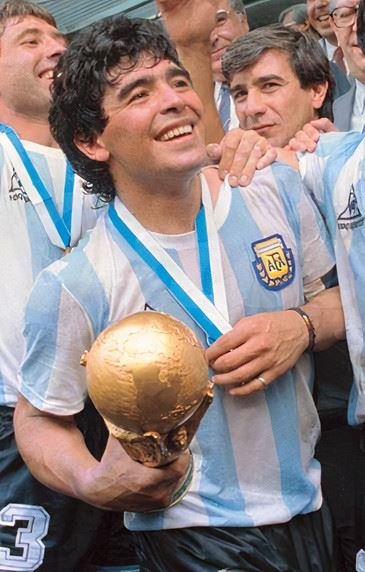
If one tournament captures Maradona, it is the 1986 World Cup in Mexico, which he won almost single-handedly as captain. The quarter-final against England produced two of the most famous moments in the sport's history, minutes apart. First came the "Hand of God" — a goal he punched in with his fist, unseen by the officials and only later admitted. Then came the "Goal of the Century": a slaloming run from inside his own half, gliding past five England players and the goalkeeper before slotting home. Genius and mischief, side by side, in a single afternoon.
Argentina went on to beat West Germany 3-2 in the final, and the trophy felt like Maradona's personal triumph. Four years later he dragged a weaker Argentina side all the way to the 1990 final, where they lost narrowly to West Germany. Even in defeat, his ability to lift ordinary teammates to extraordinary heights was unmistakable.
In Argentina, devoted fans founded a playful "Church of Maradona," complete with its own calendar counting the years from his birth. It began half as a joke and half as genuine reverence — a fitting tribute to a man fans treated as something close to a deity.
The flaws and the farewell
Maradona's brilliance came bound to a long and painful struggle. A battle with cocaine addiction shadowed much of his career and life. In 1991 he was hit with a doping ban, and at the 1994 World Cup his tournament ended in disgrace when he tested positive for ephedrine and was expelled. The same fire that made him fearless on the pitch often turned destructive away from it, and his story became as much about fragility as about greatness.
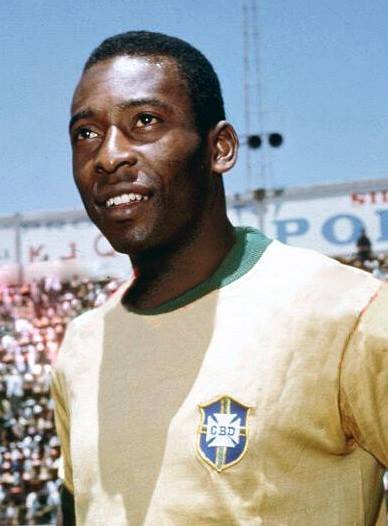
Yet the affection never faded. FIFA later named him co-Player of the 20th Century alongside Pelé, a recognition of an artistry that few have ever matched. When he died on 25 November 2020, Argentina declared days of mourning and millions across the world grieved, not for a flawless hero but for one of their own — a rebellious, beloved, profoundly human figure who belonged to the people. Maradona was never perfect, and that is precisely why so many loved him so completely.