
For a few years in the early 1950s the best football team in the world came from Hungary, played in a way nobody had seen, and lost the only match that would have made them immortal. Their captain was a stocky man with one extraordinary foot, and his career had two completely separate halves.
Ferenc Puskas was born in 1927 in Budapest, in a district where his father played and later coached at the local club. He joined it as a boy, reportedly using a false name because he was below the age limit, and by his late teens he was scoring in the Hungarian first division. His right foot, by his own cheerful admission, was mostly there for standing on. The left did everything else.
The Golden Team
Under coach Gusztav Sebes, the Hungary side of the early 1950s - the Aranycsapat, the Golden Team - went years without losing. They won the Olympic football tournament in Helsinki in 1952. More importantly, they played a formation that did not match anything their opponents had prepared for: a deep-lying centre-forward in Nandor Hidegkuti who dropped away from the centre-backs, leaving them with nobody to mark and a hole behind them that Puskas and Sandor Kocsis ran into.
It looks obvious now. At the time it was close to incomprehensible to defenders trained to pick up the man in front of them and stay there.
The Match of the Century
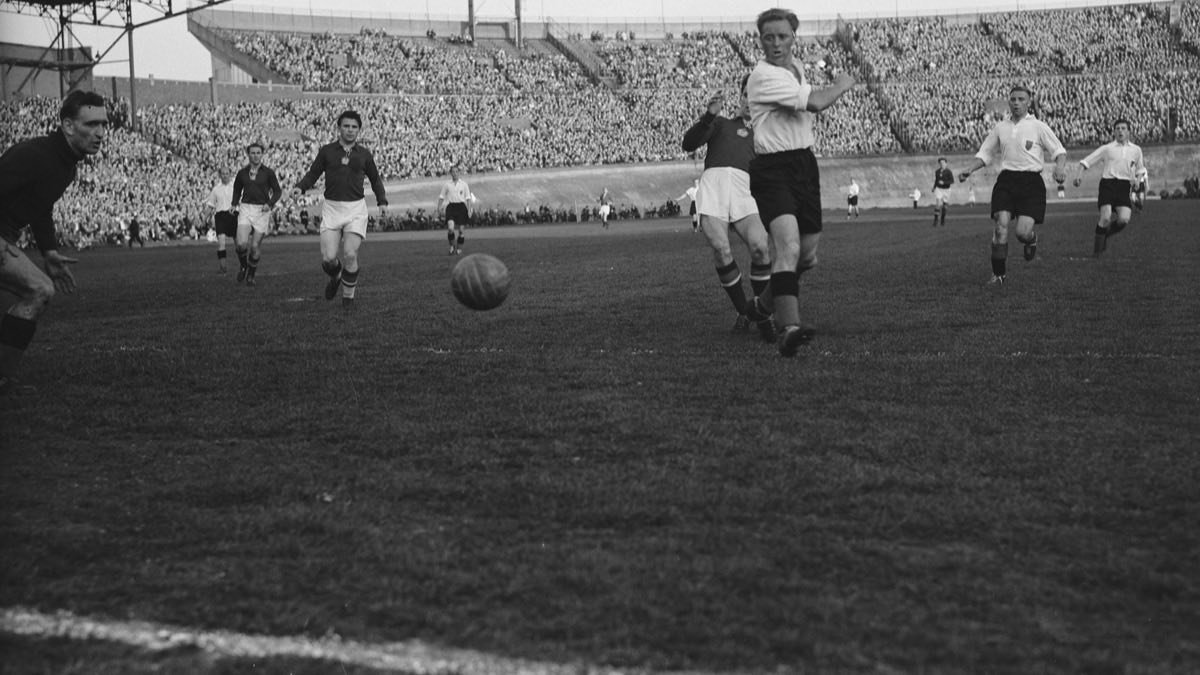
In November 1953 Hungary came to Wembley to play England, who had never been beaten at home by a team from outside the British Isles. The English press treated the visitors as curiosities. Hungary scored inside the first minute and won 6-3, and the manner of it mattered more than the score. The most replayed moment is Puskas standing over the ball near the penalty spot, dragging it backwards with the sole of his boot as an England defender slid past him into empty space, then hammering it into the net before the defender had stopped moving.
England asked for a rematch in Budapest the following spring, and lost 7-1. English football spent the next decade rethinking almost everything, and the two matches are still taught as the moment the game's centre of gravity moved away from its inventors.
They were unbeaten for years, they changed how the game was coached, and the one match they lost is the one everybody remembers.
Bern, 1954
Hungary went to the World Cup in Switzerland as overwhelming favourites and beat West Germany 8-3 in the group stage, a match in which Puskas was badly injured. He was still not fit when the same two teams met again in the final. He played anyway, scored, and watched his team's two-goal lead disappear. West Germany won 3-2, a result known in Germany as the Miracle of Bern and in Hungary as something closer to a national wound. A late Puskas equaliser was ruled out for offside, and Hungarians argued about that decision for the rest of the century.
FIFA's annual prize for the best goal of the year is named the Puskas Award. It honours a player whose most famous piece of skill - the drag-back at Wembley - was performed in front of a crowd that had been told he was not worth worrying about.
One foot, used properly
Puskas was not an athlete in the modern sense. He was short, thickly built, and visibly uninterested in the parts of training that did not involve a ball. What he had was a left foot capable of hitting a ball flat and extremely hard from any angle, with no obvious backlift to warn the goalkeeper, and the composure to use it while being closed down.
Opponents knew he would go left. Defenders were instructed to show him onto his right side and keep him there. It rarely worked, because he had spent his whole life finding ways to get the ball back onto the foot that mattered: a shift with the outside of the boot, a drag-back, a half-turn that bought the centimetres he needed. Single-footed players are usually a weakness to be managed. He turned it into a certainty the whole team could build around.
Exile, and a second career
In 1956 Hungary rose against its government and the uprising was crushed. Puskas was abroad with his club at the time and did not go back. He was banned from football for a period, spent months without training, gained weight, and by the time he was allowed to play again he was past thirty and widely considered finished.
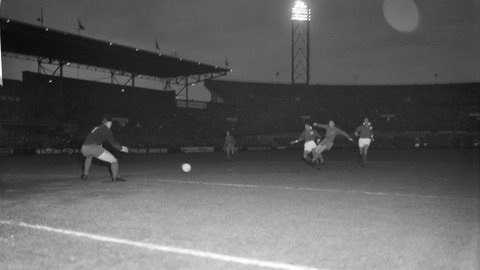
Real Madrid signed him anyway. What followed is one of the strangest second acts in the sport: he won a string of Spanish league titles, finished as the division's leading scorer several times, and became a Spanish international as well as a Hungarian one. The crowning performance came at Hampden Park in Glasgow in 1960, in a European Cup final against Eintracht Frankfurt that Real Madrid won 7-3. Puskas scored four of the seven. He was thirty-three.
What they left behind
He coached afterwards in several countries, most memorably taking Panathinaikos of Greece to a European Cup final, and eventually returned to Hungary, where he is buried in Budapest. The national stadium carries his name.
The Golden Team never won a World Cup, which is the usual measure of greatness, and that is exactly why they are worth remembering. Influence is not the same as silverware. The deep-lying forward, the fluid front line, the idea that a team might deliberately leave a defender with nobody to mark - all of it entered the sport's vocabulary through a group of Hungarians who, in the end, went home with a runners-up medal.