
The men's World Cup began in 1930. The women's equivalent did not arrive until sixty-one years later, and the gap was not an accident of interest. For much of the twentieth century women were formally prevented from playing on the grounds where the sport lived.
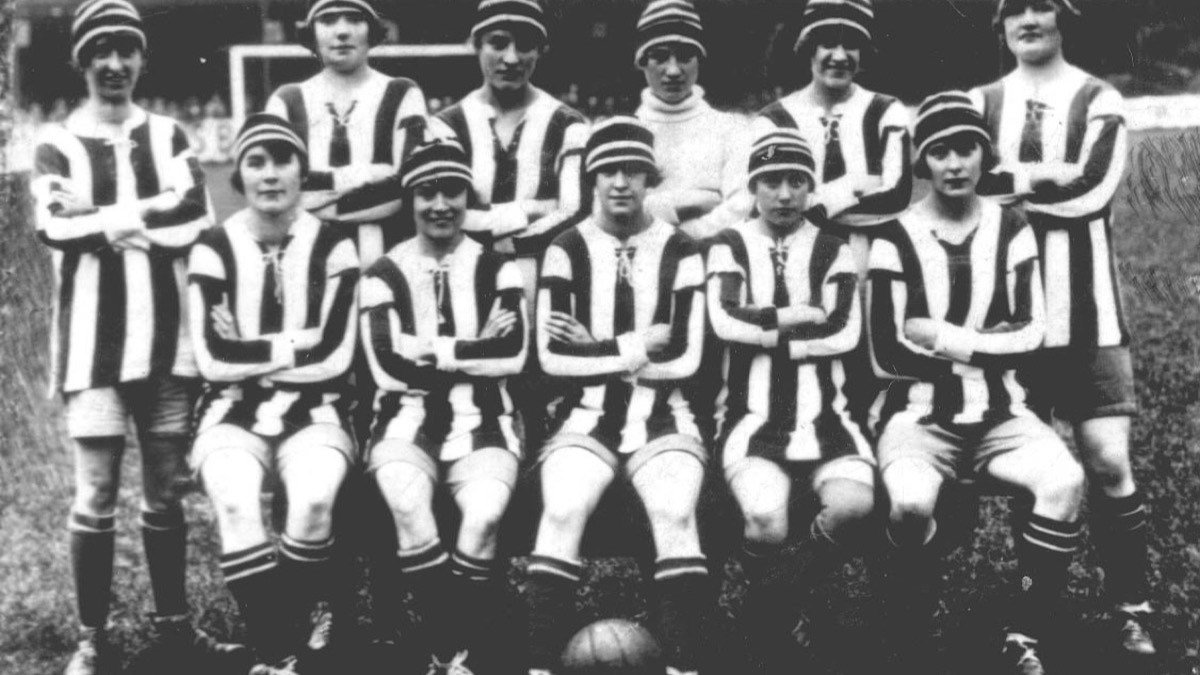
Women's football was not a late invention. In Britain during the First World War, teams drawn from munitions factories played in front of very large crowds, raising money for wartime charities. The best known of them, a side from a factory in Preston, drew a crowd of more than fifty thousand to Everton's ground on Boxing Day in 1920, with thousands more locked outside.
The ban
The response of the English Football Association was to ban it. In 1921 it ruled that football was unsuitable for women and instructed its member clubs not to allow women's matches on their pitches. Without access to grounds, the game was pushed to parks and works fields, and the crowds disappeared. Similar restrictions appeared in other countries. The English ban was not lifted until 1971 - half a century in which the sport's organisers actively prevented the thing they would later claim had simply never caught on.
The 1970s brought unofficial international tournaments, organised outside the control of the governing bodies and largely ignored by them. National associations slowly began to recognise women's teams. The demand had never gone away; it had just been made invisible.
1991: a tournament on probation
The first FIFA Women's World Cup was held in China in 1991 and won by the United States. It was treated cautiously by the organisers - matches were shorter than the standard ninety minutes, and the official name avoided the words World Cup in some promotional material. Coverage was thin. The teams who played in it have spent the decades since explaining to people that it happened at all.
Norway won the second edition in Sweden in 1995. By then the format had been normalised, and the question was no longer whether the tournament would continue but whether anyone outside the participating countries would watch it.
1999, and the answer
The 1999 tournament in the United States settled that. Organisers took the risk of putting matches in large American football stadiums rather than small venues, and filled them. The final between the hosts and China went to a penalty shootout at the Rose Bowl in front of a crowd that set a record for a women's sporting event, and the image of Brandi Chastain on her knees after the winning kick ran on front pages around the world.
It was the proof the sport needed, and also a warning about how slowly the structures move. The professional league founded in the aftermath struggled financially, and several more attempts followed before women's club football in the United States found stable ground.
The argument was never that nobody wanted to watch. It was that nobody had been allowed to find out.
The game spreads
Germany won consecutive titles in the 2000s. Japan won in 2011, a few months after the earthquake and tsunami at home, beating the United States on penalties in a final that was watched far beyond either country. The United States won the next two, with Carli Lloyd scoring a hat-trick inside the opening twenty minutes of the 2015 final - including a shot from inside her own half that went over the goalkeeper and in.
In 2023 the tournament was co-hosted by Australia and New Zealand, the first time it had been shared across two confederations, and Spain won it for the first time. The attendance figures across the tournament set a new high for the competition, and matches involving the host nations became the most watched television broadcasts in their countries' histories.
When the English FA banned women's football in 1921 it gave as its reason that the game was unsuitable for females. The crowds that had been turning up to watch it were, at the time, comparable to those at many men's league matches.
Building the pipeline
None of the growth happened on its own. It followed decisions: compulsory investment in women's teams written into club licensing rules in parts of Europe, national associations funding girls' football at school age, and broadcasters agreeing to show matches at times when people can actually watch them. Where those three things have happened together, participation and attendance have risen quickly; where they have not, the national team's results have tended to stall regardless of individual talent.
What changed, and what did not
The playing standard has risen sharply as more countries have built professional leagues, and the gap between the traditional powers and everyone else has narrowed to the point where group stages produce genuine surprises. Clubs that once fielded women's teams as an afterthought now treat them as part of the main operation, and attendances at league matches in Europe have grown year on year.
The disputes have moved on accordingly. Players have taken their own federations to court or to the picket line over pay, conditions, bonuses and the quality of pitches they are asked to play on, and several of those fights have been won by the teams rather than the administrators. That is itself a sign of how far things have travelled: the arguments are now about terms, not about permission.
A short history, still being written
The women's tournament has existed for a fraction of the time the men's has, which makes its growth easier to see. Each edition has been bigger than the one before it, the field has expanded, and the records that get broken are mostly attendance and audience records rather than sporting ones.
Seen against the fifty years in which the sport was pushed off its own grounds, that is a remarkable recovery - and a reminder that the question was never really about whether women wanted to play football.