
Football did not arrive fully formed. For most of its history it was a loose family of local games with incompatible rules, and the version the world now plays was assembled piece by piece, usually after an argument. The founding row was about whether players should be allowed to kick each other in the shins.
Before the middle of the nineteenth century, English schools and towns each played their own version of football. Some allowed carrying the ball, some did not. Some permitted tripping and hacking - deliberately kicking an opponent's legs - and treated it as the manly part of the game. When former pupils of different schools met at university, they could not play each other without first negotiating which rules applied.
The meeting that split the sport
In October 1863 representatives of a dozen London clubs and schools met at the Freemasons' Tavern in Great Queen Street to agree a single code. Over a series of meetings they produced the first Laws of the Game, drafted largely by Ebenezer Cobb Morley, a solicitor and club secretary. The sticking point was handling and hacking. When the majority voted to remove both, the Blackheath club withdrew, arguing that taking out hacking would strip the game of its courage.
Blackheath went on to help form the code that became rugby. The remaining clubs formed the Football Association, and the two sports have been separate ever since because of one disagreement about violence.
What the first rules left out
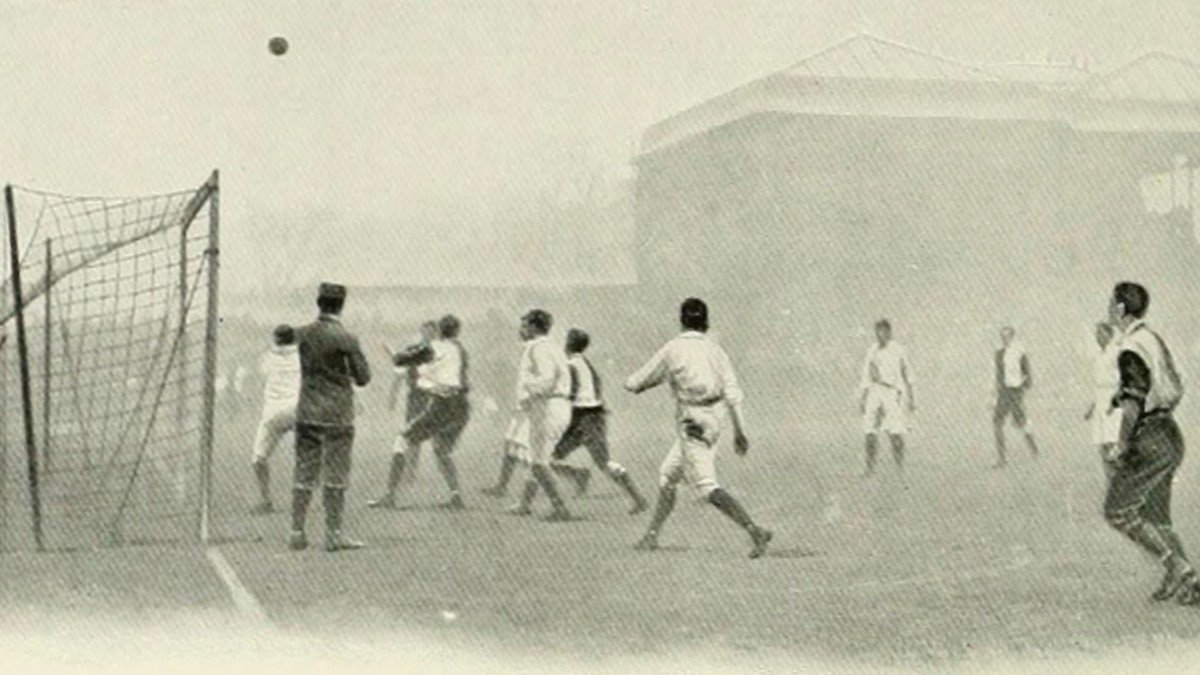
The 1863 code would barely be recognisable. There was no crossbar - a tape was stretched between the posts, and anything under it counted. There was no penalty kick, no referee on the pitch, and no halfway line marked the way it is now. Disputes were settled by the two team captains, on the reasonable assumption that gentlemen would not cheat.
That assumption did not survive competitive football. Umpires were appointed, one per team, with a referee off the field to settle anything they could not agree on. Eventually the referee was brought onto the pitch and given the whistle, and the umpires became linesmen on the touchlines - the ancestors of today's assistant referees.
The penalty, and other hard lessons
The penalty kick arrived in 1891, after it became obvious that a defender could simply foul an opponent about to score and concede nothing worse than a free kick from a hopeless angle. The proposal came from Ireland and was initially resented by clubs who felt it implied they might cheat. Within a season it was indispensable.
Goal nets appeared around the same time, invented in Liverpool, and solved an argument that had previously required witnesses: did the ball go in or not. Each of these changes followed the same pattern - a loophole exploited, a scandal, a rule.
Almost every law in the modern game exists because somebody found a way to ruin a match without technically breaking anything.
Offside, the law that never settles
Offside has been rewritten more than any other rule. The early version required three opposing players between the attacker and the goal, which made it easy for defences to catch forwards out and dull to watch. In 1925 that was reduced to two, and scoring rose immediately. The change also produced a tactical response - the deeper, more organised defensive line - which in turn produced new attacking ideas, which is roughly how football has developed ever since.
Later refinements dealt with players who are offside but not involved, with the exact moment the ball is played, and with how much of a shoulder may be in front of the last defender. The principle has stayed the same for a century. Agreement on how to apply it has never arrived.
The body that still controls the Laws of the Game was created in 1886, before most national associations existed. It is called the International Football Association Board, and no change to a law anywhere in the world is official until it approves it.
The modern amendments
Two more recent changes altered the look of matches more than their wording suggests. Goalkeepers were stopped from picking up a deliberate back-pass, which ended the practice of killing a game by knocking the ball between defender and keeper for several minutes, and forced goalkeepers to learn to play with their feet. And video review was written into the laws, giving referees a way to correct clear errors at the cost of a pause that supporters are still learning to tolerate.
Other suggestions never made it. Over the years the game's lawmakers have considered and rejected larger goals, a sin bin for the professional foul in its original form, and kick-ins instead of throw-ins. The surviving code runs to seventeen laws, covering everything from the size of the ball to what a referee should do if a dog runs onto the pitch.
The things still argued about
Not every change has settled. Handball has been rewritten repeatedly as lawmakers try to define what an unnatural arm position is, and each version produces decisions that nobody on either side of the argument considers fair. The rules on what a goalkeeper may do at a penalty, how long added time should be, and when a tackle becomes serious foul play are all revisited regularly. Each adjustment is an attempt to remove the referee's judgement from a situation that may not be reducible to a rule.
A living document
What is striking, reading the 1863 laws next to the current ones, is how much has stayed. The ball is still round, the goal is still at each end, you still may not use your hands unless you are the goalkeeper, and the whole thing is still decided by whoever puts the ball in the net more often. Everything else has been negotiated, often bitterly, by people trying to close the last gap somebody found.
That is why the laws are revisited every year. Football is not a fixed object handed down from 1863; it is a long argument that has never finished, and the rulebook is simply the current score.