
Women have been playing baseball for as long as there has been baseball to play. They have rarely been allowed to do it inside the official structures of the sport, so they built their own: travelling clubs that beat men's teams for money, and a wartime professional league that outlived the emergency that created it.
College women were playing organised baseball by the 1860s and 1870s, at Vassar and elsewhere, often against the objections of people who considered the whole business unsuitable. From those beginnings a commercial version emerged, and by the 1890s it had a name that stuck: the Bloomer Girls.
The barnstorming years
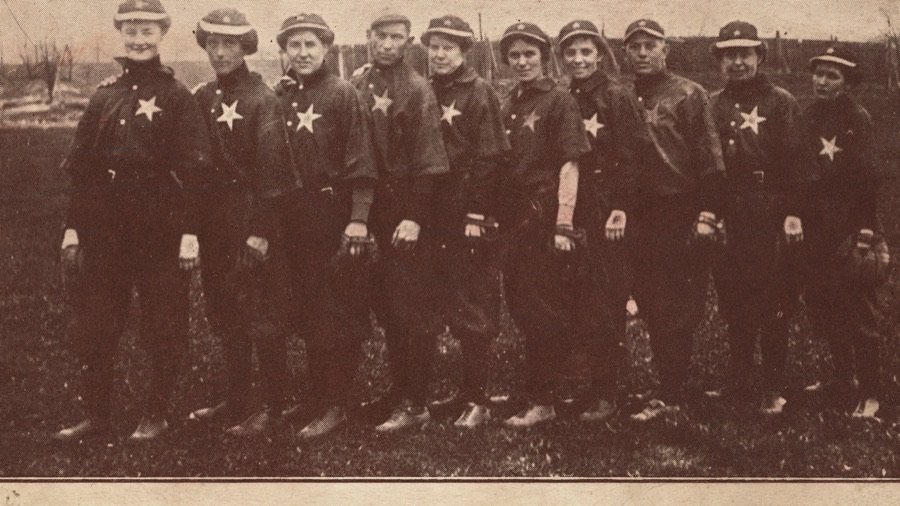
Bloomer Girls teams travelled the country by train, challenging local men's clubs and amateur sides for a share of the gate. The name came from the loose trousers that let them actually run, which were themselves a small scandal. The teams were genuine professional operations with schedules, equipment and payroll.
They won often enough to keep being invited back, which was the entire business model. A travelling side that lost every game stopped drawing crowds. Several of these clubs carried one or two male players, usually a catcher or a pitcher, a compromise the promoters made and the audiences generally knew about.
Jackie Mitchell and the exhibition that changed nothing
In 1931 a teenaged left-handed pitcher named Jackie Mitchell was signed by a minor league club in Chattanooga and appeared in an exhibition against the visiting New York Yankees. She struck out Babe Ruth, then struck out Lou Gehrig, and the story travelled around the world.
Whether it was arranged for publicity has been argued ever since. What is certain is what happened next: her contract was voided shortly afterwards on the grounds that baseball was too strenuous for women, a ruling that held for decades and has never been formally revisited.
A league built by a chewing gum magnate
With the United States at war and major league rosters emptied by the draft, Philip K. Wrigley, the owner of the Chicago Cubs, backed a professional women's league in 1943 to keep ballparks in the midwest occupied. It was conceived as a stopgap. It lasted until 1954.
Teams were based in industrial towns: Rockford, South Bend, Racine, Kenosha. The standard of play rose sharply across the league's life, moving from an underhand pitching style at the start to full overhand pitching and major league base distances by the end.
It was created to fill empty ballparks during a war, and it outlasted the war by nine seasons.- On the women's professional league
Skirts and charm school
The marketing was explicit and, by any modern reading, humiliating. Players wore short skirts that offered no protection whatsoever when sliding, and sliding was a large part of the game. Strawberry-coloured grazes down the thigh were a standard occupational injury.
New recruits were sent to evening classes in deportment, taught how to walk, sit and apply make-up, and held to rules about appearance and behaviour off the field. The league's position was that respectability was what made the product sellable, and the players put up with it because the alternative was not playing.
The crowds were real
It would be easy to file the league as a novelty, and the attendance figures do not support that. At its peak it drew large crowds across the season, the standard of fielding in particular drew admiring notices from sportswriters sent to mock it, and championship games were serious occasions in the towns involved.
The decline came with television, the return of major league baseball to full strength and the gradual disappearance of the small-city audience the league depended on. It folded in 1954 and was largely forgotten for a generation.
Toni Stone and the other route
The women's league did not admit Black players. Toni Stone took the only path available and signed with the Indianapolis Clowns in the Negro Leagues in the 1950s, playing second base in a men's professional league. Two other women, Connie Morgan and Mamie Johnson, followed her into the same circuit.
Johnson, a pitcher, had been turned away from a women's league tryout without being allowed to throw. She spent several seasons pitching professionally against men instead, which is the kind of detail that makes the official history of the sport look thin.
The Baseball Hall of Fame opened a permanent exhibit on the women's professional league in 1988, honouring the league as a whole rather than individual players. The 1992 film that made the story famous arrived four years later.
The quality of the play
Sportswriters sent to cover the women's professional league in a spirit of amusement tended to file something different from what their editors expected. The fielding in particular drew admiring notices, and the base running was aggressive in a way that the men's game of the period had largely abandoned.
The league also raised its own standard deliberately. Pitching moved from underhand to sidearm to full overhand across its existence, and the pitching distance and base paths were lengthened repeatedly until they approached men's professional dimensions. Players who started in 1943 were, by the end, playing a recognisably different and harder sport.
Where it stands
Women's baseball never disappeared; it simply lost its professional structure. There is a women's World Cup, national teams in a dozen countries and a growing amateur base, much of it built by players who refused the standard advice to switch to softball.
Women have also begun appearing in the professional men's game in coaching and front office roles, and a handful have pitched in men's professional leagues abroad. The Bloomer Girls were doing a version of this in the 1890s. The sport has taken an unusually long time to come back round to it.