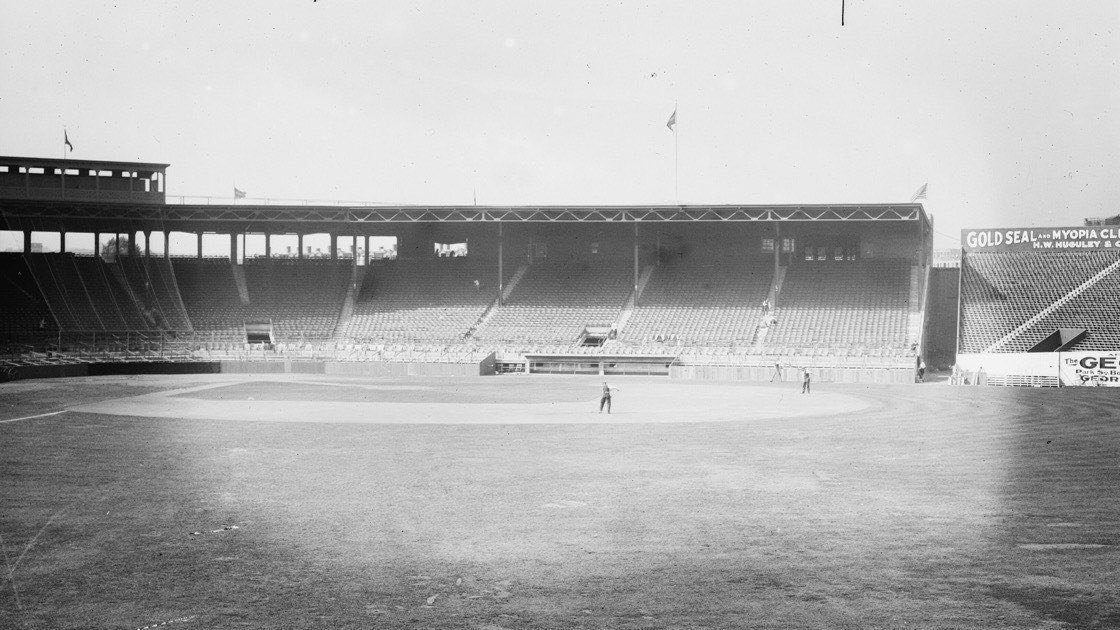

Baseball is the only major sport in which the playing area is not standardised. Outfield walls can be any distance away and any height, which is why two ballparks built before the First World War are still in use, and why their peculiarities became part of the game itself.
Fenway Park opened in Boston in 1912. Wrigley Field opened in Chicago in 1914, built for a team in a short-lived rival league before the Cubs moved in a couple of years later. Both were put up quickly, in brick and steel, on land that happened to be available, and neither was expected to last a century.
Why the shapes are strange
Early ballparks were squeezed into existing city blocks. The architect worked with the streets that were already there, and if a plot was short on one side, the outfield wall went where the property line was. The result was a generation of parks with asymmetrical dimensions and awkward corners that no designer would choose.
Because the rules set no requirement for outfield distances, those accidents became permanent features. A short wall on one side changed how teams were built, which hitters a club valued and how pitchers approached a lineup. The building shaped the baseball played inside it.
The Green Monster
Fenway's left field wall is close to home plate and very tall, because Lansdowne Street runs immediately behind it. It was originally covered in advertising, later painted green, and acquired its nickname only in the 1940s. A manually operated scoreboard still sits in its base, worked by people inside the wall.
Its effect on play is enormous. Balls that would be routine fly outs elsewhere hit the wall for doubles, and genuine home runs to the same field are harder than they look. Generations of right-handed Boston hitters have been accused of trying to pull everything into it, usually accurately.
Ivy and a hand-turned scoreboard
Wrigley Field's outfield walls were planted with ivy in the 1930s, and the plant is now written into the ground rules: a ball lost in the vines is a double, and the fielder is expected to raise both hands rather than go hunting. The scoreboard above centre field is still operated by hand.
The park's other famous variable is the wind off Lake Michigan. Blowing out, it turns the place into a hitting carnival. Blowing in, it kills deep drives at the warning track. Teams genuinely check the flags before setting a lineup, which is not a consideration in a modern enclosed stadium.
No two outfields are the same shape, so no two ballparks produce quite the same sport.- The quirk at the centre of baseball design
The concrete years
From the 1960s a wave of new stadiums replaced the old parks, and most of them were circular, symmetrical and built to host American football as well. They were efficient, they held large crowds, and they were widely disliked. Critics called them cookie-cutters because it was almost impossible to tell one from another.
Several cities came close to demolishing their old parks in those decades. Plans to replace Fenway surfaced more than once. What saved them, eventually, was that the alternative turned out to be worse, and audiences noticed.
Camden Yards changes everything back
When Baltimore opened a new park in 1992, it was designed to look and feel like a pre-war ballpark: asymmetrical outfield, exposed steel, a converted warehouse along one side, and a location downtown rather than in a car park off a motorway. It was an immediate success.
Almost every stadium built in the sport since has borrowed from it. The retro movement effectively vindicated the two survivors, and Fenway and Wrigley went from being embarrassing relics to the models that new construction was imitating.
Keeping a hundred-year-old building open
Both parks have been rebuilt around their famous features. Seating has been added, structures reinforced, lighting installed, and in Wrigley's case the surrounding neighbourhood has been redeveloped by the club. Purists complain about each change, and the alternative to each change was closure.
The seats remain narrow, the concourses tight and some views obstructed by the steel columns holding the roof up. These are the known costs of watching baseball in a building put up when the game's biggest star was Ty Cobb.
Wrigley Field played without lights for decades, hosting only day games long after every other club had installed floodlighting. Night baseball arrived there in 1988, more than half a century after the first night game was played in the major leagues.
The parks that did not survive
Fenway and Wrigley are the survivors of a much larger generation. Ebbets Field in Brooklyn, the Polo Grounds in New York, Shibe Park in Philadelphia, Forbes Field in Pittsburgh and Comiskey Park in Chicago were all built in the same wave of steel and concrete construction in the 1900s and 1910s.
Every one of them is gone. Most were demolished between the 1950s and the 1970s, usually because the surrounding neighbourhood had changed or the club wanted more parking, and in several cases the decision is still resented by the cities involved decades later.
What the old parks protect
A standardised pitch makes a sport portable and comparable. Baseball gave that up at the start and never went back, and the two oldest parks are the strongest argument that the decision was right. The Green Monster and the ivy are not decoration; they change what happens in the game.
They also anchor their cities. Both sit in dense neighbourhoods that grew up around them, reachable on foot, surrounded by bars and houses rather than parking. That was once ordinary and is now rare, which is the real reason people fight so hard to keep them standing.