
The most recognisable object in American sport began as a piece of leather a harness maker stitched together for a worried naval cadet. It then spent a century doing two contradictory things at once: protecting players, and making them willing to hit each other harder.
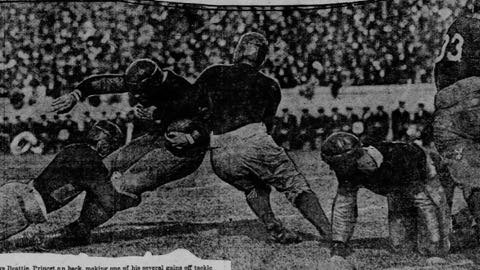
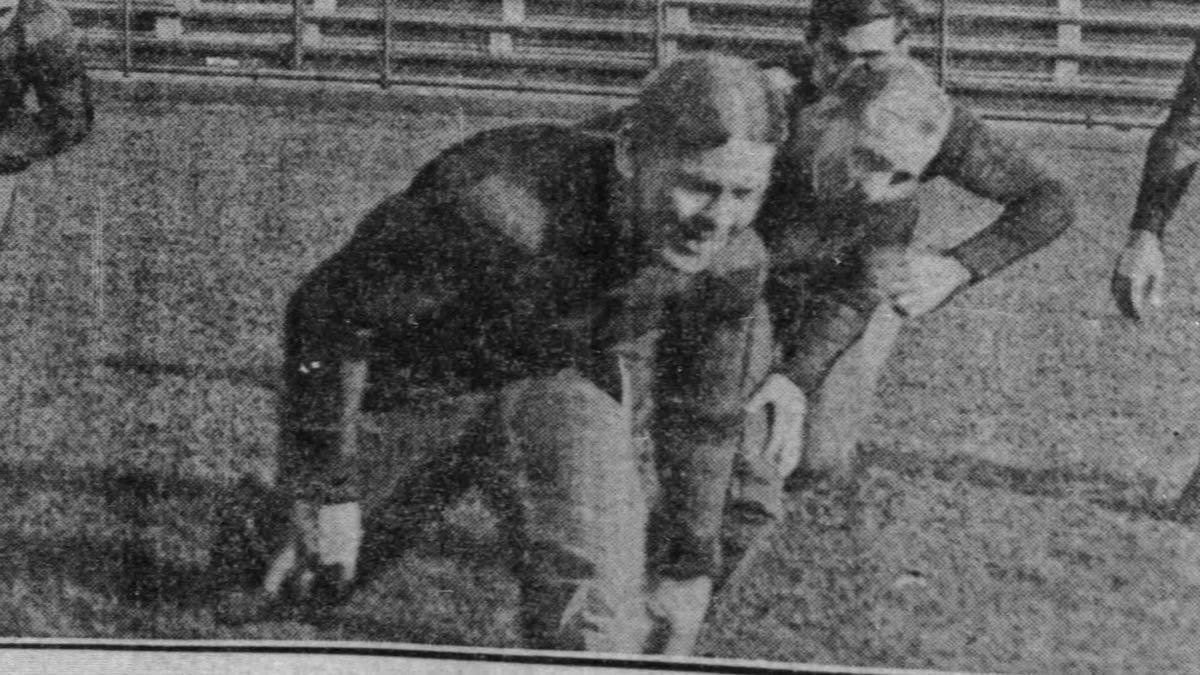
Early football was played bare-headed. The usual precaution was to grow your hair long, which tells you most of what you need to know about the standard of protection in the 1880s. Players who could afford it wore nose guards made of rubber, which were widely disliked and widely discarded.
The first one
The story usually told concerns a Navy player in the early 1890s who had taken enough blows to the head that a doctor warned him another could be serious. Rather than stop playing, he had a shoemaker build him a padded leather cap. Whether or not that was strictly the first, soft leather headgear spread through the 1890s and 1900s: earless at first, then with holes cut, then with harder shells and internal webbing to hold the leather away from the skull.
Crucially, none of it was compulsory. Players chose. Many chose not to, on the grounds that it restricted hearing and marked you out as cautious.
Plastic, and the change nobody predicted
Hard plastic shells arrived around the middle of the twentieth century, and the professional league made helmets compulsory in 1943 - remarkably late, given that the sport was already more than seventy years old. Plastic was lighter than leather, far more durable, and spread the force of an impact across the whole shell rather than the point of contact.
It also turned the head into something you could lead with. A leather cap discourages you from using your skull as a battering ram, because it hurts. A moulded plastic shell does not. The technique known as spearing - tackling head-first - became common within a generation of plastic becoming standard, and had to be banned by rule.
The face mask argument
Face protection came in the 1950s, first as a single curved bar and later as full cages. It did away with the broken noses and lost teeth that had been considered part of the job, and it created a new problem: a face mask is a handle. Grabbing one became a dangerous and immediately penalised act, which is why the rule exists in every code of football rules today.
Every improvement to the helmet made the sport safer in one direction and more dangerous in another. That pattern has not been broken yet.- PuroGoal
What a helmet cannot do
A helmet is extremely good at preventing skull fractures and lacerations. It is not very good at preventing concussion, for a reason that is simple and difficult to engineer around: a concussion is caused by the brain moving inside the skull. Padding the outside of the skull reduces the peak force, but it cannot stop the head accelerating and decelerating, and it cannot stop the rotation.
This was understood in general terms for a long time and became impossible to ignore when researchers began examining the brains of former players and finding a pattern of degenerative damage. The findings changed the sport's rules, its medical protocols and its legal position, and they are still working through the game at every level.
Quarterbacks and one defensive player per team wear a small radio receiver inside the helmet, so the coaching staff can send in the play directly. The system switches off automatically with a set amount of time left on the play clock, which is why you sometimes see a quarterback suddenly start shouting.
The modern helmet
What a professional wears now is a long way from a moulded shell with foam inside. The designs use layered liners, flexible panels and crumple structures intended to manage rotational force as well as straight impact. Helmets are laboratory-tested and ranked, and some are designed for specific positions, because a lineman's typical collision is nothing like a receiver's.
Teams have also adopted soft padded covers worn over the helmet in practice, which look faintly comic and measurably reduce the force of the routine, repeated contact that makes up most of a player's career. The thinking there is the important shift: the danger is not only the single enormous hit, it is the accumulation.
Below the professional level
Most football is not played by professionals. It is played by schoolchildren and students, in equipment that is often older, less well fitted and bought on a tight budget, and supervised by staff with far less medical support than a professional club has on the sideline. The helmet standards that matter most, in terms of the number of people affected, are the ones applied to a high school storeroom.
That has driven a quiet set of changes: reconditioning requirements, expiry dates on shells, limits on how long a helmet may stay in service, and rules about who may clear a player to return after a head injury. None of it is glamorous and all of it reaches far more players than anything worn on a Sunday afternoon.
The rules did more than the equipment
Most of the real safety gains of recent decades have come from rule changes rather than from gear: outlawing hits with the crown of the helmet, protecting defenceless players, changing how kickoffs are run, limiting contact in training, and taking the decision about whether a concussed player returns away from the player and the coach.
That is an uncomfortable conclusion for an industry that sells equipment, and it is consistent with the whole history on this page. The helmet has never made football safe. It has made specific injuries rarer, made other behaviour possible, and bought the sport time to argue about the rest.