A game played mostly with the hands, named "football", contested on a field nicknamed a frying iron, with a ball shaped like nothing else in sport. American football is full of small mysteries — and most of them have a story behind them.
American football looks, at first glance, like a sport that argues with its own name. Players carry the ball, throw it and tackle each other far more often than they kick it, yet the word "football" sits right there on the badge. That contradiction is only the beginning. Dig a little and the sport turns out to be a museum of odd origins, accidental traditions and statistics that surprise even longtime fans.
Why is it called "football" at all?
The short answer is that the name is older than the modern game. American football grew out of rugby and association football in the second half of the nineteenth century, when colleges in the United States played a rough mixture of both. Those early matches involved a great deal more kicking than today's version — the field goal and the kickoff are survivors of that era — and "football" was simply the family name for games played on foot, as opposed to sports played on horseback. As the American game drifted away from its cousins, the label stuck even as the kicking faded. To this day the rest of the world calls the kicking game "football" and the American game "American football", while in the United States the older sport is usually called "soccer".
That shared rugby ancestry explains a lot. The line of scrimmage, the idea of downs and the oval ball are all rugby ideas reshaped by American innovators such as Walter Camp, often called the father of the sport, in the 1870s and 1880s.
The strange ball and its laces
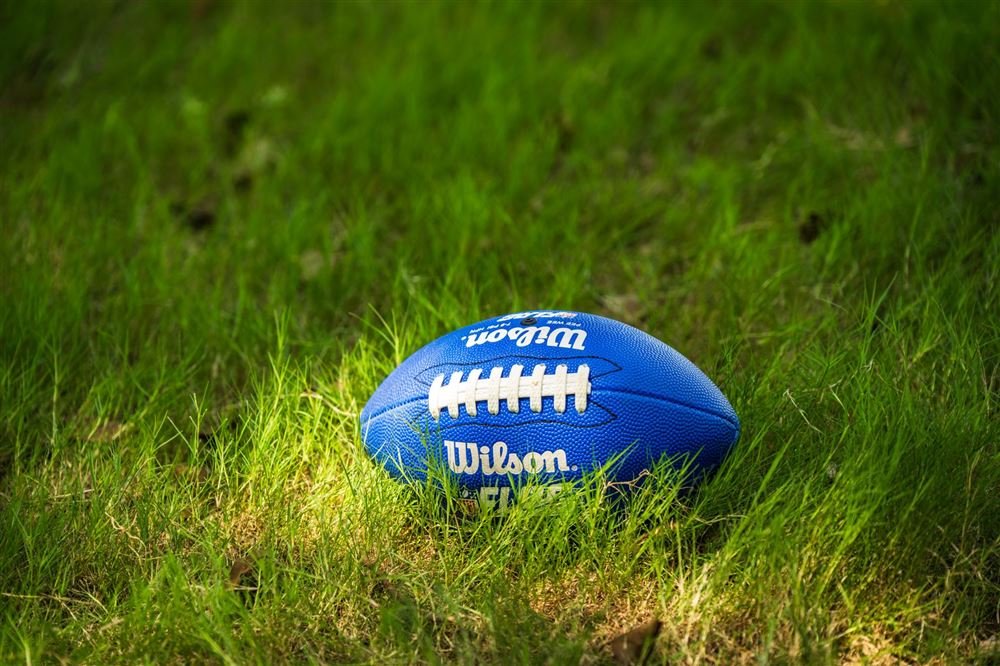
The football is a prolate spheroid — a stretched, pointed oval — and that shape is partly an accident of history. Early footballs were rounder, closer to a rugby ball, and got their bulge from inflated pig bladders, which is where the old nickname "pigskin" comes from. As the forward pass became central to the American game, the ball grew slimmer and more pointed so it could be gripped and thrown in a tight spiral. Modern balls are made of leather or rubber, not pig, but the affectionate name has outlived the material.
Then there are the laces. They began as a practical seam closing the leather around the bladder, but quarterbacks discovered that running the fingers across them gave the grip needed to spin a clean pass. What started as stitching became a feature, and "putting your fingers on the laces" is now part of how throwing is taught.
"Football is like life — it requires perseverance, self-denial, hard work, sacrifice, dedication and respect for authority."— Vince Lombardi
Gridirons, trophies and a few oddities
The field has its own nickname: the gridiron. It dates back to an early version of the game whose pitch was marked with a checkerboard of lines running both lengthwise and crosswise, making it look like a metal cooking grate — a gridiron. The crosswise lines were later dropped, but the name endured, and "gridiron" is still used as a synonym for the sport itself.
The championship trophy carries a story too. The prize awarded to the winners of the title game is named after Vince Lombardi, the famed coach whose teams won the first two such games in the late 1960s. His name was attached to the trophy after his death, turning a piece of silverware into a tribute.
- The end zones at each end of the 100-yard field add a further area where touchdowns are scored.
- A touchdown does not actually require touching the ball down to the ground — only that the ball, in a player's possession, breaks the plane of the goal line.
- The oval ball means a fumble bounces unpredictably, which is why loose-ball scrambles are some of the most chaotic moments in the game.
Despite a broadcast lasting more than three hours, studies of televised games have suggested the ball is actually in play for only a small fraction of that time — by some counts only around eleven to fifteen minutes. Most of the broadcast is huddles, replays, commercials and the long pauses between plays.
A game built on stoppages
That last fact tends to surprise newcomers more than any other. Where soccer flows for 45-minute halves with the clock rarely stopping, American football is built around short, intense bursts of action separated by deliberate pauses. Each play is its own miniature contest — a snap, a few seconds of collision and movement, then a reset. The strategy, the substitutions and the play-calling that fill the gaps are, for many fans, half the appeal.
It is a sport whose quirks all trace back to the same place: a young game borrowing from rugby and football, then reinventing itself in America until the name, the ball and the field all became something new. The contradictions are not mistakes. They are the fingerprints of how the game grew up.