
Tennis is unusual among major sports in being played on fundamentally different ground from one month to the next. A footballer plays on grass everywhere. A tennis player spends spring on crushed brick, early summer on lawn and the rest of the year on paint over concrete, and the same shot behaves differently on each.
What changes is not the rules but the physics. When a tennis ball lands, some of its forward speed is converted into vertical bounce and some is lost to friction. How much of each depends entirely on what it hits, and every tactical difference between the surfaces follows from that single exchange.
Clay
Clay courts are not clay. They are layers of crushed brick or stone over a base, loose on top, which is why the surface moves under a player's feet. That loose top layer grabs the ball, takes speed off it and throws it upwards, so the bounce is slow and high.
The consequences cascade. Points last longer because fewer shots are outright winners. Topspin becomes enormously valuable, because a heavily spun ball kicks up above shoulder height. Players slide into shots instead of planting, which saves the knees but requires a technique that takes years to learn properly.
Grass
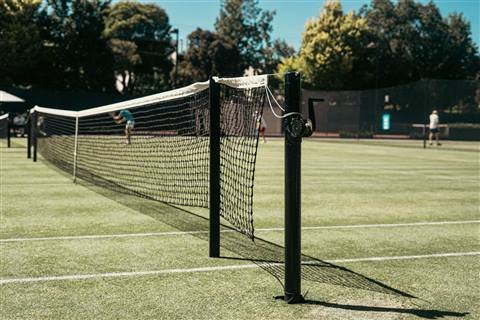
Grass does the opposite. The ball skids, keeps much of its speed and stays low, and on a worn patch it can do something unpredictable. Rallies are short. The serve is worth more than on any other surface, and the reward for taking the ball early and moving forward is high.
Grass is also the hardest surface to maintain, which is why so few tournaments are played on it. A grass court changes during a two-week event: fresh and green at the start, bare behind the baselines by the end, and playing faster as it dries.
Hard courts
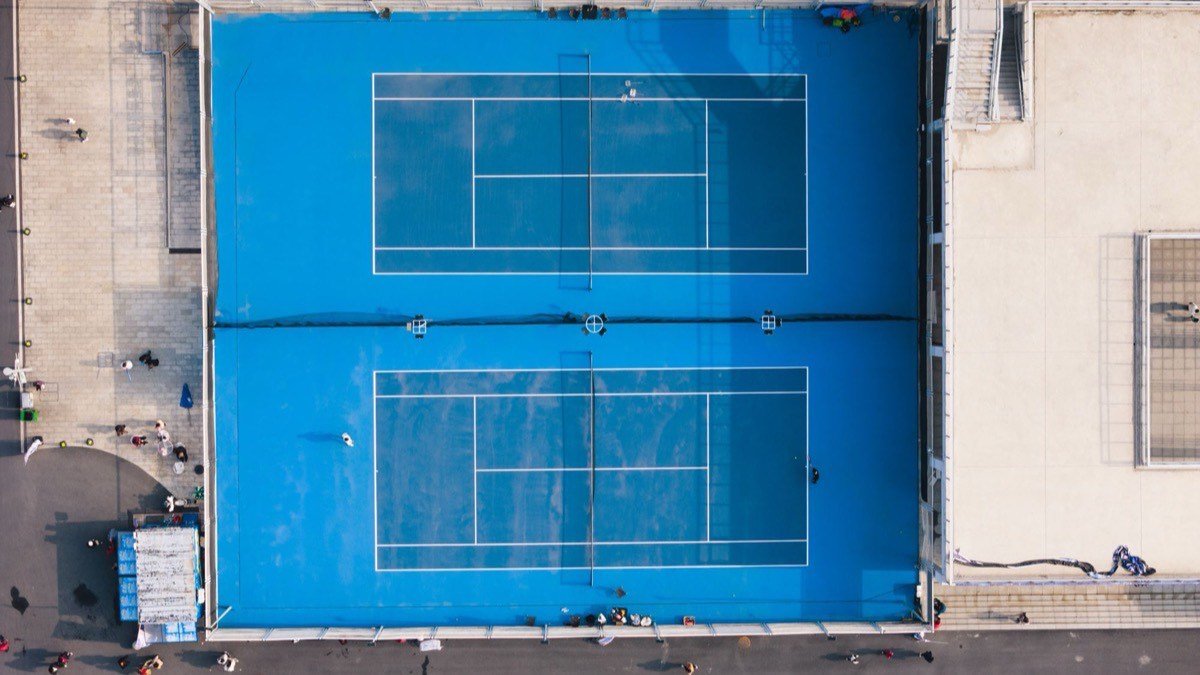
A hard court is an acrylic coating over asphalt or concrete, and its speed depends on how much sand is mixed into the paint. More sand means more friction, a slower court and a higher bounce; less means a quicker one. Two hard-court tournaments can therefore play very differently from each other.
It is the compromise surface and it dominates the calendar, because it is cheap to build, predictable and almost maintenance-free. It is also the least forgiving on the body: there is no give underfoot, and the repeated impact is widely blamed for a long list of hip, knee and back problems in the professional game.
The ball does not change. What changes is how much of its speed the ground is willing to give back.
Indoor and the forgotten carpet
For years a significant part of the professional season was played indoors on carpet - a rolled synthetic surface laid over a hard floor, extremely fast and very hard on the joints. It has largely disappeared from the top level, replaced by indoor hard courts.
Playing indoors still changes the game even on a familiar surface. There is no wind, no sun, consistent light and a slightly different ball flight in still air, which generally favours the bigger hitter.
On clay, a player can ask the umpire to come down and inspect the mark left by the ball, and the mark decides the call. It is the only surface where the ground itself keeps a record of where the ball landed.
The specialists
Surfaces produce specialists, and the gap between a player's best and worst surface can be enormous. Some careers are built almost entirely on clay, where patience, movement and heavy topspin pay; others on fast courts, where a large serve shortens every point and movement matters less.
Winning major titles on all three is therefore treated as a serious marker of quality. It means a player has solved three different tactical problems rather than optimised for one.
The great slowing down
Courts across the tour have become slower over the past two decades, by design. Tournaments and broadcasters prefer longer rallies to a procession of unreturned serves, and surface speed is one of the few things organisers can adjust.
The effect has been to narrow the differences. Grass is slower than it was, hard courts have been gritted, and the extreme specialists of earlier generations are rarer. A player who could not win a match on clay thirty years ago would struggle to survive at all today.
What to watch for
The quickest way to read a surface from the sofa is to watch where the players stand to return serve. Deep behind the baseline on clay, on or inside the line on grass, somewhere in between on a hard court. The second tell is the footwork: if they are sliding into the corners, the ground is giving way, and the points are going to be long.
The third is the ball itself. Watch how high it comes up off a heavy topspin forehand. Above the shoulder means clay or a gritty hard court; around the hip means the ball is skidding, and someone is about to come forward.
What a surface does to a career
Surfaces decide more than individual matches. They shape which juniors are identified as promising, because a national federation with clay courts will tend to produce patient baseliners and one with indoor hard courts will tend to produce big servers.
They also decide when a player peaks and how long a career lasts. Clay is kind to the joints and rewards experience, which is why clay specialists often remain competitive longer. Fast surfaces reward reflexes and raw serving power, which fade earlier. A player's best years can look completely different depending on which part of the calendar their game is built for.