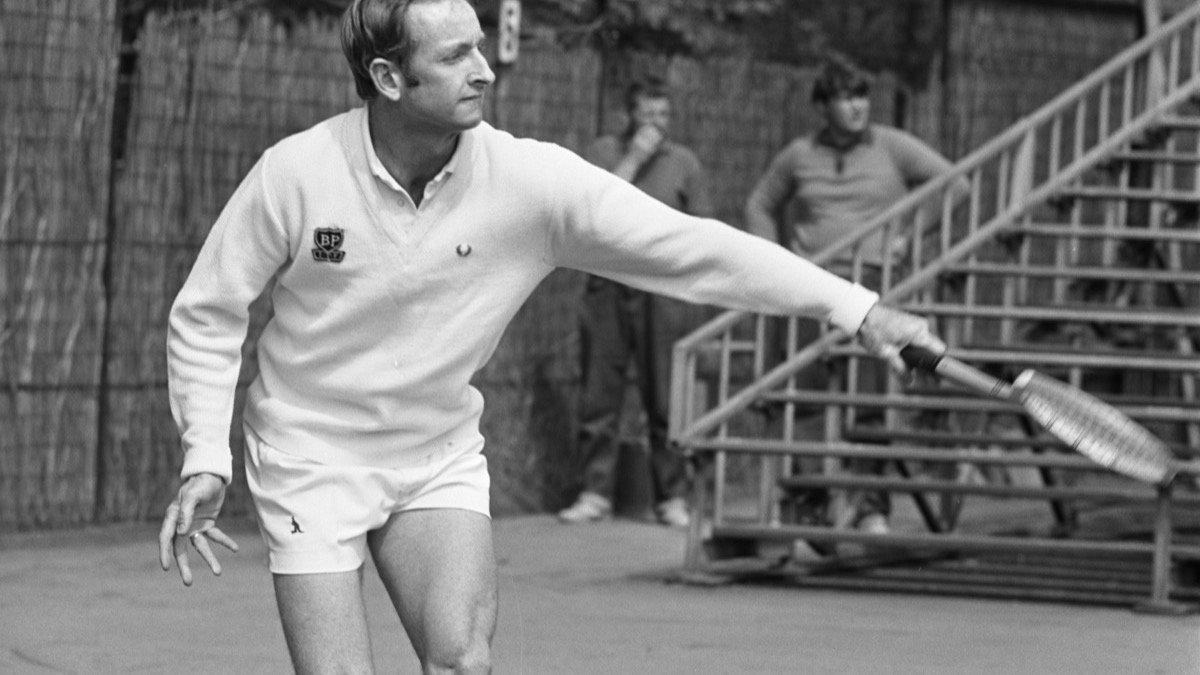

Winning all four major titles inside a single calendar year is rare enough that whole generations of players come and go without seeing it done. Rod Laver did it twice, seven years apart, with half a decade of enforced absence from those same tournaments sitting in the gap between the two.
He came from Rockhampton, a cattle town in tropical Queensland, and he did not look like a man who would dominate anything. He was short, slight and red-haired, and the Australian coach Harry Hopman gave him the nickname Rocket partly as a joke about how slow he was when he first arrived. What Laver did have was a left forearm that visitors never stopped remarking on - thick, corded, visibly out of proportion with the rest of him, the product of years of hitting a wooden racket with a wrist action nobody had taught him to restrain.
The first sweep
In the early 1960s the four championships that mattered - Australia, France, Wimbledon and the United States - were open only to amateurs. That rule produced a strange hierarchy. The genuinely best players in the world had almost all signed professional contracts, which meant they were barred from the tournaments that made reputations. The amateur game was where the trophies were, and in his last full season inside it Laver won all four of them.
It was the second time any man had managed the feat. He was still in his early twenties, he was playing with a wooden frame strung tight enough to sting, and he had nothing left to prove at that level. So he left it.
The years nobody counted
Turning professional in that era meant signing away your eligibility for the majors, probably for good. The professional tour was not a circuit of grand stadiums; it was a travelling show. Courts were unrolled in ice rinks, halls and armouries, the same handful of players met each other night after night in different towns, and the quality of the tennis was far above anything the amateur championships could offer. Almost nobody outside the sport saw it.
Laver spent five seasons there, through what should have been the absolute peak of his physical powers, with no access to the tournaments that history records. The matches were played, the results were kept, and then they were quietly left out of the record books.
The game opens
In 1968 the sport finally admitted what everyone already knew and let professionals back into the major championships. The following year Laver won all four again. This time the fields contained every serious player alive, and the achievement has never been repeated by a man since.
The second sweep is the one that settles arguments. The first could be dismissed as a strong player beating a depleted field. The second was done against the full strength of the game, by a man who had spent five years playing nothing but elite opposition and had arrived back at the majors sharper than when he left.
Two clean sweeps, in two completely different versions of the sport, separated by an absence that was not his choice.
A wrist ahead of its time
What made him difficult was not power in the modern sense. Wooden rackets did not allow it. Laver generated spin with a whipping wrist action that most coaches of the period actively discouraged, because with a heavy frame it was a reliable way to hurt yourself. He could roll heavy topspin over the net on the run, slice low and skidding when he needed the point to slow down, and he came forward constantly, because on grass there was no reward for staying back.
He was also, by every account from the locker room, entirely without ceremony. He practised more than players who needed it less, he travelled without an entourage, and he treated the one-night professional shows with the same seriousness as a final.
The main stadium at Melbourne Park, where the Australian Open is played, is named Rod Laver Arena. It is one of the few venues in world sport named after a player who competed there, and he is usually somewhere in the building during the tournament.
The question that cannot be answered
Every attempt to rank the greatest male players eventually runs into the hole in Laver's record. Nobody knows what his major total would look like if the ban had not existed, and the honest answer is that any figure anyone offers is a guess. What is not a guess is the shape of the career: he was good enough to sweep the majors before he was shut out, and good enough to sweep them again the moment the door reopened.
Modern players who have chased the calendar Grand Slam have all discovered how little margin there is. Four different surfaces, four different countries, a season that offers no rest, and a run that one bad afternoon ends. Laver survived it twice, and he did it with a racket made of laminated wood and a travel schedule that would be considered unworkable today.
The Australian production line
Laver did not emerge from nowhere. For roughly two decades Australia produced the best players in the world in quantity, and the reason was largely one man: Harry Hopman, the national captain, who ran training camps of a severity that players described afterwards with a mixture of affection and alarm. Running, circuits, repetition drills, and a flat refusal to accept excuses about the weather.
The group that came through that system dominated the Davis Cup and filled the latter rounds of every major for years. Laver was the best of them, but he grew up surrounded by players who would have been national champions anywhere else, which meant that the hardest matches of his early career were often the ones at home. By the time he reached an international final he had usually already beaten three men capable of winning it.