
There are players who beat defences and players who break them. Shaquille O'Neal did the second thing. For most of a decade the accepted strategy against him was not to defend him at all, but to grab him, foul him deliberately and send him to the free-throw line, because every other option was worse.
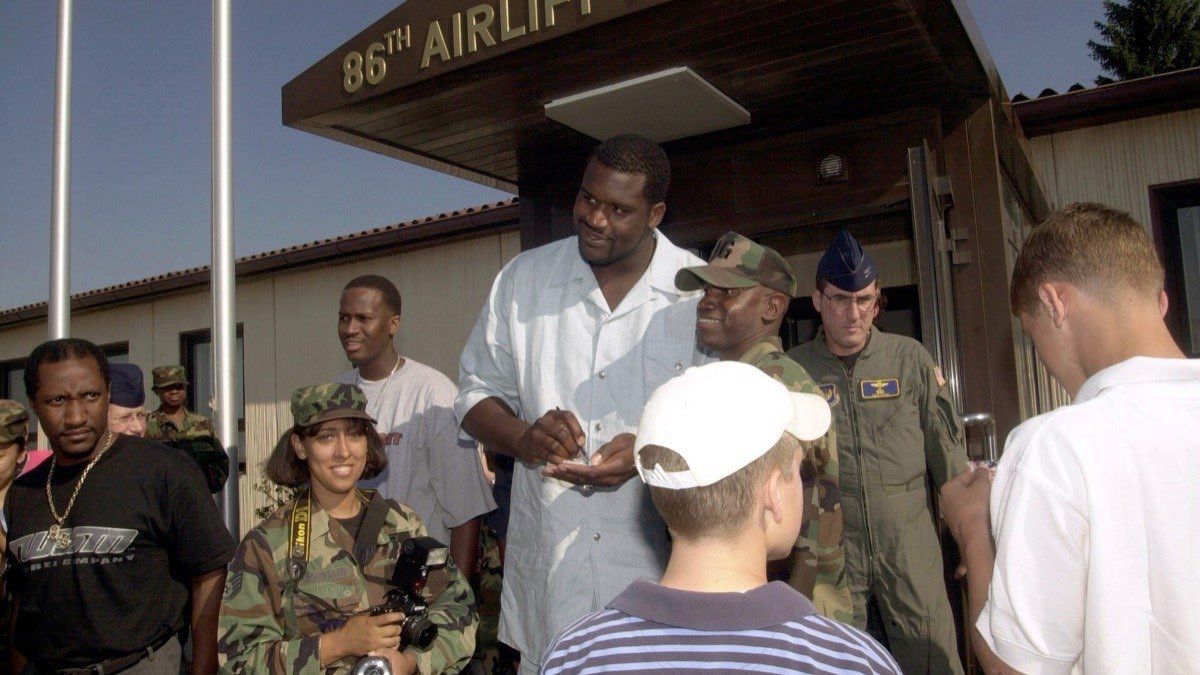
He was born in Newark, New Jersey, in 1972 and spent part of his childhood on army bases in Germany, where his stepfather was stationed. He was enormous and unusually coordinated, and by the time the family returned to the United States he was a schoolboy phenomenon in Texas. He went on to Louisiana State University, where the standard defensive plan against him was simply to send three players.
Orlando
Chosen first in the 1992 draft by the Orlando Magic, he was named rookie of the year and turned a struggling expansion team into a contender within two seasons. Orlando reached the finals in 1995 with a very young roster and lost to a Houston team led by Hakeem Olajuwon, a defeat that taught him the gap between physical dominance and knowing how to win a series.
He was already more than a basketball player by then: a rapper with platinum records, a film actor, an advertising presence. The scale of his personality was unusual for a centre, a position that traditionally produced serious, quiet men.
The Lakers years
He signed with the Los Angeles Lakers in 1996, the same summer the team acquired a teenage guard named Kobe Bryant. It took a few seasons and the arrival of coach Phil Jackson to make the pieces fit, and then the Lakers won three consecutive championships, with O'Neal named most valuable player of the finals in each of them.
At his peak he was close to unguardable. He combined the weight of a lineman with the feet of someone much smaller, and his first step from the low post arrived before defenders had settled. Teams tried double teams, triple teams, and zone schemes that bent the rules of the time. Mostly they tried fouling.
Hack-a-Shaq
The deliberate foul away from the ball became known as Hack-a-Shaq, and it was the clearest compliment the sport could pay him. Opponents calculated that two free throws from a poor shooter was a better outcome than letting him catch the ball near the basket. The tactic slowed games to a crawl and eventually pushed the league to change its rules about off-ball fouls in the closing minutes.
He was never able to fix the free throw, and he was candid about it for the rest of his life. It is the one part of his game that gave opponents anything to work with, and it probably cost his teams games they should have won comfortably.
"Me shooting free throws is just God's way of saying that nobody's perfect."- Shaquille O'Neal
Miami, and a fourth ring
The partnership with Bryant ended badly, in public, and O'Neal was traded to the Miami Heat in 2004. Two years later, alongside a young Dwyane Wade, he won a fourth championship, this time in a supporting role rather than as the centre of everything. He finished his career with short spells at several teams, still useful, no longer the gravitational force he had been.
Equipment manufacturers had to respond to him early on. He pulled down a basket support during a game as a young professional, and the league eventually strengthened its backboards and stanchions, which is not a change many individual players have forced.
Early in his career O'Neal brought down an entire basket assembly during a game. The NBA reinforced its backboard supports afterwards, and breakaway rims became standard equipment.
The partnership that won three titles
The Lakers' run at the turn of the century was built on two players who did not especially enjoy each other's company. O'Neal controlled the area around the basket; Kobe Bryant attacked from the perimeter; and defences that committed to stopping one were immediately exposed by the other. Phil Jackson's job, by his own account, was less about tactics than about keeping two enormous competitive egos pointed in the same direction.
It held together for three championships and then came apart publicly, through press conferences, trade demands and a long exchange of unflattering comments. Both men later said the split had cost them titles they should have won, and both spoke warmly about each other in Bryant's final years.
The rules changed around him
Dominance on his scale forces a sport to respond. Beyond the reinforced equipment and the off-ball foul rules, the league's gradual relaxation of restrictions on zone defence in the early 2000s was understood at the time as a way of letting teams put extra bodies between O'Neal and the rim without breaking the rulebook.
It is a strange compliment and a familiar one in basketball: the game's rule-makers have repeatedly adjusted the sport because one player was making it too predictable. Chamberlain forced changes, Alcindor forced changes, and so did O'Neal.
After the game
He moved into television analysis, business and a surprising amount of charitable work, much of it unpublicised. He also completed a doctorate in education, which he mentions roughly as often as he mentions the championships.
Basketball has moved away from the kind of player he was. Teams now space the floor and shoot from distance, and a centre who demands the ball on the block is a rare thing. That makes his peak look even stranger in hindsight: a decade in which the entire sport organised itself around the problem of one man standing near the rim.
His own summary of his career was typically blunt: he wanted to be remembered as someone opponents could not deal with, and he was. Whatever the modern game thinks of traditional centres, there has not been another player since who made an entire league redesign its tactics, its equipment and parts of its rulebook around the problem of one body in the paint.