
Every great player has a signature move, and most of them can be defended if you work hard enough. Kareem Abdul-Jabbar had one that could not. The skyhook was released so high, with the shooter's body turned so completely between the ball and the defender, that for twenty seasons the best answer anyone found was to hope he missed.
He was born Ferdinand Lewis Alcindor Jr. in New York City in 1947, and he was taller than his classmates before he was old enough to care. By high school he was a national story, recruited by every programme in the country and already uncomfortable with the attention. He chose the University of California, Los Angeles, and the coach who would shape the rest of his thinking about the game.
Three years at UCLA
Under John Wooden, UCLA won the national championship in each of Alcindor's three varsity seasons. The dominance was so complete that it provoked a rule change: college basketball banned dunking in 1967, a prohibition that stayed in place for nearly a decade and was known almost universally, if unofficially, as the Alcindor rule.
Taking away the dunk did not slow him down. It pushed him towards the shot that would define him. Denied the easiest way to score from close range, he refined a hook shot taken off one foot, with the ball released at the top of a fully extended arm, and he practised it from both sides until the angle stopped mattering.
The skyhook explained
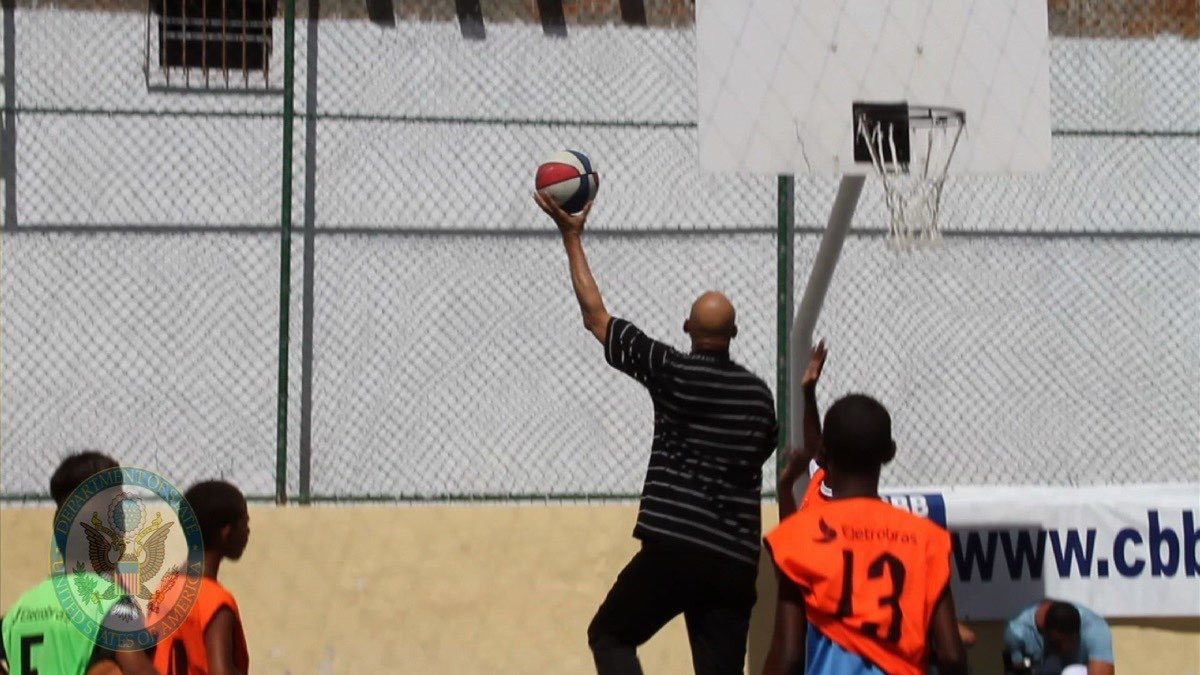
Mechanically it is simple and almost nobody does it well. The shooter steps across the defender, turns his shoulders so that the body screens the ball, and releases with a sweeping arm high above the head. Done properly the release point is out of reach even for an opponent of the same height, and the shooter is moving away from contact rather than into it.
It was also remarkably easy on the body, which explains the length of his career. Where other centres wore themselves down absorbing collisions in the paint, Abdul-Jabbar scored from a position where contact was rare. He played into his forties and was still useful at the end.
Milwaukee, and a new name
Drafted by the Milwaukee Bucks, he turned a young expansion team into a champion almost immediately, winning the title in his second professional season alongside the veteran Oscar Robertson. In 1971 he announced that he had converted to Islam and would be known as Kareem Abdul-Jabbar, a decision he had made privately some years earlier and which drew a predictably mixed public reaction.
Milwaukee was a difficult fit for a reserved, bookish New Yorker, and he eventually asked to be traded. The Los Angeles Lakers made the deal in 1975, which turned out to be the beginning of the longest and most successful chapter of his career.
"I try to do the right thing at the right time. They may just be little things, but usually they make the difference between winning and losing."- Kareem Abdul-Jabbar
Showtime
For his first few seasons in Los Angeles the Lakers were good without being champions. That changed when a rookie point guard named Magic Johnson arrived and gave the team a running attack to pair with the most reliable half-court shot in basketball. The Lakers of the 1980s could beat you at either speed, and Abdul-Jabbar was the reason the slow option still worked.
He won five championships in Los Angeles, the last of them at an age when most centres are long retired. His six Most Valuable Player awards remain the most any player has won, and he collected them across two different decades, two teams and two very different styles of basketball.
Abdul-Jabbar held the record for most career points in the NBA for nearly four decades after his retirement in 1989. It stood until LeBron James passed the mark in 2023.
A career measured in decades
He played twenty professional seasons, which is still an unusual number for anyone and close to unheard of for a centre. Opponents who had grown up watching him as children ended up guarding him. He adapted his game as his body changed, scoring less and positioning better, and he was a contributor on a championship team in his final years rather than a ceremonial presence.
His durability was not an accident. He practised yoga long before professional athletes did so openly, trained in martial arts, and was meticulous about diet and recovery in an era when many players treated the off-season as a holiday. Teams now employ departments to do what he worked out largely on his own.
He had a parallel life in film and television that began while he was still playing. He appeared opposite Bruce Lee in a martial arts film, played a memorably deadpan version of himself in a famous comedy, and has turned up as an actor, author and commentator ever since.
The long second act
He retired in 1989 and did not disappear. He wrote books on history and culture, worked as a coach and mentor to young big men, and became a widely read columnist on politics and race. The quiet, sometimes prickly figure of his playing days turned out to have a great deal to say once the questions stopped being about basketball.
No one has successfully copied the skyhook, which remains one of the strangest facts in the sport. A shot that was effectively unguardable for twenty years has essentially vanished, because it takes years to learn and looks unfashionable while you are learning it. Abdul-Jabbar's career is the argument for patience that modern basketball keeps declining to accept.
There is a version of his story in which he is remembered mainly as a statistic, the man who scored more than anyone else for forty years. That version misses the point. What made him unusual was a willingness to solve a problem the hard way, invent a technique nobody else wanted to learn, and then repeat it for two decades until it became the most reliable shot in the history of the sport.