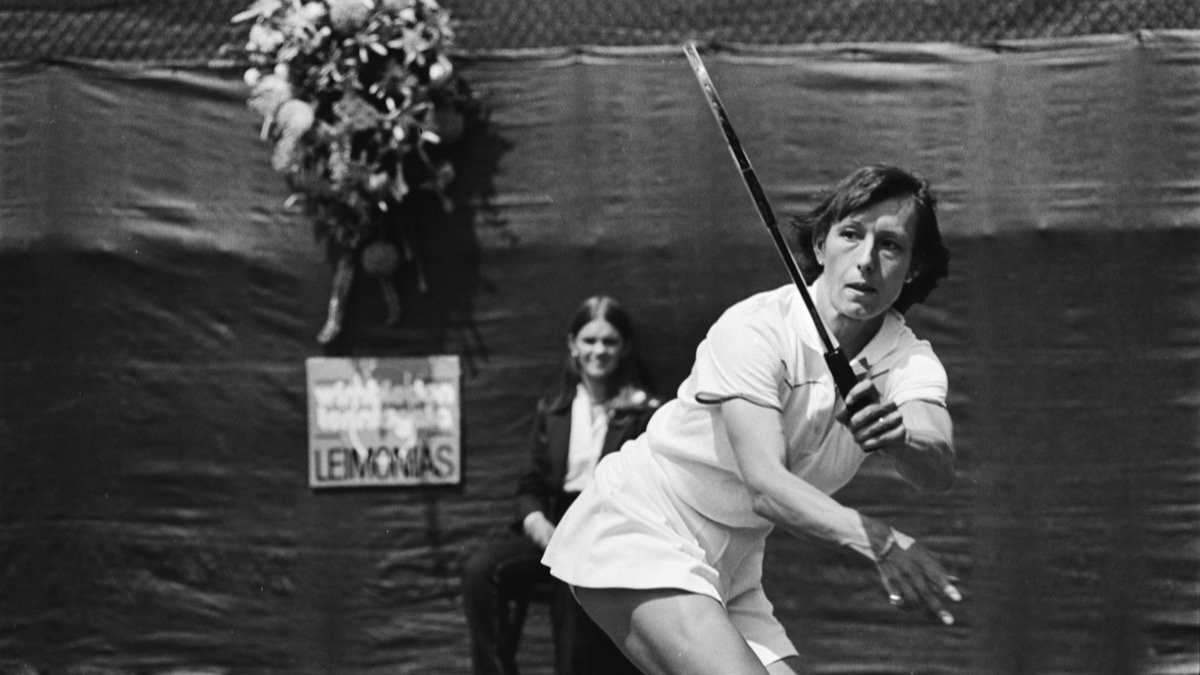

Martina Navratilova did not simply win a great deal of tennis. She rebuilt herself in order to do it, treating her own body as a project at a time when most players still thought of training as something you did to stay in shape between tournaments.
She was born in Prague and learned the game in Czechoslovakia, where the state controlled who travelled and how often. She was a prodigy in a system that did not much like prodigies with opinions, and the friction grew with every trip abroad. At nineteen, during the US Open, she walked into an immigration office in New York and asked for asylum. She did not see her family for years afterwards.
Talent, and the thing talent is not
The early Navratilova was quick, left-handed, naturally gifted at the net and prone to collapsing when matches got long. She lost finals she should have won. The diagnosis, which she accepted more readily than most players would, was that she was simply not fit enough or strong enough to impose her game for three hours.
What followed was unusual for the period. She assembled a team around her - a conditioning coach, a nutritionist, a basketball player who put her through drills designed for a different sport entirely - and trained like an athlete rather than a tennis player. Weights, sprint work, measured diet, recovery. It is standard now because it worked then.
A game built to go forward
Her tennis was simple to describe and miserable to play against. Serve, follow it in. Return, follow it in. Chip a backhand low, cross the service line, and volley into the space the opponent had just abandoned. She had the hands for it, the reach for it and, after the reinvention, the legs to keep doing it in the third set.
Grass suited her best, and Wimbledon became something close to a private residence. She won the singles title there nine times, more than any other player, and did it in a style that has since almost vanished from the professional game.
The rivalry that made both of them
Chris Evert was everything Navratilova was not: a baseliner of immaculate consistency, unhurried, two-handed on the backhand, content to let an opponent make the error. They met in an enormous number of matches across more than a decade, and for long stretches the final of any given tournament was simply assumed to be the two of them.
Each forced the other to change. Evert added strength work and more aggression; Navratilova added patience and a more reliable backhand pass. They were also, unusually for rivals of that intensity, genuine friends, and have spoken warmly about each other for forty years.
Serve, come in. Return, come in. For a decade it was the simplest plan in tennis and almost nobody could stop it.
Longevity
She kept winning long after her contemporaries retired, and then kept playing doubles long after she stopped contending in singles, picking up major titles in her forties alongside partners young enough to be her children. Doubles rewarded exactly what she was best at - reflexes at the net, angles, the ability to read where a ball was going before it was struck.
She also became, in the 1980s, one of the first prominent athletes in any sport to be openly gay, at a cost to her sponsorship income that she has never pretended was small. She has spent the decades since as a commentator and an unusually blunt one, which is roughly what anyone who watched her play would have predicted.
Serve-and-volley tennis has nearly disappeared from the professional tour. Slower court surfaces, heavier strings and much better passing shots mean that a player who follows every serve to the net today is usually punished for it within a few games.
Why the style died and the lesson did not
Nobody plays like Navratilova any more, and the reasons are technical rather than mysterious. Rackets and strings let modern players hit passing shots with enough dip and spin that standing at the net has become a liability. Surfaces have been slowed. The percentages that made constant attacking sensible in the 1980s no longer hold.
What survived is the other half of her contribution: the idea that a tennis player is an athlete first, that strength and conditioning are part of the craft rather than an optional extra, and that a career can be extended by a decade if you are willing to treat preparation as seriously as the matches themselves.
Doubles, and the second career
Long after the singles titles stopped arriving she remained close to unbeatable in doubles, and the reason says a good deal about what kind of player she was. Doubles is a game of first volleys, poaching and position, where a point is often decided in the two shots after the serve. Those were precisely her strengths, and they aged far better than the speed required to chase down a baseline rally.
She won major doubles titles across an astonishing span of years, with a series of partners, and added mixed doubles titles after returning to the tour in her forties. Younger players who partnered her have described the experience as a tactical education: she would call the pattern before the point began, and the ball would usually end up exactly where she said it would.
The left hand
Being left-handed mattered more in her era than it might now. The serve swung away from a right-handed opponent's backhand on the advantage court, which is where break points are played, and the spin on her approach shots opened angles that right-handers had less practice defending.
Combined with her willingness to attack a second serve, it meant she could win a service game without the rally ever starting, and could manufacture pressure on her opponent's serve from the first point. Left-handed players remain over-represented at the top of tennis for precisely these reasons, and she was the most complete example of what the advantage looks like when the rest of the game is built to exploit it.