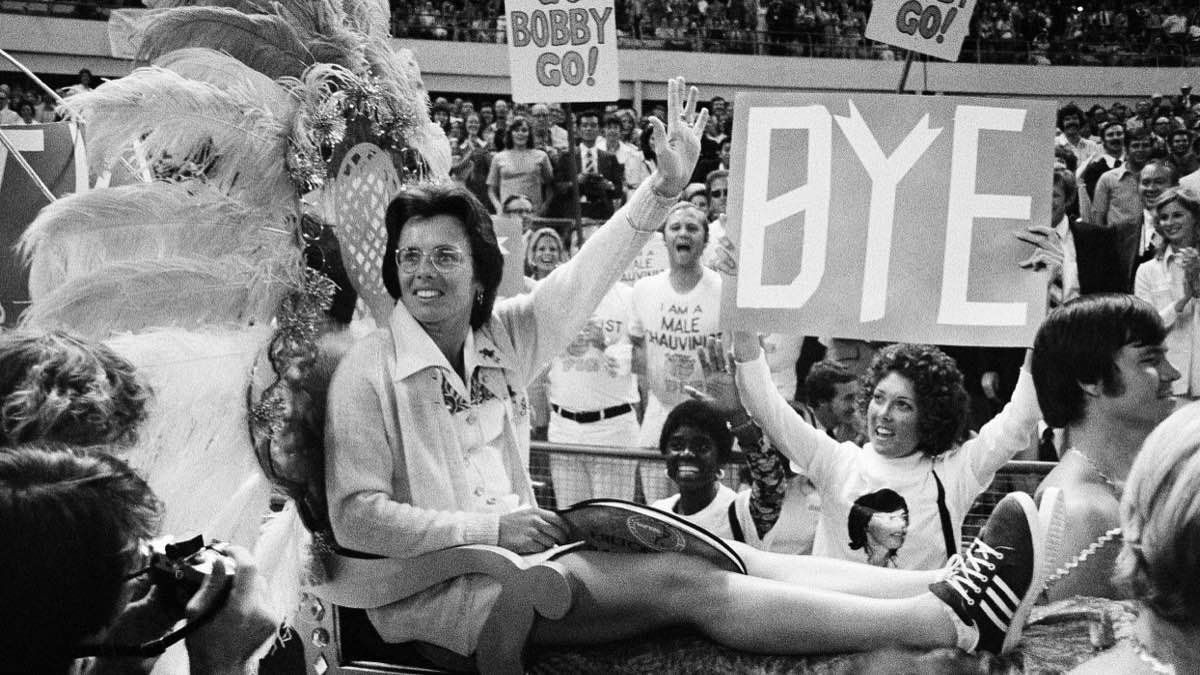

Billie Jean King was one of the outstanding players of her generation, and that is the smaller half of her story. The larger half is what she did off the court, in meetings and press conferences and one deeply strange exhibition match, to change what women in her sport were allowed to earn.
She grew up in Long Beach, California, in a family with no money for private clubs, and learned the game on public courts. That background mattered later. Tennis in the 1960s was still run by people who thought of it as a pastime for the comfortable, and King spent most of her career arguing with administrators who could not understand why anyone would want to be paid properly for playing it.
The prize money gap
When the open era began and tournaments started paying real money, the split between the men's and women's prizes was not slightly uneven. At some events the women's champion received a fraction of what the men's champion did, and tournament directors defended the difference as a simple matter of what the market would bear. The women, they argued, sold fewer tickets.
King's response was to test the claim. If the women were worth so little, she reasoned, a tournament without them would lose nothing. And if they were worth more, the only way to prove it was to put on events of their own and count the crowd.
Nine players and a symbolic contract
In 1970 King and eight other players broke away to join a new circuit organised by the publisher Gladys Heldman, signing contracts for a token one dollar. They were threatened with suspension and with exclusion from the majors. The group became known as the Original 9, and the tour they launched grew into a professional women's circuit with its own sponsors, its own calendar and, crucially, its own revenue.
Three years later King was central to the founding of the Women's Tennis Association, which gave the players a single organisation to negotiate on their behalf. That same year, after she made clear that the leading women would not enter unless the prize money matched, the US Open became the first of the four majors to pay its men's and women's champions the same amount.
The match she could not refuse
Bobby Riggs was a former champion, decades past his best, who had built a late career out of saying loudly and often that any competent man could beat the best woman in the world. He challenged King. She turned him down. He then played another leading woman, won, and spent the following months being quoted everywhere.
So she accepted. The match was staged in a domed stadium in Houston, carried live on prime-time American television, and surrounded by the kind of circus that made serious players wince - she was carried in on a litter, he arrived in a rickshaw. Underneath it she played a disciplined, unglamorous match, moved him corner to corner until his legs went, and won in straight sets.
"Pressure is a privilege."- Billie Jean King
What the exhibition actually did
By any sporting measure the result proved nothing. Riggs was an old man and King was in her prime; a win was expected and a loss would have been meaningless. By every other measure it mattered enormously. An audience that had never watched a women's match saw one, and the argument that women's sport was not worth televising became harder to make the following week than it had been the week before.
King understood exactly what she had been handed. She has said since that losing would have set the movement back years, and that she played it as a business obligation rather than a sporting one.
Equal prize money did not arrive everywhere at once. The US Open levelled up first, and the other three majors followed over the following decades, with Wimbledon and Roland Garros among the last to do it.
The record and the legacy
None of the campaigning should obscure the player. King won major titles in singles, doubles and mixed doubles, was especially formidable at Wimbledon, and played an aggressive serve-and-volley game that suited fast grass and short points. She was a willing net player in an era when that meant taking the ball early and accepting that some of them would go past her.
Her lasting monument is structural rather than statistical. The women's tour exists as an independent professional organisation because a small group of players risked their careers to build one, and the fact that a modern champion is paid the same as her male counterpart at every major is the direct result of arguments King was having in hotel conference rooms fifty years ago.
The argument that keeps returning
Equal prize money at the majors is settled, but the wider argument has not gone away. It resurfaces whenever somebody points out that men play best of five sets at the majors and women play best of three, or compares television audiences for one tour against the other. The counter-arguments are familiar too: the number of sets is set by the tournaments rather than the players, and the combined events sell a combined ticket.
What King established was not a final answer to any of that. It was a principle - that the women's game should negotiate as an organised body rather than as individuals hoping for fair treatment - and a precedent that champions at the biggest events are paid the same. Every subsequent debate about pay in women's sport has taken place on ground that the Original 9 cleared.