
Before Franz Beckenbauer, the last defender's job was to destroy attacks and get rid of the ball. After him, the same position was a place to start them from. Almost no footballer has changed the job description of an entire role, and he did it while winning everything there was to win.
He was born in Munich in 1945, into a city of rubble and ration cards, the son of a postal worker. Football was played on bombsites. The story of how he ended up at Bayern Munich is almost comic: as a boy he fully intended to join 1860 Munich, then the bigger club in the city, but a bad-tempered youth tournament match against them - he was slapped by an opponent - changed his mind. He signed for Bayern instead, who at that point were not even in the top division.
Inventing the libero
Continental football of the era used a sweeper, a spare defender playing behind the back line to mop up whatever got past it. It was a defensive, reactive job. Beckenbauer played it the other way round. Having won the ball, he kept it, carried it out of defence, and passed forward into midfield himself - sometimes continuing all the way into the attack. He had the balance of an attacking midfielder and the reading of a centre-back, and he looked entirely unhurried while doing it, which is where the nickname came from. Der Kaiser: the Emperor.
It worked because of the rest of the system around him. Bayern of the mid-1970s had Sepp Maier in goal and Gerd Muller scoring, and the team won the European Cup three seasons in a row. Domestically they went from a regional side to the dominant force in German football within a decade, and Beckenbauer was the axis of the change.
Three World Cups as a player
He played in the 1966 final at Wembley as a twenty-year-old, given the job of marking Bobby Charlton while England's players were given the job of marking him - a mutual cancelling-out that both sides later regretted. West Germany lost. In 1970 came the semi-final against Italy in Mexico, a match so chaotic that it is simply known as the Game of the Century; Beckenbauer dislocated his shoulder, had his arm strapped tightly to his chest, and played on because the substitutions were used up. The photograph of him on the pitch with his arm bound is one of the sport's enduring images.
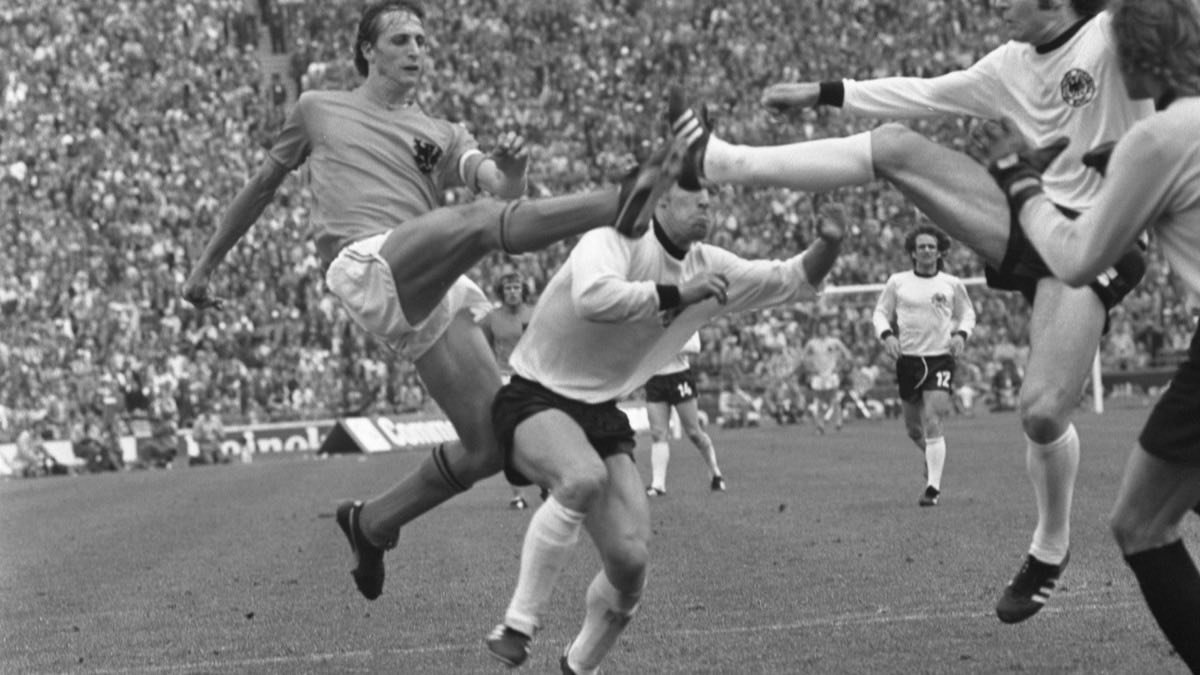
The reward came in 1974. West Germany won the European Championship two years earlier and then the World Cup on home soil, with Beckenbauer as captain, beating a Netherlands side widely held to be the better team. He finished his European career with two Ballon d'Or awards and a trophy cabinet that had nothing missing from it.
He did not clear the ball. He started with it - and for a defender in the 1970s, that was close to heresy.
What the libero asked of everyone else
The role only works if the rest of the team accepts a set of obligations. Somebody has to cover the space he leaves when he carries the ball forward, which usually meant a holding midfielder dropping into the back line. The full-backs have to stay disciplined rather than both attacking at once. And the forwards have to make runs that create passing lanes for a defender forty metres away, which is a strange habit to teach.
That is why so few teams could copy it. Plenty of clubs had a sweeper; very few had a sweeper who could pick a pass through two lines, and almost none had a team organised around the assumption that their last defender was also their best playmaker. When German and Italian sides tried to reproduce the model in later decades, the usual failure point was not the libero but everybody around him.
New York, and a second career
Like several European stars of his generation, he finished his playing days in the North American Soccer League, joining the New York Cosmos alongside Pele and helping sell the sport to a country that had resisted it for a century. He came back to Germany to play briefly for Hamburg, then retired.
What happened next is the part that sets him apart. He took charge of the West Germany national team with no previous coaching experience, lost the 1986 World Cup final, and won the next one in 1990 in Italy. That placed him in an extremely short list of men who have won the World Cup both as a player and as the person in charge.
Beckenbauer almost became a 1860 Munich player. A scuffle during a boys' tournament sent him to Bayern Munich instead - a club that was, at the time, the smaller and less successful of the two.
The 1990 victory also made him one of a very small number of people to have lifted the World Cup as a player and then directed a winning campaign from the bench. The two jobs have almost nothing in common - one rewards instinct under pressure, the other rewards patience, selection and the ability to tell a famous player he is not starting - and most great captains who have tried the second have found it humbling.
The ambassador
For the rest of his life he was German football's public face: a club president, a television pundit, and the man who led the campaign that brought the World Cup back to Germany in 2006, a tournament remembered there as a summer that changed the country's image of itself. Later years brought questions about how that bid had been run, and the arguments outlived him.
None of it altered what he had been on the field. Beckenbauer died in January 2024, and the tributes kept circling the same point: he had made something difficult look casual, and in doing so had quietly rewritten what a defender was allowed to be.