Baseball looks simple from the bleachers, but few sports hide so many odd traditions beneath the surface. A seventh-inning singalong, a tin of secret mud, a scorebook full of cryptic letters — this is a game that wears its history on its sleeve.
For more than a century and a half, baseball has been collecting little rituals and superstitions the way an old jacket collects patches. Some of them have logical roots; others survive simply because no one ever wanted to stop. Here are a few of the curiosities that make the sport so distinctive — with the contested ones flagged, because baseball history is famous for its tall tales.
Stand up and stretch
Somewhere in the middle of the seventh inning, the crowd rises to its feet, stretches its legs and, in many ballparks, sings along to "Take Me Out to the Ball Game". The seventh-inning stretch is one of the sport's most beloved customs. Its exact origin is disputed: one popular story credits United States President William Howard Taft, who is said to have stood during a game in 1910, prompting the crowd to rise out of respect. A handwritten letter from the 1860s describing fans stretching their legs suggests the habit may be older still. Whatever the truth, the stretch endures as a shared pause in the action — a moment when a stadium full of strangers does the same small thing at the same time.
The secret mud
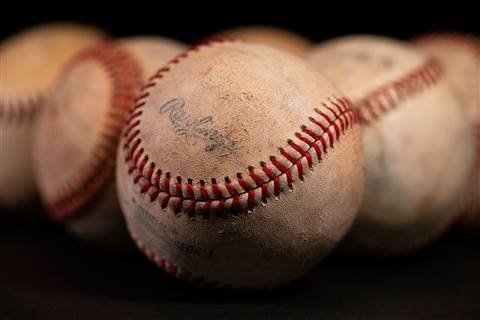
Before nearly every Major League game, an umpire or clubhouse attendant sits down with a tin of brown mud and rubs it, by hand, into dozens of baseballs. Straight from the factory a ball is slick and shiny, which makes it hard to grip and dangerous to hit. The fix is a substance known as Lena Blackburne Baseball Rubbing Mud, gathered from a closely guarded spot along a tributary of the Delaware River in New Jersey.
The mud takes the factory sheen off the leather without scratching it, giving pitchers a reliable grip. The product traces back to former player and coach Lena Blackburne, who began supplying it in the 1930s, and for decades the league has had no widely adopted replacement. The precise location of the mud source is famously kept secret, passed down rather than published.
"There is no clock to kill in baseball — only the game can do that."— a common saying among fans
A game without a clock
For most of its history baseball was defined by what it lacked: a clock. Unlike football, basketball or hockey, a baseball game could not simply run out of time. In theory a team had to record 27 outs to win, however long that took, and games tied after nine innings rolled on into extra innings until someone broke the deadlock. That open-ended quality gave baseball its unhurried, summer-evening character — and, critics argued, its occasional sprawl.
That changed more recently. To speed up play, Major League Baseball introduced a pitch clock, limiting the time a pitcher can take between deliveries. It was a striking break from tradition for a sport that had defined itself for so long by the absence of a ticking clock, and it noticeably shortened the average length of a game.
The "K" used to mark a strikeout in a scorebook is widely said to come from the last prominent letter in "struck", chosen because the letter "S" was already in use for other plays. A backwards "K" traditionally marks a batter caught looking at strike three rather than swinging.
Cryptic letters and quiet rituals
Keeping score by hand is its own small language. Each position has a number — the pitcher is 1, the catcher 2, around the diamond to the right fielder at 9 — so a routine groundout can be written as a tidy string of digits. Hits, errors and outs each have their own shorthand, and a finished scorecard reads like a coded diary of the game. The strikeout "K" is only the most famous of these marks.
The sport is layered with other quirks worth knowing:
- A pitcher who allows no hits across a full game throws a "no-hitter"; allow no runner to reach base at all and it becomes the much rarer "perfect game".
- Foul balls hit into the stands are, by long custom, kept by the fan who catches them — a tradition that took hold in the early twentieth century.
- Superstitions run deep: many players avoid stepping on the foul line as they jog on or off the field, and teammates have been known to stay silent around a pitcher working on a no-hitter so as not to jinx it.
- The "bullpen", where relief pitchers warm up, has a disputed name; theories range from old outfield advertising to the idea of pitchers penned up like cattle, and no single explanation is settled.
Records and statistics fall and traditions evolve — the pitch clock is proof of that — but the texture of baseball stays the same. It is a game measured in innings rather than minutes, kept alive by a tin of river mud and a stadium that rises, every seventh inning, just to stretch.