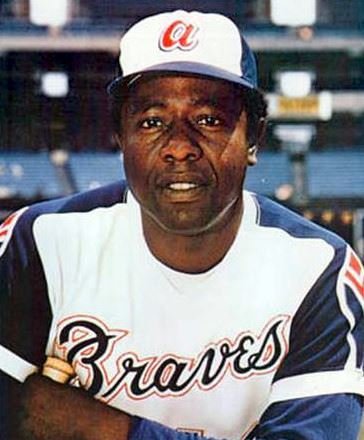
He chased the most famous record in American sport with a swing so smooth it looked effortless — and carried the weight of hatred and threats with a dignity that never cracked. Henry Aaron let the bat, and the silence, do the talking.
Henry Louis Aaron was born on 5 February 1934 in Mobile, Alabama, into a large family with little money. He learned to hit with bottle caps and broomsticks, and grew up in the segregated South, where a Black boy who dreamed of professional baseball faced barriers far higher than any outfield wall. As a teenager he played briefly in the Negro Leagues, gripping the bat cross-handed in the unorthodox way he had taught himself, before professional scouts noticed his rare bat speed and signed him into the minor leagues. From those modest beginnings he built one of the most complete careers the game has ever seen.
Aaron's path to the majors ran straight through the harshness of mid-century America. He played in towns where he could not stay in the same hotels as his white teammates or eat in the same restaurants, and he answered that treatment not with anger but with relentless production at the plate. The lesson of those early years — that performance was the one argument no one could take away from him — would shape everything that followed.
A swing built to last
Aaron reached the majors with the Milwaukee Braves in 1954 and stayed with the franchise — through its move to Atlanta in 1966 — for most of his career. He was never the loudest star of his era, and he rarely led the league in home runs in any single season. His genius was consistency: year after year of high averages, line drives, and power, accumulated with a quiet professionalism that made greatness look ordinary. He helped the Braves win the World Series in 1957 and was named the National League's Most Valuable Player that same season.
The chase and the hate
By the early 1970s, Aaron was closing in on the most sacred number in baseball: Babe Ruth's career total of 714 home runs, a mark many believed would never fall. As he neared it, he received thousands of letters — some full of encouragement, but many filled with racist abuse and death threats aimed at stopping a Black man from passing a white icon. He played on under police protection, often unable to celebrate openly the achievement he had earned. That he endured the chase with such composure is, for many, the truest measure of the man.
"I never wanted them to forget Babe Ruth. I just wanted them to remember Hank Aaron."— Hank Aaron
On 8 April 1974, before a home crowd in Atlanta, Aaron drove a pitch over the left-field fence for his 715th home run, passing Ruth at last. Two fans ran onto the field to join him as he rounded the bases — a rare moment of pure joy in a long and lonely pursuit. He would go on to retire after the 1976 season with 755 career home runs, a record that stood for more than three decades until Barry Bonds surpassed it.
For all the focus on home runs, Aaron's most enduring record may be his career total of runs batted in — more than 2,200, a mark that still stands at the top of baseball's all-time list and that no player since has come close to matching.
A legacy beyond the numbers
Aaron was elected to the Baseball Hall of Fame in 1982 with one of the highest vote shares in its history. He retired holding a long list of career records, and beyond the home runs he remained the game's all-time leader in runs batted in and total bases — marks built on more than two decades of steady, unglamorous brilliance. After his playing days he became a respected executive, one of the first Black men to hold a senior front-office role in the sport, and a tireless advocate for opportunity in the game and beyond, using the platform his career had built to push baseball toward fairness. The annual award given to each league's best hitter now bears his name.
When he died on 22 January 2021, tributes came from across the worlds of sport, politics, and civil rights. Records can be broken, and one of his most famous already has been — but what Aaron represented endures. He was proof that quiet excellence, sustained over a lifetime and carried with grace under the cruelest pressure, can outlast even the loudest noise.