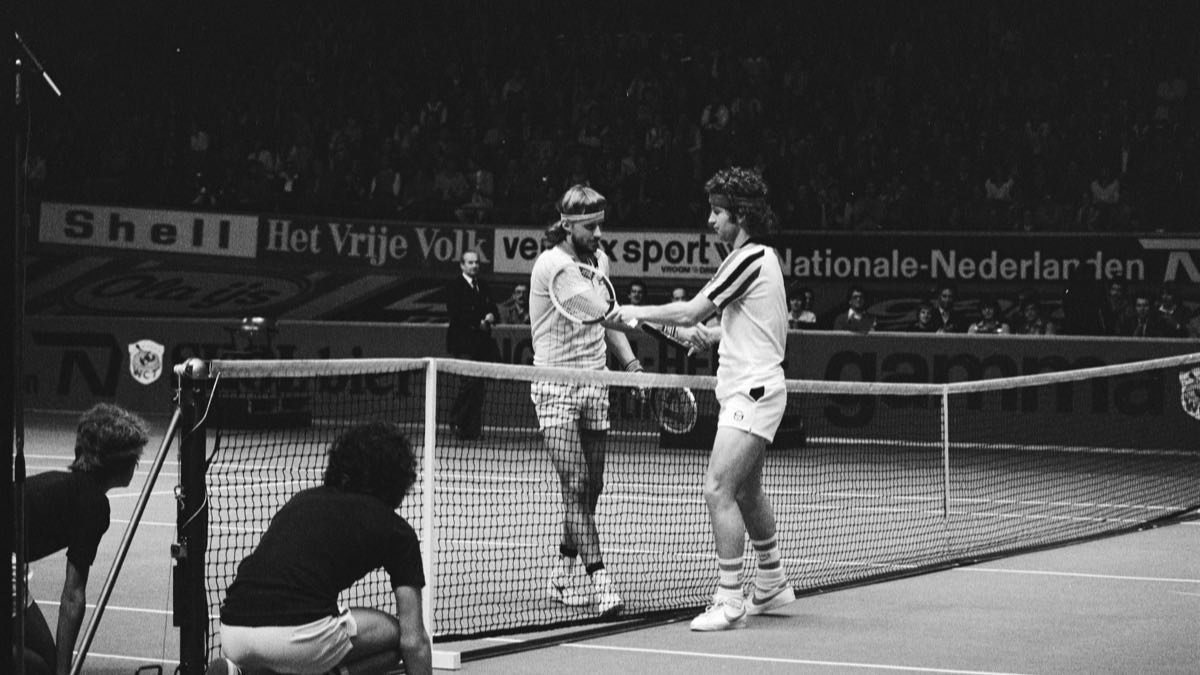

Sport loves a contrast and rarely gets one this clean. Bjorn Borg said almost nothing and showed less. John McEnroe said everything, usually at volume, usually to an official. For a few summers at the end of the 1970s they met each other at the top of the game and neither could quite finish the other off.
Borg arrived first. A Swedish teenager with long hair and a headband, he hit a two-handed backhand and heavy topspin off both wings at a time when the orthodoxy was still flat drives and a trip to the net. On clay the style was obviously effective. On the fast grass of Wimbledon it should not have worked at all, and for five consecutive years it did.
The man who did not react
What unsettled opponents was not the tennis but the absence of any visible response to it. Borg did not celebrate winners, did not complain about calls, and did not appear to speed up or slow down whether he was a set ahead or a set behind. Players spoke about the experience of hitting what should have been a winning shot, watching it come back, and finding nothing in his face to read.
Underneath the calm he was an extraordinary competitor and physically relentless. His game was built on never missing: deep topspin, a low error count, and the willingness to play a point for as long as it took.
The arrival of the opposite
McEnroe was from New York, played left-handed, and had hands that seemed to belong to a different and much older era of the sport. His serve came out of a strange side-on windup that gave the ball a swerve nobody enjoyed returning. His volleys were soft, angled and intelligent. He was also incapable of letting a disputed call pass without comment, and his arguments with umpires became famous enough to obscure how good he was.
The contrast was irresistible to broadcasters, and the matches lived up to it. McEnroe attacked, Borg absorbed. McEnroe shouted, Borg adjusted his headband.
The 1980 final
They met for the title with Borg chasing a fifth straight Wimbledon and McEnroe arriving as the player most likely to stop him. The match turned on a fourth-set tiebreak that ran to 18-16, with championship points saved on one side and set points saved on the other, and which is still shown in full most summers.
McEnroe won that tiebreak. Borg won the match, taking the fifth set without dropping serve - which is, in its way, the most Borg thing in the entire story. He had just been through the most draining twenty minutes of his career and he came out of it calmer than he went in.
McEnroe won the tiebreak that everyone remembers. Borg won the fifth set that almost nobody can recall a single point of.
The year after
They met again in the final the following summer and this time McEnroe won, ending the run. He won their meeting at the US Open later that year as well. Borg, at an age when most players are entering their best years, walked away from full-time tennis almost immediately afterwards.
The retirement has been explained in a dozen ways - burnout, the loss of motivation after being beaten, the sheer accumulated cost of the way he played. He has never given a tidy answer. What is clear is that the rivalry did not fade out; it stopped.
Borg won Wimbledon and the French Open in the same year more than once, a double that was considered close to impossible at the time because the surfaces demanded such different games and the two tournaments were only weeks apart.
Why it lasted
Plenty of rivalries have produced better tennis over a longer period. Few have produced a better story, and the reason is that the two men were not merely different players but different arguments about how a competitor should behave. One insisted that emotion was a leak; the other insisted it was fuel. Both were right often enough to make the question unanswerable.
They became friends afterwards, which surprised everybody except them. McEnroe has spent much of the time since explaining that Borg's retirement took something out of the sport that it did not recover for years, and that he has never entirely stopped feeling responsible for it.
Two kinds of courage
The easy reading is that Borg was the disciplined one and McEnroe the undisciplined one, but that misses what each was actually doing. Borg's calm was not natural; by his own account he was a volatile junior who was told, in effect, that he would never be allowed to compete again if he kept throwing rackets, and who then built the composure deliberately, over years, until it became a weapon.
McEnroe's temper was equally functional, whatever it cost him in fines. He played his best tennis in a state of irritation, and several opponents noticed that an argument with the chair umpire was frequently followed by three immaculate games. Neither man was simply being himself in public; both had found a way to convert their own temperament into points, and the fascination of watching them was seeing which conversion held up longer.
The surface that shaped them
Wimbledon in that era was far quicker than it is today. The grass was cut and prepared differently, the ball skidded low, and a well-struck serve frequently decided the point outright. That environment should have favoured McEnroe's game entirely and ruled out Borg's heavy topspin baseline tennis.
Borg adapted rather than converted. He flattened his groundstrokes slightly, shortened his swings, and served far better on grass than his clay-court reputation suggested. The fact that the two of them met in consecutive finals on a surface that suited only one of their natural games is part of why the rivalry is remembered as a contest of wills rather than of styles.