
Arthur Ashe won the biggest titles in tennis and spent most of his life being asked about something else. He never resisted the questions. He had decided early that the platform was the point, and he used it with a patience that frustrated people on every side of every argument he entered.
He grew up in segregated Richmond, Virginia, where the public courts he could use were not the good ones and several tournaments in his own state were closed to him. His father worked for the parks department; his mother died when he was six. He was taught by a doctor who ran a summer programme for Black junior players and who insisted on manners, schoolwork and an absolute refusal to argue with officials - partly as discipline, partly because he knew exactly how a Black teenager arguing with a white umpire would be reported.
The first of the titles
Ashe won the US Open in the first year it was open to professionals as well as amateurs, which makes him the first champion of the open era at that tournament and the first Black man to win it. He added the Australian title soon after. Then came a long stretch in which he was consistently excellent and rarely quite good enough at the majors, and a general assumption settled that his best chances had gone.
That assumption was still in place when he reached the Wimbledon final as a clear outsider against a younger, more powerful opponent who had beaten him comfortably before.
The final nobody expected him to win
What he produced that afternoon is still studied as a piece of tactical work. Rather than trade power, he took pace off the ball, sliced low and short, varied the direction of every serve and made his opponent generate everything himself. Between games he sat with his eyes closed. He won, and became the first Black man to take the Wimbledon singles title.
It was a victory of preparation over force, and it fit the man. Ashe was not the most naturally gifted player of his era and never pretended otherwise. He was the one most likely to have thought about the problem in advance.
South Africa
For years Ashe applied for a visa to play in South Africa and was refused. When he was finally admitted he was criticised by activists for going at all, and he answered that he wanted to see the system himself and to be seen by people living under it. He later became a leading voice for sporting sanctions against the apartheid government and was arrested at a protest outside its embassy in Washington.
The position he took was uncomfortable by design. He believed in engagement and in boycotts at different times and for different reasons, and he explained his thinking in public each time rather than simply switching sides.
"Start where you are. Use what you have. Do what you can."- Arthur Ashe
A player who organised
He was one of the founders of the men's players' association and served as its president, at a time when professional players had almost no say in scheduling, prize money or the rules under which they competed. Much of the structure of the modern men's tour exists because a group of players in the early 1970s were willing to risk being banned, and Ashe was among the most persuasive of them.
He also captained his country's Davis Cup team after retiring, and was known for managing much louder personalities than his own with a calm that occasionally drove them to distraction.
The main court at the US Open, the largest tennis stadium in the world, is named Arthur Ashe Stadium. The tournament also runs a community day in his name before the main draw begins.
The last argument
A heart condition ended his playing career, and during surgery he received a blood transfusion that was contaminated with HIV. He learned of the infection years later and kept it private until a newspaper prepared to publish the story, at which point he called a press conference and announced it himself. He was visibly furious about having been given no choice.
He spent the time he had left campaigning on AIDS awareness, founding a foundation, addressing the United Nations and finishing a three-volume history of Black athletes in America that he had researched for years. He died in 1993.
What he left
The trophies are only part of it. Ashe changed what a professional athlete was permitted to be in public - informed, willing to be unpopular, and unembarrassed about caring more for the argument than for the endorsement. He did it without raising his voice, which in his era was itself a tactical choice.
Players who have followed him into activism tend to cite him first, and usually for the same reason: he did his homework. He arrived at every subject having read about it, and that is harder to dismiss than enthusiasm.
The craft behind the calm
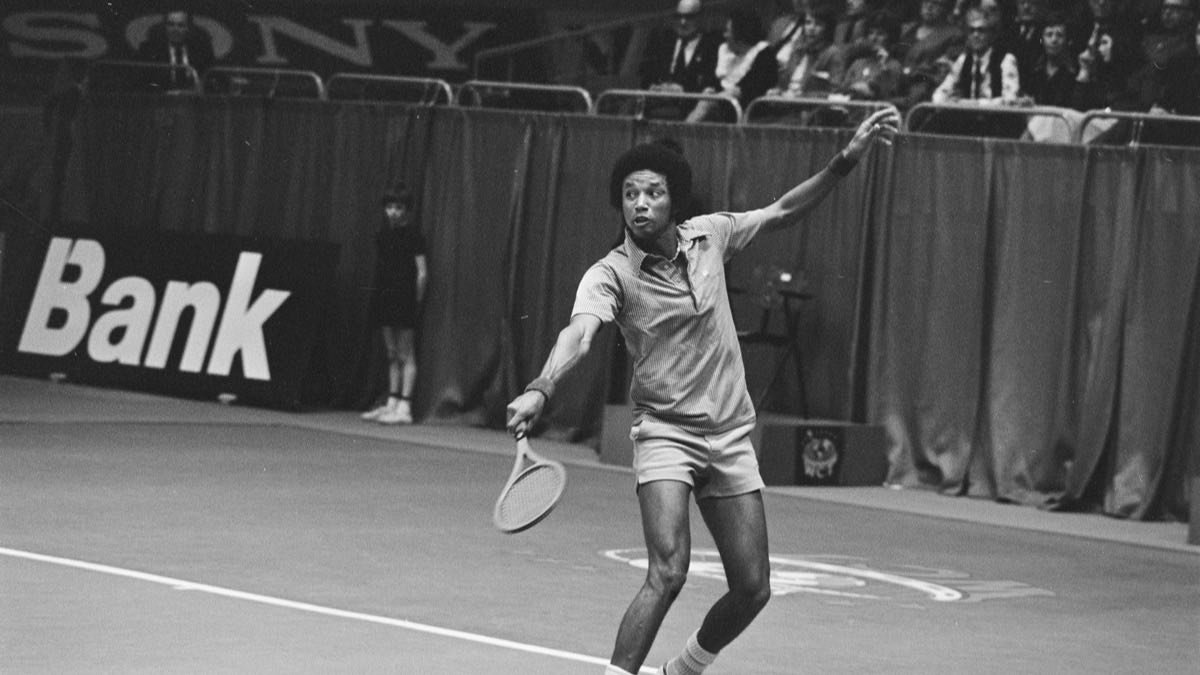
Technically he was a product of his era and slightly ahead of it. He served heavily and came in behind it, volleyed cleanly, and had a flat backhand drive that he could redirect late. What set him apart was an unusual willingness to abandon a pattern that was not working, mid-match, and start again with something slower or stranger.
He kept notes. He studied opponents in an age when that mostly meant watching from the stands and remembering, and he arrived at finals with a plan written down. Several of his contemporaries have said that the plan was the difference, because on pure shot-making there were players in every draw who could outhit him.