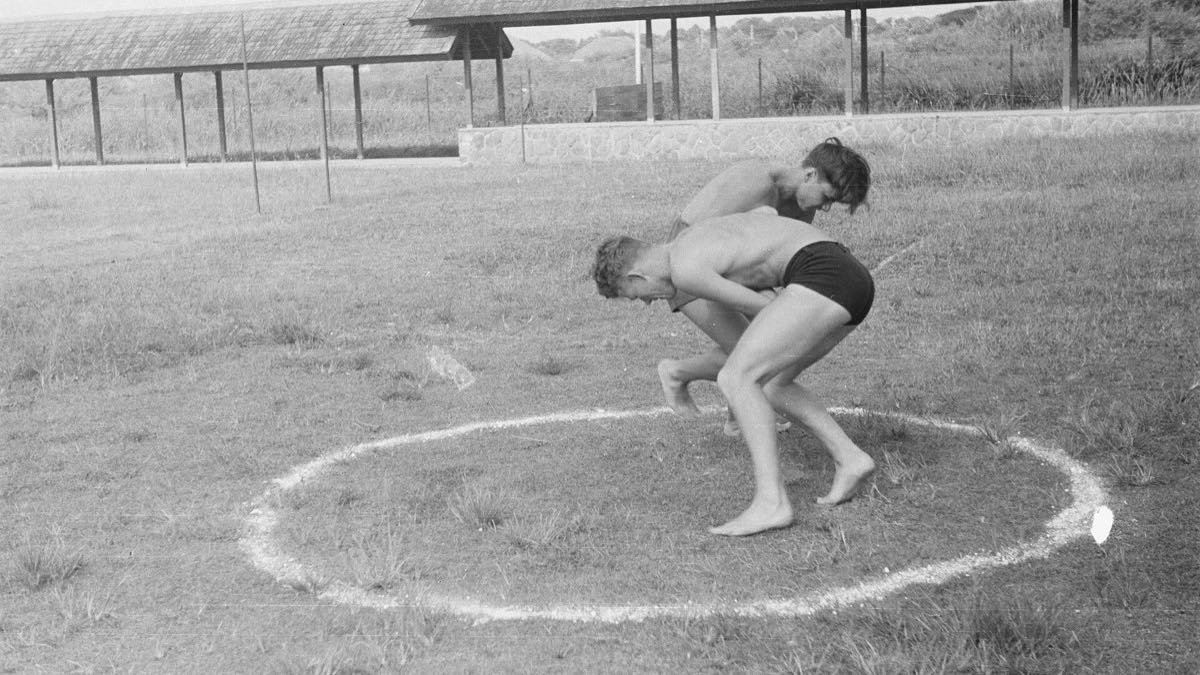

Ask coaches which background gives a newcomer the best head start in mixed martial arts and the answer comes back with suspicious consistency. Not the most dangerous striking, not the deepest submission game, but wrestling - a sport in which nobody is ever knocked out and nothing is ever submitted.
The reason is not that wrestlers hit harder or choke better. It is that wrestling trains the one skill that decides what kind of fight the other man is allowed to have. A fighter who can take the contest to the floor at will, and keep it standing when he prefers, has effectively chosen the contest. Everybody else is reacting.
Position is the real currency
Every other discipline needs a specific range to work. A kickboxer needs space, a jiu-jitsu player usually needs the ground, a clinch specialist needs contact. Wrestling is the skill of moving the fight between those ranges and refusing to let the opponent do the same, which makes it less a weapon than a steering wheel.
This is why a wrestler can beat a better striker without ever outstriking him and a better grappler without ever threatening a submission. He is not winning the exchanges. He is deciding which exchanges happen.
The training habits travel too
Competitive wrestling programmes produce a particular kind of athlete: used to daily hard practice, comfortable with discomfort, familiar with making weight, and accustomed to losing in public and coming back the following week. Those habits transfer to a professional fight camp more cleanly than any technique does.
Scrambling is the other inheritance. Wrestlers spend years in the chaotic seconds when neither person has control, and they learn to keep moving toward a better position instead of freezing. In mixed rules those seconds are where fights are usually decided.
What the cage adds
A wrestling mat has out-of-bounds lines. A cage has a wall, and the wall changes everything. It gives a defender something to stand up against and gives an attacker something to pin a hip to. A large part of modern training is simply wrestling adapted to a surface that does not let anybody escape by stepping outside.
The fence also rewards the unglamorous parts of the sport: underhooks, head position, wrist control, the patient work of keeping a man's back against it. None of that looks like anything on a highlight reel, and all of it wins rounds.
A wrestler does not need to be the better fighter. He needs to make sure the fight is the one he prefers.The logic of a wrestling base
Where it stops working
Pure wrestling has an obvious hole: it has no concept of submission. A wrestler who has never trained to defend a choke will walk into one, because in his original sport being on top with an arm around a neck is simply good work. Every wrestler who moves across has to unlearn a few things that used to be safe.
There is a second hole. Takedown attempts carry risk in a sport where the other man is allowed to punch. The same shot that scores a point in a tournament can be met with a knee or a sprawl into heavy ground strikes, so entries have to be rebuilt around the threat of damage.
Freestyle and Greco-Roman reward different things: freestyle allows attacks on the legs, while Greco-Roman forbids holds below the waist, which is why Greco specialists often arrive in the cage with unusually strong clinch and upper-body throws.
Takedown defence is the quieter half
The skill is symmetric, and the defensive side is frequently more valuable. A striker who cannot be taken down becomes extremely hard to beat, because he can treat every exchange as a striking exchange and ignore the threat that would otherwise dictate his footwork.
That is why many strikers spend their first years in the sport learning to sprawl, to frame, and to stand back up against the fence. They are not learning to wrestle in order to wrestle. They are learning it in order to be allowed to keep doing what they are good at.
Pressure is a weapon
Wrestlers bring a concept that other disciplines rarely name: pressure. It is the accumulated effect of constant forward weight, repeated attempts and the simple refusal to let an opponent rest. Nothing about it appears on a statistics sheet, and by the third round it is often the only thing that matters.
Fighting a pressure wrestler is exhausting in a specific way. Every exchange has to be answered, every position has to be re-established, and the mental cost of never being allowed to settle is heavier than the physical cost of any single technique.
Learning it late
The uncomfortable part of the advice is that wrestling is much easier to acquire young. The sport is built on thousands of repetitions in live competition, and adults who start late can become competent without ever acquiring the instincts that a childhood in the sport produces.
That is not an argument against trying. Plenty of successful fighters learned to wrestle in their twenties, and the defensive half in particular is very learnable. It is an argument for being realistic about which half of the skill is being bought.
The base, not the whole building
None of this makes wrestling sufficient. A fighter who only wrestles will eventually meet someone who defends the takedown and punishes him standing, or someone who welcomes the floor and submits him there. The base has to be built on.
But a base is exactly the right word. It determines what can be put on top, and it is far easier to add striking and submissions to a wrestler than to add a wrestler's instincts to someone who has never had them. That is why the advice keeps being given, and why it keeps being right.