
There are a handful of coaches whose names became adjectives. Only one became an object. The trophy handed to the winners of the Super Bowl every February carries the name of a man who did not get a head coaching job until he was forty-five, and who had eleven seasons to use it.
Vincent Thomas Lombardi was born in Brooklyn in 1913, the son of an Italian immigrant butcher. He spent two years in a seminary before deciding against the priesthood, then went to Fordham University, where he played on an offensive line that the New York papers christened the Seven Blocks of Granite. He was undersized for the position and got by on leverage and refusal.
Fifteen years of waiting
What followed was an unusually long apprenticeship. He studied law briefly, worked for an insurance company, and then spent most of the 1940s teaching Latin, chemistry and physics at a New Jersey high school while coaching its football team for very little money. He was in his thirties and going nowhere in particular.
The break came at West Point, as an assistant to Earl Blaik, whose methods - total preparation, no tolerance for sloppiness, film studied until it was memorised - Lombardi absorbed completely. From there he went to the New York Giants as offensive coach, where his units were good enough that other clubs began to notice the assistant rather than the head coach.
Green Bay
In 1959 the Green Bay Packers, coming off one of the worst seasons any professional club had produced, gave him the job - as head coach and general manager, because he insisted on both. Green Bay was and is the smallest city in the league, a town with a community-owned football team and a long memory of being good a very long time ago.
He did not rebuild the roster. Most of the players who would win championships for him were already there, losing. What he changed was the standard of what was acceptable, in a way that his players described afterwards as exhausting and, eventually, clarifying. The team had a winning record in his first season.
"Perfection is not attainable, but if we chase perfection we can catch excellence."- Vince Lombardi
The play everyone knew was coming
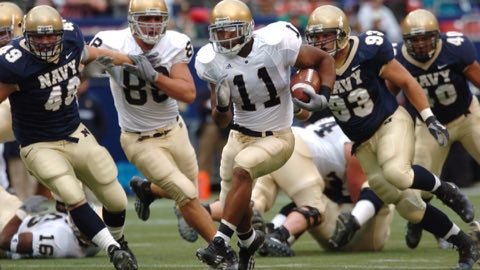
Lombardi's offence was not complicated, and that was the argument. Its signature was the power sweep: the ball carrier running wide behind two pulling guards, with the receivers and tight end blocking down. Opponents knew it was coming. They were told it was coming. The point was that it would be executed precisely enough that knowing did not help.
He ran the same handful of plays out of different formations, drilled them relentlessly, and expected each player to understand not only his own assignment but why it existed. Players who could not handle the repetition left. Those who stayed - Bart Starr, Paul Hornung, Jim Taylor, Forrest Gregg, Willie Davis, Herb Adderley and others - ended up in the Hall of Fame in numbers that are hard to credit for a club in a town that size.
Lombardi was notably intolerant of prejudice in a league that was slow to change. He told his teams he did not care about a player's colour or background and would not keep anyone who did, and he quietly arranged for the team to avoid hotels and restaurants in segregated cities that would not take all of his players.
Five titles and two Super Bowls
Green Bay won the league championship in 1961 and 1962, lost ground for two seasons, then won three in a row from 1965. The last two of those came with a new fixture attached: the championship game against the winners of the rival American Football League, which was quickly renamed the Super Bowl. The Packers won both of the first two.
The last of the league title games, played at Lambeau Field on the final day of 1967 in temperatures that froze the field solid, is one of the most famous matches in American sport. It ended with a quarterback sneak from a yard out in the final seconds, on a surface where a field goal attempt would have been a lottery. Lombardi's stated reason for the call was that he did not want the crowd to sit in that cold any longer.
A short retirement and an early death
He stepped back from coaching after that season and found within a year that he could not stand it. In 1969 he returned to the sideline with Washington, a club that had not had a winning season in more than a decade, and gave it one immediately. He was diagnosed with cancer the following summer and died in September 1970, at fifty-seven.
The league renamed the Super Bowl trophy after him within weeks. It is a strange and rather moving form of permanence: every championship team in the sport, for more than half a century, has lifted an object with his name engraved on it.
What survives, and what does not
Plenty of the Lombardi mythology deserves scepticism. He is routinely quoted saying that winning is the only thing, a line he used and later regretted the flattening of, and the harder edges of his method would not survive contact with a modern dressing room.
What has survived is the less quotable part: that execution beats novelty, that a team can only run well what it has run a thousand times, and that the job of a coach is mostly to decide what the minimum acceptable standard is and then refuse to move it. Every coach in the sport is still working inside that idea, whether or not they would put it his way.