
For about five years it looked as if football had been solved. A Spanish national team and a Catalan club passed the ball in short triangles until the other side stopped chasing, and they won nearly everything. Then the rest of the sport worked out what to do about it - which is how every dominant idea in football ends.
The name came from television. A Spanish commentator used the phrase during the 2006 World Cup to describe the sound and rhythm of his team's short passing, and it stuck, partly because it is onomatopoeic and partly because nobody had a better word for what they were watching. The players themselves mostly disliked the term, arguing that it made a demanding system sound like a party trick.
Where it came from
The roots run back to Johan Cruyff. As Barcelona's coach he imported the positional ideas he had learned at Ajax, rebuilt the youth academy around them, and insisted that small technical players could succeed if the team was organised to protect them. A generation of academy graduates grew up being taught the same principles from childhood: receive on the half-turn, keep the pitch wide, pass and move immediately.
Pep Guardiola, a Cruyff signing as a player, took over the first team in 2008 and pushed the idea to its limit. His Barcelona side kept possession for long stretches not merely to attack but as a form of defence - an opponent without the ball cannot score with it - and pressed immediately and furiously in the seconds after losing it, on the theory that a team is most disorganised just after winning possession.
Three tournaments, one method
Spain won the European Championship in 2008, the World Cup in 2010 and the European Championship again in 2012 - three consecutive major international tournaments, which no other men's national team has managed. The spine of the side came from the same club and the same academy, so the understanding that normally takes an international squad years to develop was already there.
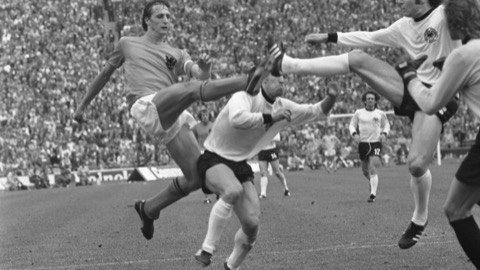
The 2010 final against the Netherlands was not pretty: a bad-tempered match settled deep into extra time by Andres Iniesta. The 2012 final was the opposite, a 4-0 win over Italy in which Spain played without a recognised centre-forward for long periods and simply overwhelmed the opposition in midfield.
Keeping the ball was not the point. It was the means - the opponent cannot hurt you with something they never have.
The criticism
Not everyone enjoyed it. Critics called the approach sterile, pointing to matches in which Spain completed hundreds of passes and won by a single goal, or by none. The complaint had some substance: at its worst the system produced possession without penetration, a team passing sideways in front of a packed defence because the risky forward ball had been coached out of it.
Opponents also learned. Sides stopped trying to win the ball high up the pitch, dropped into two compact banks, conceded possession deliberately and waited to counter-attack into the space behind an advanced defensive line. Done well, it turned Spain's greatest strength into a trap.
The commentator who popularised the phrase was describing the rhythm of the passing, not inventing a tactical label. Several of the players who became famous for the style have said in interviews that they never used the word themselves.
The reckoning
The end, when it came, was abrupt. Spain arrived at the 2014 World Cup as holders and were beaten 5-1 by the Netherlands in their opening match, a result that read like a deliberate demolition of the previous four years. They went out in the group stage. Around the same time, German clubs playing a faster, more vertical game were having a great deal of success against possession-based opponents in Europe.
Obituaries for the style were written immediately, and they were too quick. What actually happened was absorption. The pressing, the positional discipline and the insistence on playing out from the goalkeeper spread everywhere, including to teams that have no interest in holding sixty per cent of the ball.
The players it needed
A system this specific only works with players trained for it, and the Spanish side had an unusual concentration of them. Xavi Hernandez and Andres Iniesta could both receive the ball in a crowd with a defender touching their back and come out the other side facing forward, which is the single hardest skill in central midfield. Sergio Busquets provided the part nobody noticed: a holding midfielder who was almost never dispossessed and who positioned himself a fraction earlier than the pass required.
None of the three was physically imposing. That was the point of the academy that produced them - it selected for understanding of space rather than size, on the argument that a player who always knows where the next pass is going does not need to be quicker than the man marking him. It is a risky principle, and for a while it was comprehensively vindicated.
What survived
Watch a match at almost any level now and you will see pieces of it: a goalkeeper expected to pass under pressure, a defensive midfielder dropping between the centre-backs, full-backs stepping inside, a team counter-pressing within seconds of losing possession. Those were not standard a generation ago.
Guardiola himself moved on, adapting the ideas in Germany and then in England with faster, more direct attacking patterns bolted on. That is the usual fate of a dominant football idea. It does not get defeated and disappear; it gets copied, countered, broken into parts, and the useful parts end up in everybody's coaching manual.