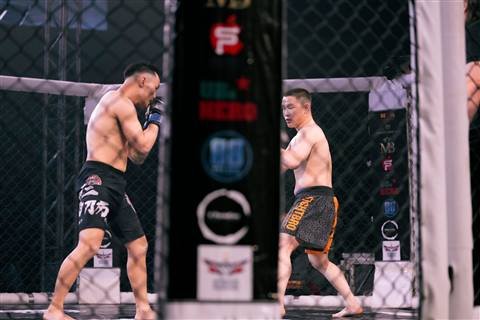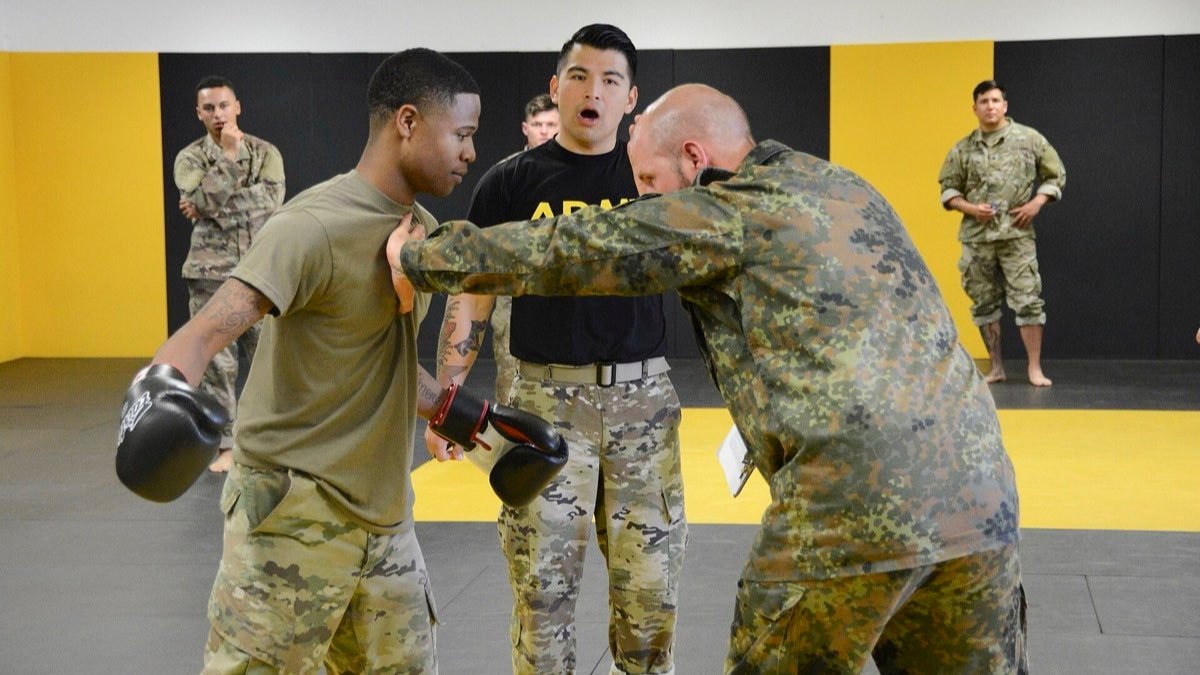

Two men are circling. One drops his level, steps in and disappears below the other's hips. Within two seconds the fight is either on the floor, back where it started, or in the chaotic middle state that decides more contests than anything else. This is the most important exchange in the sport and it is over almost before it registers.
A takedown is simply the act of moving the fight from standing to the ground while keeping the better position. A sprawl is the standard answer: throwing the hips forward and down, driving weight onto the attacker's shoulders and taking the legs out of reach. Everything else in this part of the sport is a variation on those two intentions.
The shot has three parts
First comes the level change: bending at the knees rather than the waist so that the head stays up and the back stays straight. Fighters who bend forward instead are giving away their neck, which is why the most common punishment for a bad entry is a guillotine rather than a punch.
Then comes penetration, a long step that puts the lead knee near the opponent's feet, and finally the finish, in which the attacker turns a corner or lifts. A shot that stalls between the second and third parts is where most takedown attempts die, because a stationary attacker is a defender's gift.
What the sprawl is protecting
It looks like a dive to the floor and it is actually a hip movement. By snapping the hips down and back, the defender puts his centre of mass behind the attacker's grip and turns the attacker's forward drive into dead weight. The legs go backwards because the hips went forwards, not the other way around.
A good sprawl does not end there. The defender immediately looks to control the head and an arm, because an attacker who is stuck on his hands with his head down is one small step from being spun onto his back.
Not every takedown is a shot
Attacks on the legs are only one family. From the clinch a fighter can trip, throw with the hips, lift from a body lock or drag a man down by the head and arm. These travel from wrestling and judo and have one enormous advantage in a cage: they do not require the attacker to dive into punching range from the outside.
That is why clinch takedowns have become more prominent as the sport has matured. The long shot from open space is spectacular and risky. The quiet trip after thirty seconds against the fence is neither, and it wins just as many rounds.
The long shot from open space is the most photographed takedown and increasingly the least used.How the sport's habits shifted
The scramble is where fights are won
The seconds immediately after a failed or partial takedown belong to neither fighter. Both are off balance, both have a hand somewhere useful and neither has control. Wrestlers call this the scramble, and the ability to keep making decisions during it is probably the single most valuable attribute in the sport.
What separates fighters here is not strength but willingness to keep moving to the next position rather than clinging to the last one. The scramble punishes hesitation more reliably than it punishes mistakes.
In the cage a fighter who is taken down can use the fence to stand back up by walking his shoulders up the wall and freeing a hip - a technique with no equivalent on a wrestling mat, where there is nothing to stand against.
Punches change the arithmetic
In wrestling a failed attempt costs position. In mixed martial arts it can cost considerably more, because dropping the head invites a knee and staying low invites hammer fists. That risk has reshaped entries: fighters set up takedowns behind strikes, attack off the opponent's own movement, and abandon attempts earlier than a wrestler would.
Conversely, the threat of a takedown makes striking easier. An opponent who is worried about his legs cannot sit down fully on his punches or commit to a high kick, so many takedown attempts are worth attempting purely for the hesitation they buy.
Defence is footwork first
The best takedown defence rarely involves sprawling at all. It is distance management: staying at an angle, keeping the hips away, framing with the hands, and circling off the fence before being trapped there. Fighters with excellent defence tend to be fighters who are simply not where the shot was aimed.
The second line is the sprawl, and the third is standing back up, which is a skill in itself. Many fighters who are easy to take down are nonetheless hard to keep down, and in a sport scored by rounds that distinction matters enormously.
Reading the entry
Experienced fighters defend takedowns before they start, because the preparation is visible. A dip in the knees, a shortened step, a hand reaching for a wrist, a sudden change in head position - each is a tell, and each gives a defender the fraction of a second that separates a sprawl from a trip to the floor.
This is why fighters who have trained together are so hard to take down. Familiarity removes the element of surprise, and without surprise a takedown becomes a contest of strength and position that the defender usually has the better of.
Why this exchange decides fights
Judges reward control, damage and effective aggression, and all three are shaped by who decides where the fight happens. A fighter who can take the contest down at will owns the scorecards. A fighter who cannot be taken down owns the striking exchanges by default.
That is why so much of a modern fight camp is spent on an exchange that lasts two seconds. It is not the most dramatic part of the sport, but it is the hinge on which almost everything else swings.