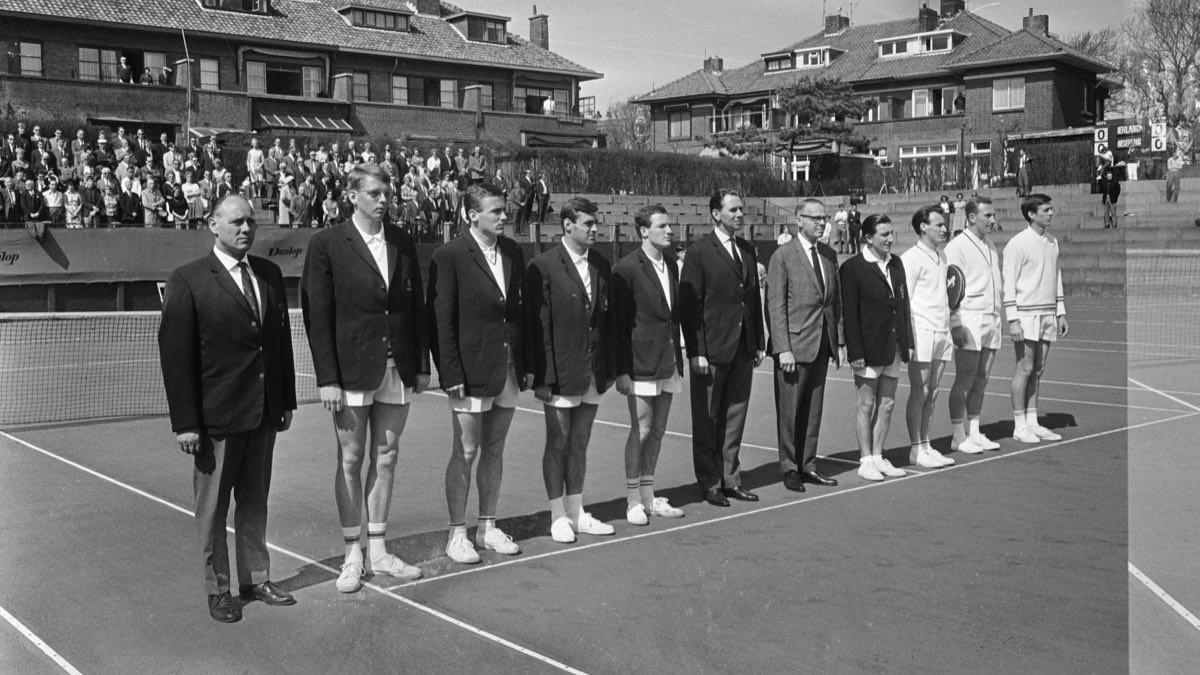

Tennis is an individual sport in almost every week of the year. For a handful of weeks it is not, and the result is the oldest international team competition the game has, played in front of crowds that behave nothing like a normal tennis audience.
It started in 1900 with a student at Harvard named Dwight Davis, who proposed a match between the United States and the British Isles and paid for a silver bowl to give the winners. The bowl is still the trophy. It has been enlarged over the years with additional tiers to hold the engraved names, and it is now large enough that carrying it requires a plan.
From two countries to a world competition
The original contest was a private arrangement between two tennis-playing nations. Others asked to join, and within a few decades it had become a genuine international knockout with qualifying zones spread across the continents, culminating in a final between the surviving teams.
For most of the twentieth century it was one of the most important events in the sport. National federations treated it as the priority, and a player's record in it carried as much weight in his own country as his record at the majors.
The home-and-away rule
The feature that made the competition distinctive was that ties were hosted. The home nation chose the venue and, crucially, the surface. A team of clay-court specialists drawn against a team of fast-court players would lay clay; the reverse would happen the following year.
That produced genuinely strange sporting occasions - matches in bullrings, in football stadiums, on courts built for the week in cities with no tennis tradition at all - and crowds that sang, chanted and jeered in a way that the sport normally forbids.
The format
A traditional tie ran over three days and five rubbers: two singles on the first day, the doubles on the second, and the reverse singles on the third, with the first team to three wins taking the tie. Matches were best of five sets.
It meant that the doubles rubber, usually the least glamorous event in tennis, frequently decided everything. Countries with one outstanding singles player and no doubles pair often lost ties they should have won, and nations with a strong partnership punched far above their ranking.
The only week of the year when a tennis crowd is allowed to behave like a football crowd.
Why top players sometimes skipped it
The competition's great weakness was the calendar. Ties were scattered through the season, often immediately after a major, and involved long-haul travel to play best-of-five matches on a surface chosen to be as uncomfortable as possible. Players who were chasing ranking points and trying to stay healthy began to decline selection.
The result was a slow erosion. A competition that depends on national pride struggles when the best players are not in the team, and the absences became more common as the professional schedule grew.
The women's equivalent, founded decades later, is now named after Billie Jean King. It has gone through its own series of format changes for very similar reasons.
The redesign
In recent years the competition has been restructured more than once, with the knockout spread over the season replaced by group stages and a finals week in a single location, shorter matches and fewer rubbers per tie. The stated aim was to get the best players to commit by making the commitment smaller.
Reaction has been mixed, and that is putting it kindly. Supporters argue the old format was unsustainable in a crowded calendar. Critics point out that the thing being saved - a home tie, in your own country, on your own surface, in front of your own crowd - is precisely what the redesign removed.
The upsets
What kept the competition alive through its difficult years was its capacity to produce results that individual tennis never could. A country with no player inside the world's best fifty could beat a country with two, because a tie is five separate matches and a partisan crowd on a chosen surface is worth something real.
Those weekends tend to be remembered for decades in the smaller nation and forgotten almost immediately in the larger one. They are also the reason federations fought so hard to keep the home-and-away format: the chance of an upset is a function of the venue, and a neutral finals week in a single city removes most of it.
Playing for someone other than yourself
Players who are otherwise undemonstrative behave differently in team ties, and most of them have tried to explain why. A tennis professional spends the year losing alone, in front of a crowd with no particular attachment to them, and then once or twice a season sits on a bench with team-mates and a captain who is allowed to coach between points.
The coaching is itself unusual. In almost every other week a player must solve the match without help; in a team tie there is somebody courtside telling them what to change. Several leading players have described their Davis Cup weekends as the matches they enjoyed most and the ones they found hardest to lose.