
No single person invented ice hockey. It assembled itself over centuries from games that people were already playing, in places where winter was long enough to make a frozen surface the most convenient field available. What can be dated is the moment it stopped being an improvisation and became a sport with rules, boundaries and a flat piece of rubber at the centre of it.
The ancestors are scattered across northern Europe. Dutch painters of the seventeenth century filled canvases with figures on frozen canals, some of them carrying curved sticks and chasing a ball in a game related to early golf. Scotland had shinty, Ireland had hurling, and England had bandy, played on ice with a ball and a wide pitch. Each contributed something, and none of them is the direct parent.
What they share is the basic idea: a stick, an object to drive, and ice that lets players move faster than they can on grass. Soldiers, immigrants and traders carried these games across the Atlantic, where the winters were longer and harder, and where the combination turned out to work unusually well.
Nova Scotia and the Mi'kmaq
Some of the earliest documented organised play in North America comes from Nova Scotia, where games on the lakes around Halifax and Dartmouth were being described in the first half of the nineteenth century. The region also produced the sport's first manufacturing tradition: Mi'kmaq craftsmen carved sticks from hornbeam and yellow birch, cutting them so the grain followed the bend of the blade, and sold them widely.
These were the best sticks available for decades, and the trade continued long after the game had spread. It is a part of the sport's origins that was largely ignored for a century and has only recently been given sustained attention, which is unfortunate, because the earliest equipment the game used came from a specific craft tradition rather than a factory.
Montreal, March 1875
On 3 March 1875, at the Victoria Skating Rink in Montreal, a game was played that is generally treated as the sport's formal beginning. It was organised by James Creighton, who had come from Halifax and brought the Nova Scotia version of the game with him, and it was advertised in advance in a local newspaper. Nine players lined up on each side.
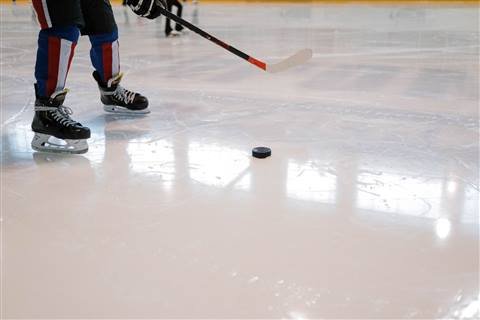
Two things made it different from what had gone before. It was played indoors, inside walls, which meant the playing area had edges and the game could not simply wander. And instead of a ball, the players used a flat wooden disc. The reason was practical: a ball bounces, and a bouncing object in an enclosed building full of spectators is a hazard. Flattening it kept the play on the ice.
Writing it down
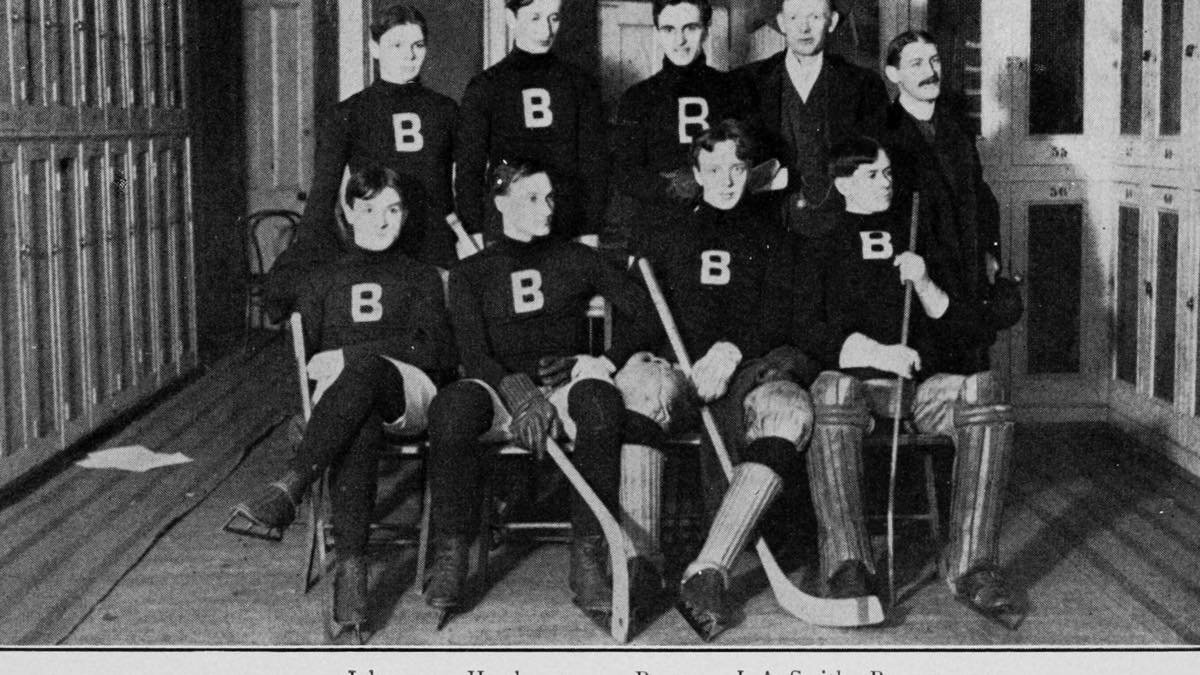
Two years later students at McGill University formed a club and produced a set of written rules, which is the point at which the game became transmissible. Rules on paper can be posted to another city and adopted by people who have never seen a match, and that is precisely what happened. The game spread along the rail lines through Ontario and Quebec, then west and south.
The early rules look unfamiliar. Forward passing was not permitted, which meant the puck had to be carried or passed laterally and backwards, and teams were larger than they are now. Sides of nine shrank to seven, including a position called the rover who moved freely, and eventually to the six that the sport settled on.
Flattening the ball to stop it bouncing into the crowd is the single most consequential piece of improvisation in the history of the sport.
The trophy that organised everything
Competition needs something to compete for. In 1892 Lord Stanley of Preston, then Governor General of Canada and by that point an enthusiastic convert, purchased a silver bowl to be awarded to the country's leading amateur club. The first presentation followed the next year.
The effect was immediate and larger than intended. Clubs across Canada reorganised themselves around the chance to challenge for it, and the trophy acquired a status that long outlasted the amateur system it was created to crown. It remains the prize that professional hockey plays for, which makes it the oldest trophy still contested by a professional team sport in North America.
The earliest pucks were wooden, cut from a plank or sliced from a ball. Rubber came later, and for a time pucks were made by trimming the flat sides of a solid rubber ball - which is why the dimensions the sport settled on are so close to what you get when you slice a ball of that size.
From amateurs to professionals
Through the 1890s the game remained formally amateur, and informally much less so. Clubs competed for players with jobs, expenses and quiet payments. By the first years of the twentieth century the pretence was abandoned in places, openly professional leagues appeared, and the resulting disputes over eligibility took years to resolve.
Artificial ice changed the economics. Once a rink could be refrigerated, the season no longer depended on the weather, buildings could be larger, and teams could schedule reliably. The combination of paid players and guaranteed ice is what made a national professional league possible, and the NHL was founded in 1917 out of the wreckage of an earlier organisation.
What survived
Very little of the 1875 game would be recognisable to a modern spectator, apart from the two most important things. The rink is an enclosed surface with boards, so the puck stays in play and the game is continuous rather than broken up by throw-ins. And the puck is flat, so it slides rather than bounces, which is the reason hockey can be played at the speed it is.
Everything else - forward passing, six players, blue lines, substitutions on the fly - was added later to fix problems that the original rules created. The sport has been revised continuously for a century and a half, but it is still built on an enclosed rink and a flattened ball, both of which were decided in one Montreal building on one evening in March.