Few sports mix raw speed with such gloriously odd rituals. Ice hockey is a game of frozen rubber, flying hats, the occasional airborne octopus, and players who treat a missing tooth as a minor inconvenience.
For a sport built on simple ingredients — a sheet of ice, a stick, a small disc of rubber — hockey has gathered an unusual number of strange habits over the years. Some are practical, some are pure superstition, and a few are so peculiar that newcomers assume they must be jokes. They are not. Here are some of the quirks that make the game what it is.
The puck comes out of the freezer
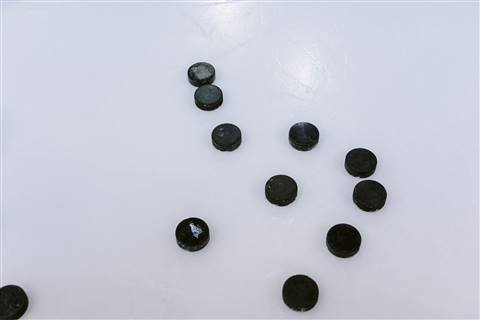
Before a game, the pucks are not just sitting in a box at room temperature. They are frozen. A standard puck is a disc of vulcanised rubber weighing around 6 ounces (roughly 170 grams), and when it warms up the rubber becomes livelier and bounces more. Freezing the pucks beforehand keeps them flat and predictable, so they slide cleanly across the ice instead of skittering off at odd angles. Teams typically keep a supply chilled and swap them out during play, because a puck that has been in the action for a while soon warms up.
Hats, octopuses and other things thrown on the ice
Hockey crowds have a tradition of throwing objects onto the rink, and the most famous is the "hat-trick". When a player scores three goals in a single game, fans toss their hats over the boards to celebrate. The phrase itself is older than hockey and is usually traced to cricket, but hockey adopted it wholeheartedly, and a sudden rain of caps remains one of the sport's great sights.
Stranger still is the octopus. In Detroit, fans of the local team have long thrown octopuses onto the ice during the playoffs. The most repeated origin story dates the tradition to the 1950s, when a team needed a number of wins to claim the championship and the eight legs of an octopus were said to stand for those victories. Whether that tale is exactly true is hard to confirm, but the custom has stuck for decades, and arena staff have become very practised at scooping the creatures away.
"Lose a few teeth, win the cup — most players would take that trade in a heartbeat."— Hockey locker-room saying
The Zamboni and the smooth sheet of ice
Between periods, a slow, boxy machine rolls out and glides around the rink, and the crowd often cheers it almost as loudly as the players. This is the ice resurfacer, known to nearly everyone by the brand name Zamboni, after the family that built the first practical version in the late 1940s. It shaves a thin layer off the scratched, chewed-up surface, washes it, and lays down a fresh film of water that freezes into a clean sheet of glass. Without it, the ice would quickly turn rough and slow. The machine became such a beloved oddity that it now has fans of its own, complete with its own moment in the spotlight.
The ice resurfacer is so iconic that driving one has become a bucket-list experience for many fans. The machine was invented out of frustration: resurfacing a rink by hand once took a small crew the better part of an hour, and one rink owner decided there had to be a faster way.
Teeth, toughness and a few more oddities
Hockey players are famous for their relaxed attitude toward losing teeth. Flying pucks, high sticks and the occasional collision have left many a professional with a gap in their smile, and the gap-toothed grin lifting a trophy has become an enduring image of the sport. Players often simply have the gaps filled in later, treating dental work as part of the job.
- Pucks are frozen before games so the rubber stays flat and does not bounce unpredictably.
- A hat-trick — three goals by one player — sends fans' hats sailing onto the ice.
- Detroit fans have thrown octopuses onto the rink for generations, a habit whose exact origin is debated.
- The ice resurfacer, almost universally called a Zamboni, lays down a fresh sheet between periods.
- Lost teeth are practically a badge of honour, and many players just get them fixed afterward.
Put it all together and you have a game that takes itself seriously on the scoreboard and not at all when it comes to ritual. The speed and skill are real, but so is the charm of a freezer full of pucks, a sky full of hats, and a beloved machine that exists only to make the ice smooth again.