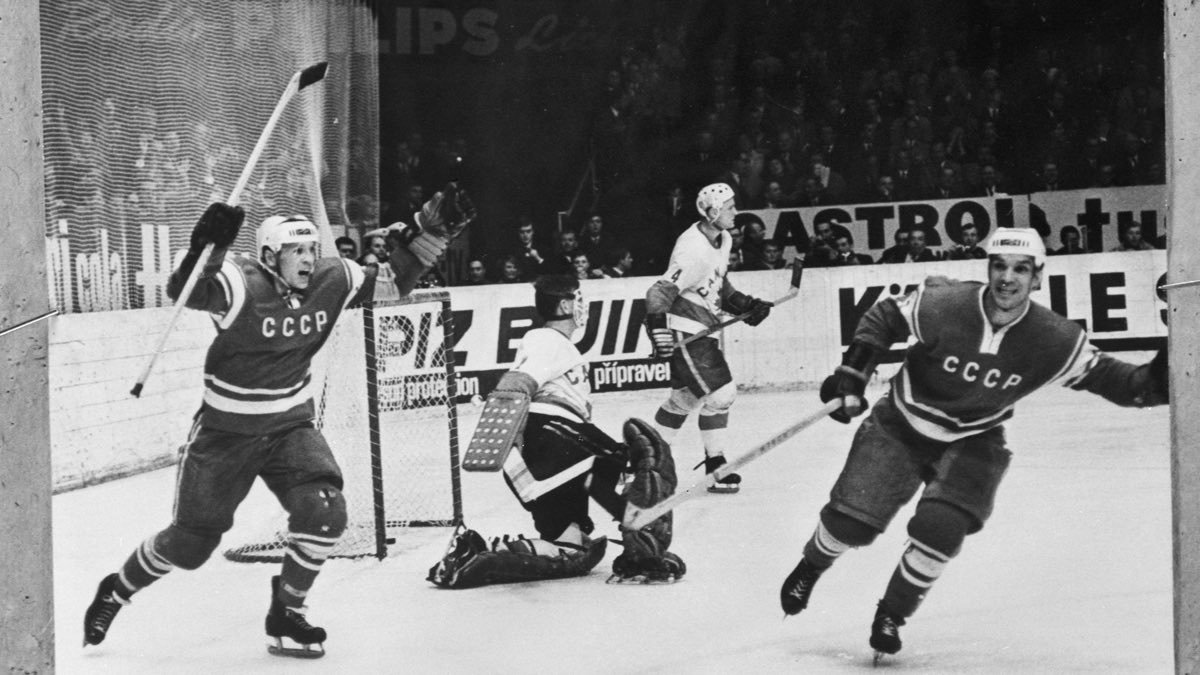

The Soviet Union did not have an ice hockey tradition. Before the Second World War the winter game played there was bandy, a faster, wider sport played with a ball on a surface the size of a football pitch. Within roughly a decade of taking up hockey seriously, the Soviets were beating everybody, and they went on doing it for thirty years.
The decision to adopt the Canadian game was made from above, as sporting decisions in the Soviet Union generally were. International competition was understood as a demonstration of the system, and hockey was a winter sport with a world championship in it. Clubs were attached to institutions: the air force, the trade unions, the secret police, and above all the army, whose club in Moscow became the centre of everything.
Central Army, usually known abroad as CSKA, functioned as both a club and a national training base. Its players held nominal military rank, which also solved the awkward question of how a state without professional sport could field men who did nothing but train. They were, in every practical sense, full-time athletes, years before most of their Western opponents were.
Tarasov and the method
Anatoli Tarasov is the figure around whom the whole story is usually told. He coached the army club and shaped the national programme, and he approached the sport as a problem to be solved from first principles rather than a tradition to be inherited. Having no Canadian habits to copy, he built his own.
His training drew openly on other disciplines. Gymnastics supplied balance and body control; ballet supplied footwork and the idea that movement could be choreographed; chess supplied the language he used to describe positional play. Players carried weights, did acrobatics, and spent large amounts of time on exercises that had no obvious resemblance to a hockey game. The intention was to produce athletes who could skate and handle the puck at a level the sport had not previously required.
Hockey as geometry
What this produced on the ice looked strange to North American eyes. Soviet teams rarely dumped the puck into the offensive zone to chase it. They carried it, regrouped in their own half if the entry was not available, and attacked in patterns that moved all five players. Shots were taken when a good one appeared rather than at every opportunity, which Canadian commentators initially mistook for timidity.
The passing was the most admired element. Soviet forwards passed into space ahead of a teammate rather than at his stick, which requires both players to have agreed in advance about where the play is going. Achieving that reliably takes enormous amounts of time together, which the system provided by keeping the same units intact for years.
They treated a hockey rink as a space to be organised rather than a race to be won, and for thirty years almost nobody could work out how to disorganise them.
The units
The most celebrated of those units came later, in the 1980s: a forward line of Vladimir Krutov, Igor Larionov and Sergei Makarov, playing with the defence pairing of Vyacheslav Fetisov and Alexei Kasatonov. The five operated as a single shift and were known in the West as the Green Unit, after the colour of their practice jerseys. Watching them is still the clearest demonstration of what the Soviet system was trying to build.
In goal, for much of the preceding era, stood Vladislav Tretiak, who had been dismissed in Canadian scouting reports before the 1972 Summit Series and who emerged from it with a reputation as one of the best goaltenders in the world. He retired comparatively young, having never been permitted to join the NHL clubs that wanted him.
The cost
The regime that produced this hockey was brutal in a way that the elegance of the play concealed. Under Viktor Tikhonov, who took over the national team and the army club in the later period, players were kept in training camps for most of the year, separated from their families, with leave granted at the coach's discretion. Discipline was absolute and dissent was dangerous.
By the late 1980s it began to break. Igor Larionov published an open letter criticising Tikhonov's methods, which took real courage, and Fetisov refused to back down in a public confrontation about his right to leave. The players eventually won, and the movement of Soviet stars to the NHL began - late enough that several of them arrived past their peak, having spent their best years unable to go.
Several members of that famous unit were later reunited in the NHL by the Detroit Red Wings, who assembled a group of Russian players often called the Russian Five. Opponents described facing them as a sudden switch into a different sport, with the puck circling back and sideways instead of being driven forward.
What the West took from it
For a long time North American coaches treated Soviet hockey as an interesting curiosity unsuited to a tighter rink and a longer season. That view did not survive contact. Off-ice conditioning, year-round training, systematic skill development for young players and the emphasis on skating all moved west, unevenly and with some resistance, over the two decades following 1972.
Modern elite hockey is, in its structure, considerably closer to what Tarasov was describing than to what the NHL looked like when he was describing it. The puck-possession game that dominates the sport now, with controlled zone entries and regroups rather than constant dump-and-chase, is recognisably the idea the Soviets were working on when the rest of the world thought they were simply refusing to shoot.
An inheritance with no state behind it
The Soviet Union dissolved and the machine that produced those teams went with it. Russia and the other successor states have continued to produce outstanding individual players, many of them among the best in the NHL, but the particular thing that made the Red Machine distinctive - total institutional control of an athlete's life from childhood - is gone, and few would argue for its return.
What remains is the body of ideas. Coaches still show footage of those five-man shifts to young players as a demonstration of what passing and movement can look like when everyone on the ice has agreed on the same plan.