
Long before anyone built a cage, the Greeks had already worked out that the most popular fight to watch is the one where almost nothing is forbidden. They called it pankration, and for centuries it was among the most prestigious events on the Olympic programme.
The name combines two words meaning roughly all and power, and the event combined the two established combat sports of the time. A boxer could only strike. A wrestler could only grapple. A pankratiast could do both, and the overlap produced something that modern spectators would find unnervingly familiar.
An event built by subtraction
Greek sources describe only two prohibitions: biting and attacking the eyes. Everything else was allowed, including strikes, throws, joint locks, chokes and fighting on the ground. Where other sports defined themselves by what they contained, this one defined itself by the very short list of what it left out.
There were no rounds, no time limit and no weight classes. A bout continued until one man raised a finger to signal surrender or was physically unable to go on. Officials carried rods and used them on competitors who broke the two rules, which tells us both that the rules existed and that they needed enforcing.
Where it was fought
Competitors fought in a dug sand pit, barefoot and unclothed, their skin oiled and then dusted so that it could still be gripped. The sand did two useful things: it made the surface survivable for throws, and it made the footing unreliable, which rewarded balance over raw speed.
Spectators stood close. There was no barrier of the kind modern sports put between crowd and contest, and the noise of a packed sanctuary at a festival was part of the experience for everyone involved.
Two ways to win
Ancient writers distinguished between upright pankration and ground pankration, and the distinction maps neatly onto arguments still had in gyms today. Some competitors preferred to stay standing and use the strikes. Others were happy to drag the contest down and work for a submission, knowing that a man who does not know the ground is lost there.
One celebrated champion was nicknamed for his habit of attacking the fingers, breaking an opponent's grip until he gave up. The technique sounds eccentric until you realise it is the same logic a modern grappler uses when he strips a hand away before passing: take away the tool first, then take the position.
A sport defined by two prohibitions rather than a hundred permissions is a sport that will always draw a crowd.Why pankration lasted
Training for it
Athletes prepared in the palaistra, the wrestling school attached to most Greek gymnasia, under a trainer who controlled diet, practice and rest. Training partners worked in pairs on throws and holds, and heavy bags filled with grain or sand were used for conditioning the hands and shoulders.
Preparation was a profession rather than a hobby. Successful competitors travelled a circuit of festivals, collected prizes that were often substantial, and could expect civic honours at home. The idea of the purely amateur ancient athlete is largely a modern invention.
Greek and Roman writers repeatedly recommended pankration as training for soldiers, on the grounds that a man who had learned to keep thinking while being hit would keep thinking in a battle line.
What the vases show
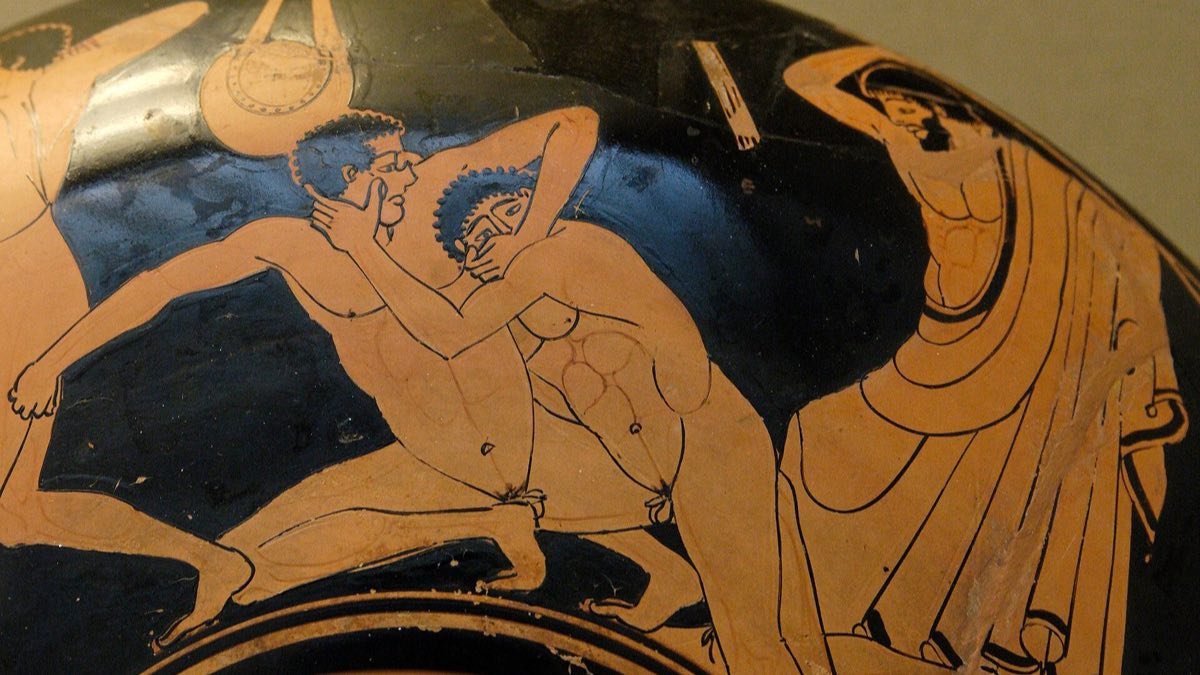
Much of what we know comes from painted pottery, where artists recorded holds, throws and the occasional foul in progress, often with the official stepping in. These images are the closest thing we have to footage, and they show positions that any modern grappler would name instantly.
They also show the limits of the evidence. A painter chose a dramatic instant, not a representative one, so the record is weighted toward the spectacular. We can describe the shape of the sport with confidence and its everyday texture only with caution.
The men who competed
Victors were celebrated far beyond the festival. Cities commissioned statues, poets were paid to write odes, and a champion could expect meals at public expense for the rest of his life. The rewards were substantial enough that successful athletes travelled a professional circuit from festival to festival.
That professionalism shaped the field. Competitors were not farmers taking a week off but specialists with trainers, diets and schedules, which is one reason the technical level described by ancient writers sounds so high.
Boys competed too
There was a separate event for boys, introduced later than the men's competition, with its own champions and its own prizes. The existence of a youth division tells us the sport had a training pathway rather than simply attracting whoever happened to be strongest.
It also tells us something about how the Greeks saw the event. A contest considered suitable for a junior division is a contest understood as a sport with rules and teaching, not an unregulated brawl, however short the list of prohibitions was.
An ancestor, not a parent
It is tempting to draw a straight line from the sand pit to the modern cage, and the temptation should be resisted. Pankration disappeared with the ancient festivals, and the mixed-rules contests of the twentieth century grew out of entirely different roots: Japanese grappling, European wrestling circuits, boxing and Brazilian challenge matches.
What the two share is not lineage but logic. Give two trained people permission to both strike and grapple, and the same problems appear: how to close distance safely, what to do once the contest hits the floor, and how to end it without a referee having to decide. The Greeks reached those problems first, and left us pictures of their answers.