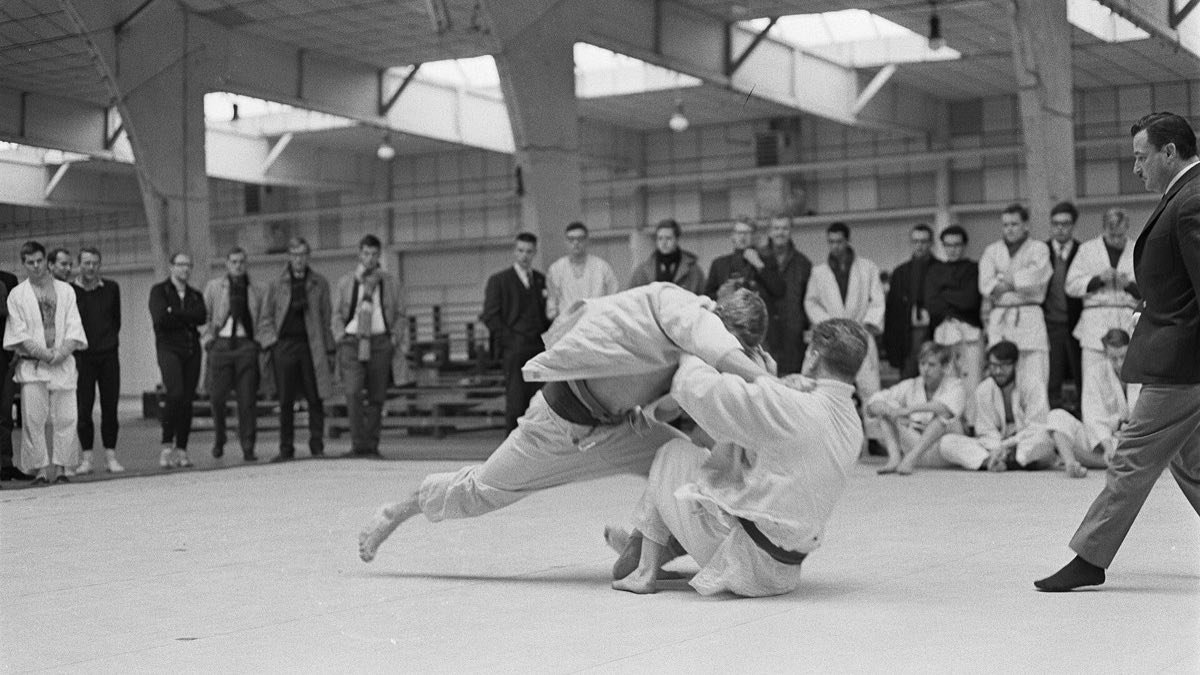

A judo throw is one of the most efficient things in sport: a few centimetres of broken balance, a hip turned under a falling body, and a much larger opponent lands flat without anybody having been hit. Transferring that to mixed rules is harder than it looks, and the reason is embarrassingly simple.
Judo is built on the jacket. Almost every entry begins with a grip on a lapel, a sleeve or a collar, and the whole art of kumi-kata - grip fighting - exists to win that handle before anything else happens. Take the jacket away and a judoka loses not a technique but the first move of every technique he knows.
What replaces the grip
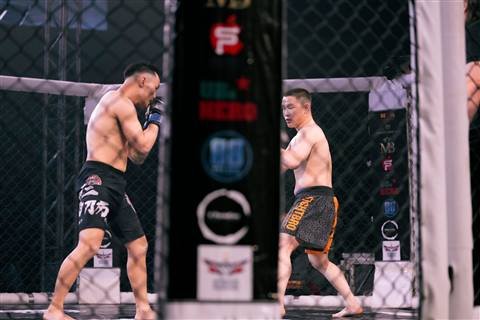
In the cage the handles become the body itself: underhooks beneath the arm, overhooks above it, a collar tie on the neck, wrist control, a hand clamped on the hip. These are less reliable than cloth, they slip when both fighters are wet, and they have to be regained constantly rather than held.
The adjustment is a long one. A judoka who steps across without rebuilding his entries finds he is reaching for something that is not there, and reaching is punished with a punch. The ones who adapt well tend to be the ones who accept that the clinch has to be won again every few seconds.
The throws that survive
Hip and body throws built on close contact travel best, because they do not depend on a long pull. Sweeps that attack the foot as weight shifts onto it survive too, since they need timing rather than cloth. So do the rear-leg reaps that work from a collar tie, which is a grip you can have without a jacket.
What tends not to survive is anything requiring a strong two-handed pull across the body. Those techniques are spectacular on the mat and nearly impossible in shorts, which is why the mixed-rules version of judo looks narrower and more conservative than the sport it comes from.
Falling is a skill
The most underrated thing a judoka brings is not a throw but a breakfall. Years of being thrown teach a body how to land, how to turn into the floor, and how to get up immediately rather than lying still working out what happened. In a sport where being put on your back is routine, that is worth a great deal.
There is a related advantage in composure. Someone who has been thrown thousands of times does not panic at the sensation of losing his feet, and panic is what turns a bad position into a finished fight.
Judo does not transfer as a set of throws. It transfers as a relationship with balance.What actually crosses over
The ground half nobody mentions
Judo contains a full groundwork curriculum - pins, strangles and armlocks - that is often overlooked because competition rules limit how long fighters may work there. Judo strangles in particular adapt well, since many of them use the arms rather than the lapel and work identically without a jacket.
The limitation is that judo groundwork is trained in short bursts under a clock. Fighters who come from the sport usually have excellent entries into pins and a thinner game once the exchange slows down, which is exactly the opposite of a jiu-jitsu player's profile.
In judo a throw that lands an opponent largely on his back with control and force can end the contest immediately. In mixed martial arts the same throw ends nothing: it simply moves the fight to the floor, where the work begins again.
Strikes change the posture
Judo is practised upright, with a straight back and the head high, because that posture is efficient for throwing. It is also the posture most likely to be hit. Fighters who make the transition have to learn to throw from a lower, more defensive stance, which costs them some of the leverage the technique assumes.
The threat of strikes also changes timing. A deep entry that takes half a second too long is an invitation for a knee, so the judoka learns to attack off the opponent's movement rather than setting the throw up slowly and correctly.
The clinch is judo's home ground
Much of the modern cage game happens with both fighters holding each other against the fence, and that is precisely the distance judo is built for. A judoka arriving in that position is not improvising: he already has a vocabulary for breaking posture, loading weight and attacking the legs from close range.
What he has to add is the understanding that the fence is both an obstacle and a tool. A throw that needs space to complete may simply not fit, while a trip that uses the wall for leverage has no equivalent on a mat.
A different idea of the clock
Judo contests are short and can end in an instant, which breeds a particular urgency: attack now, because the opportunity will not be repeated. Mixed martial arts rewards a longer view, where a position can be built patiently over minutes.
Fighters who cross over often carry the urgency with them, and it can work either way. It makes them dangerous in the first exchange and occasionally wasteful afterwards, spending energy on attacks that a more patient grappler would have waited to set up.
Why coaches still want it
Despite the losses in translation, a judo background keeps showing up in good fighters. It supplies off-balancing in the clinch, confidence in the scramble, a sense of when an opponent's weight has committed, and throws that come from close range where most takedown defence is aimed lower.
Above all it supplies a different question. A wrestler asks how to get under the hips. A judoka asks how to make the other man step. Fighters who can ask both questions in the same exchange are unusually hard to keep upright.