
A submission looks like something being forced. It is almost always the opposite: a position arranged so carefully that very little force is needed, and the losing fighter's own structure does most of the work against him. Once you see the mechanics, the mystery disappears and the skill becomes visible.
Every submission belongs to one of two families. Strangles interrupt something the body needs continuously. Joint locks take a hinge past the direction it was built to travel. Both rely on the same underlying idea: use a long lever against a short one, and make sure the opponent cannot simply move away from the problem.
Why position comes first
The oldest piece of advice in grappling is position before submission, and it is advice about physics rather than patience. A lock applied from an unstable position can be escaped by moving the whole body, which is easy. The same lock applied from a controlled position leaves the opponent only the small movements of the limb itself, which is hard.
This is why experienced grapplers often appear to be doing nothing for long stretches. They are removing exits. By the time the finishing movement begins, the outcome has usually already been decided by the thirty seconds of adjustment that nobody noticed.
What a strangle actually does
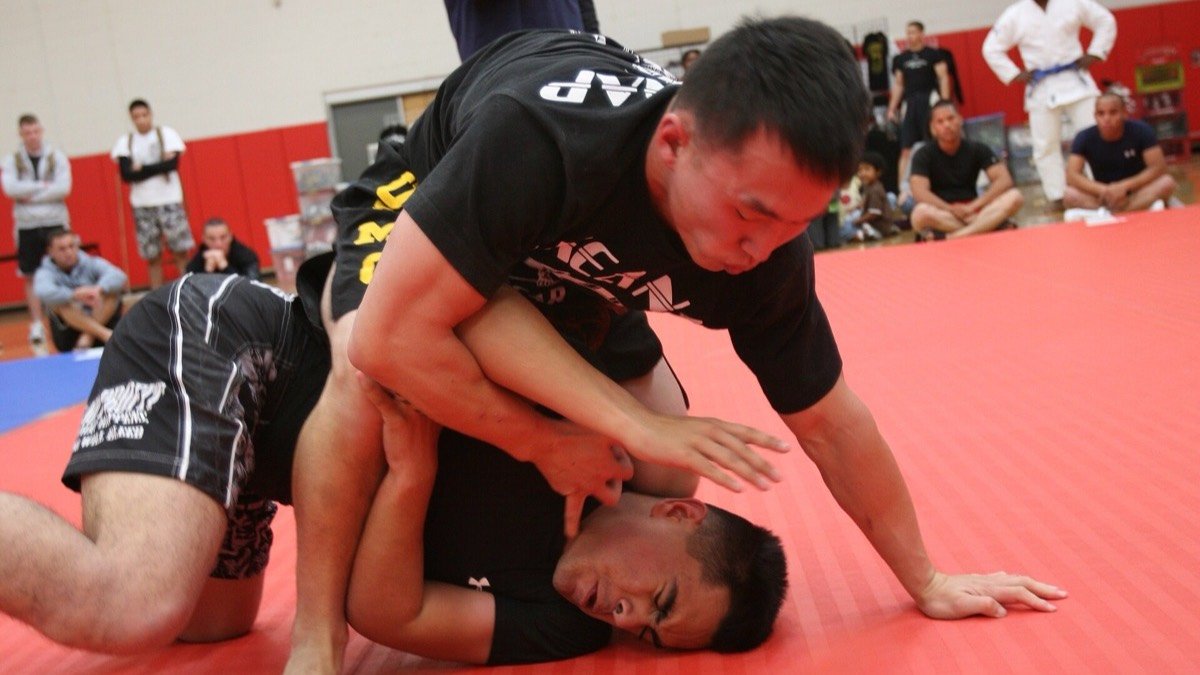
The effective strangles compress the sides of the neck rather than the windpipe, restricting blood flow to the brain. That is why a well-applied one works quickly and quietly, and why a badly applied one that crushes the front of the throat is both more painful and less effective.
The practical consequence is counter-intuitive. Fighters defending a choke are often fighting the wrong thing: they resist the arm that is uncomfortable rather than the one that is closing the circle, and they lose because the discomfort and the danger are in different places.
Joint locks and the short lever
An armlock works because the forearm is a long lever and the elbow joint, once straightened, has very little range left. Hips acting against a straightened arm produce far more force than that joint can resist, which is why the technique does not care much about the relative size of the two people.
The same logic covers the knee, the shoulder and the ankle, with one important difference: the smaller and more mobile the joint, the faster the margin disappears. Leg locks in particular leave less warning time than an armlock does, which is why training them demands unusual discipline from both partners.
A submission is not something you do to somebody. It is a position in which the other person has run out of better options.How finishes actually arrive
The tap is what makes the sport possible
Grappling can be trained at full intensity because it has a reliable off switch. A fighter who is caught signals, the partner releases, and both of them start again. That single convention is the reason a jiu-jitsu player can spend thousands of hours in genuinely competitive practice without the accumulated wear that full-contact striking produces.
It also teaches something that transfers to competition. Losing a position in training is routine, immediate and consequence-free, so students learn to recognise danger early rather than denying it, which is exactly the habit that keeps a fighter safe when it matters.
In mixed martial arts the clock changes the mathematics. A submission that would be inevitable with unlimited time may simply not arrive before the round ends, so fighters often choose a weaker finish that is available now over a stronger one that is thirty seconds away.
Defence is mostly early
Good submission defence does not look like escaping. It looks like never arriving. Keeping the elbows close to the body, protecting the neck with the chin and shoulders, refusing to give away a wrist, declining to turn away from a dominant opponent - these are the habits that prevent most finishes before any technique is named.
Once a submission is properly applied, options narrow very quickly. This is why coaches spend more time on posture and framing than on spectacular escapes: the escapes that work are the ones made two steps earlier.
Why strikes change the picture
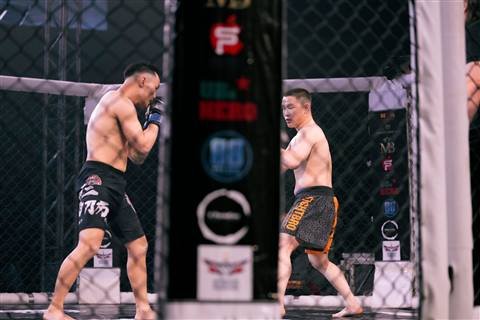
Pure grappling and mixed rules produce different submission games. The presence of punches makes some excellent positions unwise, because a hand that is busy controlling a sleeve is a hand that is not protecting a face. Certain guards that are dominant without strikes become liabilities with them.
Strikes also create openings that would not exist otherwise. A fighter covering up to defend his head stops defending his arms, and a fighter posting a hand on the mat to keep his balance is offering a limb. Many finishes in mixed martial arts are set up by the threat of damage rather than by grappling alone.
Why some finishes are more common
A handful of techniques account for most submissions at every level. Attacks on the neck from behind are the most reliable, because the position that creates them is also the safest one for the attacker and the hardest to escape. Armlocks and front chokes follow for similar reasons.
The pattern is not about which technique is most powerful. It is about which positions can be reached against a resisting opponent and held long enough to finish, and the answer has been remarkably stable across decades of competition.
The part that is genuinely learnable
Of everything in combat sport, submission grappling may be the most teachable, because so much of it is geometry rather than athleticism. Angles, levers, base and the sequence of small steps can be explained, drilled, corrected and repeated, and progress is visible within months rather than years.
That accessibility is why the art spread so fast once it was demonstrated in public. It was not promising anybody that they would become stronger. It was promising that strength would matter less than they had assumed, and it could show the proof on a mat the same evening.