
For a short period in the early 1990s, mixed-rules tournaments advertised the absence of weight classes as a feature. It was, after all, the question the events claimed to be answering. Within a few years that selling point had been quietly removed, and the reason had less to do with fairness than with legality.
Combat sports invented weight divisions long before anyone thought of combining them. Boxing and wrestling both learned the same lesson: without divisions, the sport becomes a demonstration of size, and the audience stops caring about anything else. Mixed martial arts had to relearn it in public.
The argument for having none
The original tournaments were framed as a test of style against style, and matching fighters by weight would have undermined the premise. Part of the appeal was watching a smaller specialist against a much larger generalist, and in the first events that was frequently what happened.
It worked exactly once as a novelty. After the question had been answered and every serious fighter had started cross-training, size went back to doing what size does in any physical contest, and the spectacle became less interesting rather than more.
Regulation drew the lines
The decisive pressure came from athletic commissions. For the sport to be sanctioned, it had to look like a regulated contest rather than an exhibition, and commissions had a template: weight classes, medical checks, rounds, gloves, a referee with authority to stop a bout. Divisions were part of the price of being legal.
What emerged was the set of classes written into the Unified Rules, with limits expressed in pounds and spaced in a way that borrows heavily from boxing's long experience. Commissions later added intermediate divisions, which are recognised in the rules but not used by every promotion.
Why the gaps are uneven
The divisions are not evenly spaced. At the lighter end a few pounds represent a meaningful share of a fighter's body, so the classes sit close together. At the top the heavyweight division spans an enormous range, because there are simply not enough very large fighters to subdivide it usefully.
That asymmetry has consequences. A heavyweight contest can feature a genuine size mismatch that would be impossible three divisions lower, and the tactical character of the division changes as a result: fewer long fights, and more contests decided early.
A weight class is not a statement about fairness. It is a promise to the audience that the contest will be about skill.Why divisions exist at all
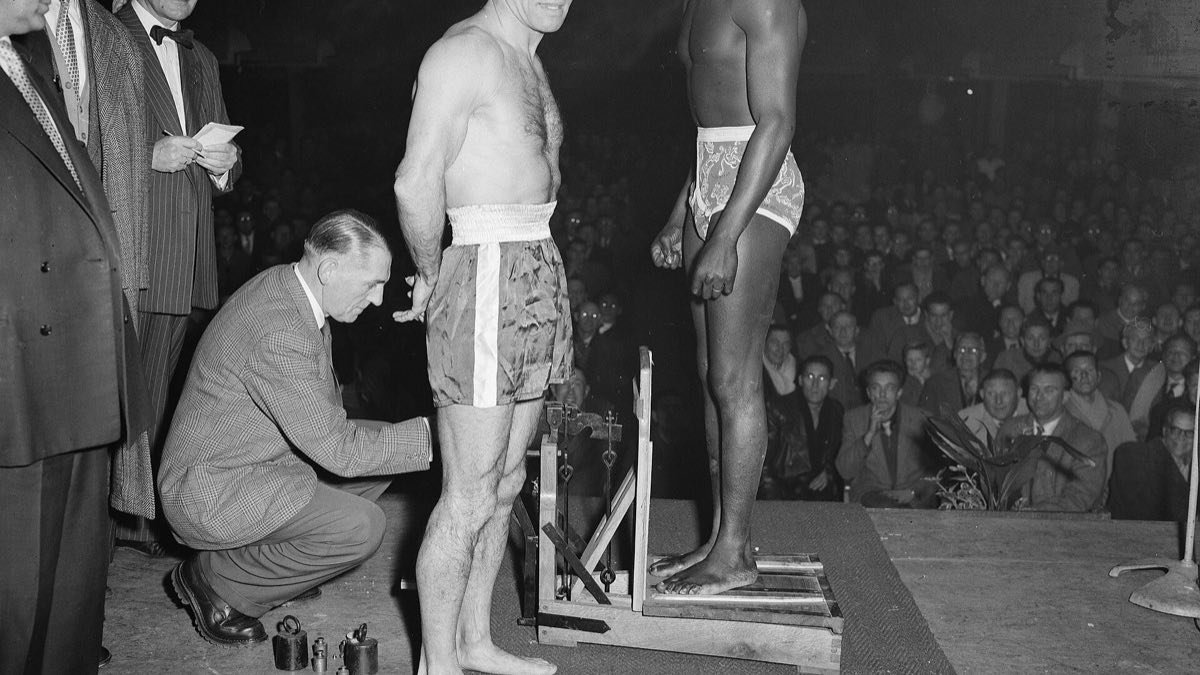
The weigh-in became its own contest
Once divisions existed, fighters began competing at the lowest weight they could reach, and an entire practice grew up around reaching it temporarily. Water manipulation, sweating and restricted intake allow a fighter to present a number on the scale that he does not carry into the cage.
By fight night much of that weight has been recovered, which is the point. The division therefore does not describe how big the fighters are; it describes how small they were able to be, briefly, on the previous day.
Many commissions moved the weigh-in to the morning before the event rather than the afternoon, specifically to give fighters more hours to rehydrate before competing.
The pressure on the scale
The practice has obvious costs. A fighter who misses the limit may forfeit part of his purse, and a bout may be cancelled outright or converted into a catchweight contest agreed between the two camps. Promotions, commissions and coaches have all tried to discourage extreme cutting with varying success.
Proposals circulate regularly: weight checks during fight week, hydration testing, more divisions to shorten the distance a fighter has to travel. Each has been adopted somewhere and none has been adopted everywhere, which is the usual pattern in a sport regulated jurisdiction by jurisdiction.
Catchweight and the practical exception
Sometimes two fighters simply agree on a number that belongs to no division. A catchweight bout is a negotiated contest, often arranged late when a replacement is needed or when a fighter has struggled to reach the limit, and it cannot be for a title.
These bouts are a reminder that the divisions are administrative rather than natural. The lines were drawn by committees, they vary between organisations outside the unified framework, and they can be stepped over by mutual agreement.
What the divisions do to styles
Each class tends to develop its own character. Lighter divisions favour pace, volume and scrambles, because smaller fighters recover faster and a single clean strike is less likely to end the contest. The heaviest divisions reward the opposite: economy, patience and the knowledge that one exchange may be all there is.
Coaches build game plans around those tendencies. The same strategy that wins rounds at one weight can be reckless two divisions up, and fighters who move between classes often have to change more than their diet.
Moving up and moving down
A change of division is one of the most common turning points in a career. Moving down promises a size advantage and demands a harder cut. Moving up removes the cut and hands the advantage to somebody else, but often leaves a fighter faster and fresher than the people around him.
There is no general rule about which works. What is consistent is that the decision is usually made late, after a fighter has spent years discovering what his body will and will not do, and that it is at least as much a health decision as a competitive one.
What the divisions gave the sport
Weight classes made champions comparable, careers legible and rankings possible. Without them there is no meaningful question of who the best fighter is, only who the biggest one was on a given night.
They also quietly settled the original argument. Once everybody trains everything and everybody is the same size, the thing being measured is finally what the first tournaments claimed to be measuring, and that is skill.