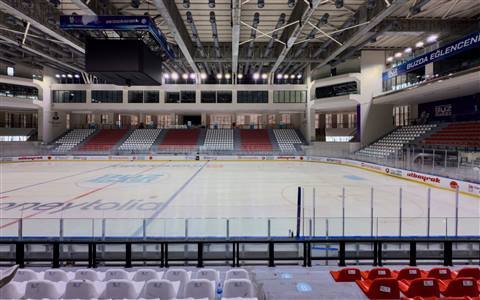

A hockey rink looks like a frozen pond with lines painted on it. It is closer to a refrigeration plant with a thin sheet of water on top, built in layers over several days by people who treat the ice as a manufactured product with a specification, because that is exactly what it is.
The foundation is a concrete slab containing many kilometres of pipe, laid in loops a few centimetres apart. Through those pipes runs a chilled fluid, usually a brine or glycol solution, cooled by a refrigeration plant elsewhere in the building. The slab does not freeze the air above it; it draws heat downwards out of the water placed on top.
Underneath the slab sits insulation and, in most buildings, a second set of pipes carrying warm fluid. These are not a mistake. Without them the ground beneath a permanent rink would freeze and expand over time, lifting and cracking the slab from below, so the floor is gently heated to keep the earth under it above freezing.
Building the sheet
The ice is not poured. It is built up in very thin layers, each sprayed on and allowed to freeze before the next, because a thick layer of water freezes unevenly and traps air. The first layers are the most delicate, since they have to bond to cold concrete without cracking.
Once a few millimetres have formed, the surface is painted white. This is partly so spectators can see a black puck and partly so the lines and logos show. The white layer is sealed with more thin coats of water, and then the markings are added by hand onto the frozen surface.
The lines
Lines and circles are laid onto the painted layer, traditionally using string soaked in paint to snap a straight edge, and advertising or team logos are applied as thin fabric or paper transfers. Everything is then flooded over with further layers of water until the markings sit well below the playing surface.
This matters for durability. If the lines were on top they would be scraped away within a period. Buried under several millimetres of clear ice they survive an entire season, and are only lost when the sheet is taken out at the end of it.
Good ice is not frozen water. It is about fifty separate layers of frozen water, each thin enough to freeze clear.
Temperature, and what players notice
The finished sheet is kept at a temperature a few degrees below freezing, and small changes have effects that players detect immediately. Colder ice is harder and faster, with the puck sliding further and bouncing more; warmer ice is softer, slower, and chips up into snow quickly, which slows the puck and makes passing unreliable.
Building conditions matter as much as the plant. A full arena produces a great deal of heat and moisture from the crowd, and humidity is the enemy: damp air condenses onto cold ice and ruins the surface. Large rinks run substantial dehumidification equipment, and the ice crew watches the readings throughout a game.
The resurfacer
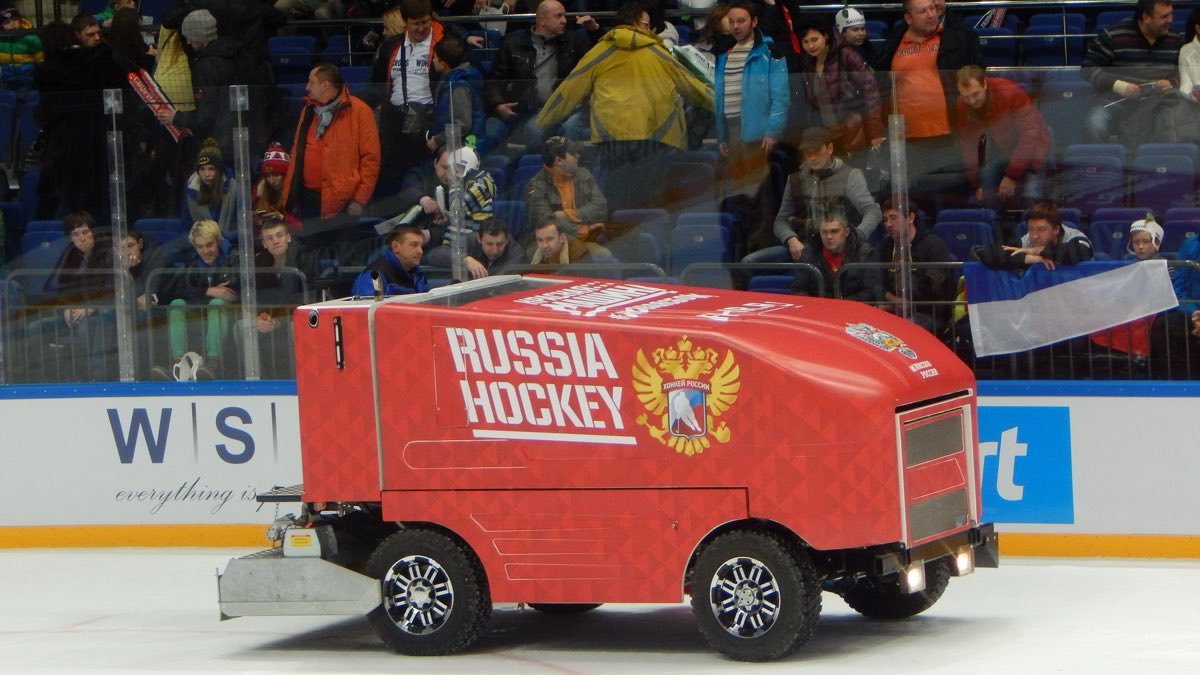
Between periods the surface is cut by a machine that does three things in one pass. A blade shaves a very thin layer off the top, taking away the ruts and the loose snow; a horizontal auger collects that snow into a tank; and a towel at the rear lays down a film of fresh water that freezes into a new surface.
The water laid down is warm rather than cold. Warm water holds less dissolved air, so it freezes clearer and harder and bonds better to the layer beneath. It is the single most counter-intuitive detail of ice-making and the one that surprises people most.
The machine is named after Frank Zamboni, who built the first practical version in 1949 for his own rink in Paramount, California, after deciding that resurfacing by hand with a tractor and several workers took far too long. The name has become a generic term even though it is a company.
Taking care of it mid-season
Ice is repaired constantly. Deep gouges near the goal creases are patched by hand with slush and cold water, the areas that take the most wear are given extra attention between sessions, and the whole sheet is measured for thickness periodically, because repeated resurfacing adds material in some places and removes it in others.
In arenas that also host basketball and concerts, the ice stays in place beneath an insulated floor. The slab remains cold, and the sheet is uncovered and resurfaced afterwards. It is a routine operation, though the ice is rarely as good immediately after a week of other events.
The plant and the people
The refrigeration itself happens in a plant room, where a compressor cycles a refrigerant to pull heat out of the brine that circulates under the floor. Many large rinks use ammonia, which is efficient and inexpensive but requires careful handling, monitoring equipment and trained staff, since a leak is a serious matter.
The people who run all this are ice technicians, and in professional arenas they are specialists with long careers. They monitor temperature and humidity through a game, decide how much water each resurfacing pass should lay down, and adjust the plant in anticipation of a full building rather than in reaction to one.
Why the detail is worth knowing
Players and coaches complain about ice quality often, and from the outside it sounds like an excuse. It is not. A soft, chipped surface changes how a pass behaves and how a puck can be received, and in a sport decided by small margins the difference is real.
Outdoor games have made this visible to everybody. When a professional match is played in a stadium, the ice crew works through sun, rain and wind to keep a surface playable, and the resulting games are usually slower and bouncier than the indoor version. It is a useful reminder that the fast, clean ice people take for granted is a piece of engineering, maintained continuously by people the audience never sees.