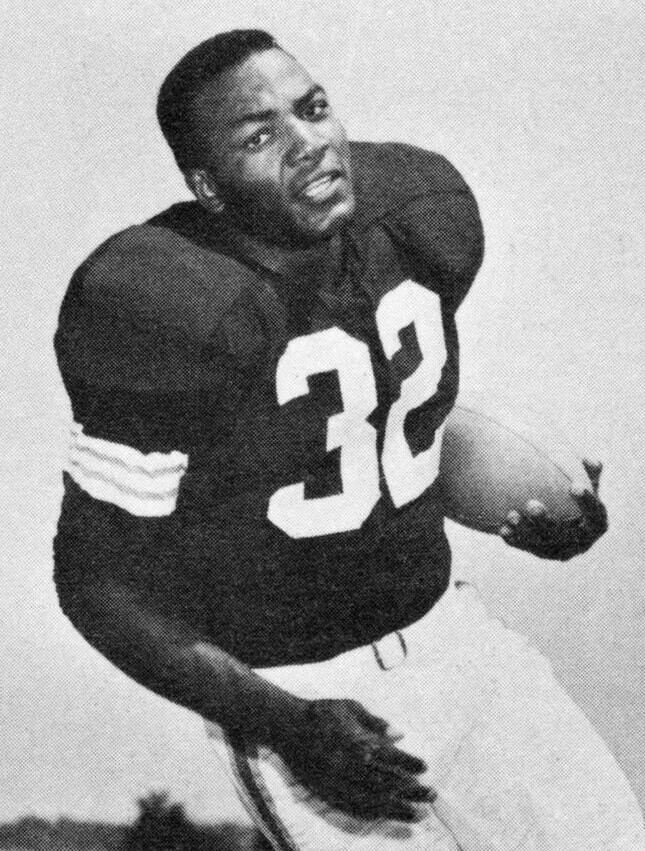
For nine seasons he carried the ball like no one before him — bigger, faster and more punishing than the men sent to stop him. Then, at the height of his powers, Jim Brown simply walked away, leaving behind a legend that has only grown.
James Nathaniel Brown was born on 17 February 1936 on St. Simons Island, Georgia, and grew up in Manhasset, New York. A gifted all-round athlete, he starred in football, basketball, track and especially lacrosse. By the time he reached Syracuse University, it was clear that the games could barely contain him — and football was about to meet a force it had never seen.
A college star in more than one sport
At Syracuse, Brown was a sensation. On the gridiron he became an All-American running back, and on the lacrosse field he was so dominant that he is still remembered as one of the greatest players the sport has ever produced. Few athletes in any era have excelled at two demanding sports at that level; Brown did it almost as an afterthought, with a blend of size, speed and balance that defied the categories of his day.
Nine seasons of dominance in Cleveland
Drafted by the Cleveland Browns, Brown played his entire professional career there from 1957 to 1965. Across those nine seasons he led the NFL in rushing in eight of them — a stretch of sustained dominance that has rarely been approached. He was named the league's Most Valuable Player multiple times and helped lead Cleveland to the 1964 NFL championship, the franchise's last title for decades.
What set Brown apart was not only the numbers but the way he produced them. He combined the power of a much larger man with the acceleration of a sprinter, dragging tacklers forward and breaking long runs when defenses thought they had him cornered. Opponents recalled him rising slowly after every carry, never showing pain, then delivering the next blow himself.
He was, by the standards of his era, almost impossible to game-plan against. Defenses stacked the line to stop the run, and Brown still found the edge. They tried to wear him down over four quarters, and he grew stronger as the game went on. Coaches and teammates described a player who treated every snap as a contest of will, and who almost always won it. In an age before modern training and nutrition, his physical advantages over the men around him looked like something from a different decade.
"Make sure when anyone tackles you, he remembers how much it hurts."— Jim Brown
Walking away at the top
Most great athletes are forced from the game by age or injury. Brown left on his own terms. In 1966, at just 29 and still widely regarded as the best player in the sport, he retired to pursue a career in acting and a deepening commitment to civil-rights activism. He went on to appear in numerous films and became a prominent, sometimes controversial, voice for Black athletes and communities.
The decision stunned the football world. Players of his stature did not simply stop, least of all while still leading the league. But Brown had always seen himself as more than a running back, and he refused to let the game define the limits of his life. That choice, as much as anything he did on the field, became part of his myth — the rare champion who decided for himself when his story on the gridiron was complete.
In 1967, Brown helped organize a gathering of leading Black athletes — including Bill Russell and a young Kareem Abdul-Jabbar — to support Muhammad Ali during his refusal of the military draft. The meeting became one of the defining images of sport and activism intersecting in that era.
A legacy beyond the numbers
Because he retired so early, Brown's career totals are modest next to players who carried on for fifteen seasons or more. Yet his per-game and per-season production remains a benchmark, and he is routinely named among the greatest and most dominant players in football history. He left the field having never missed a game to injury, a testament to both his durability and the punishment he absorbed without flinching.
Jim Brown died on 18 May 2023 at the age of 87. Tributes came from across sport and society, honouring not only the runner who could not be stopped but the man who used his fame to push for change. Rules evolve and records eventually fall, but the image of Brown shrugging off tacklers and walking away on his own terms remains one of football's enduring legends.