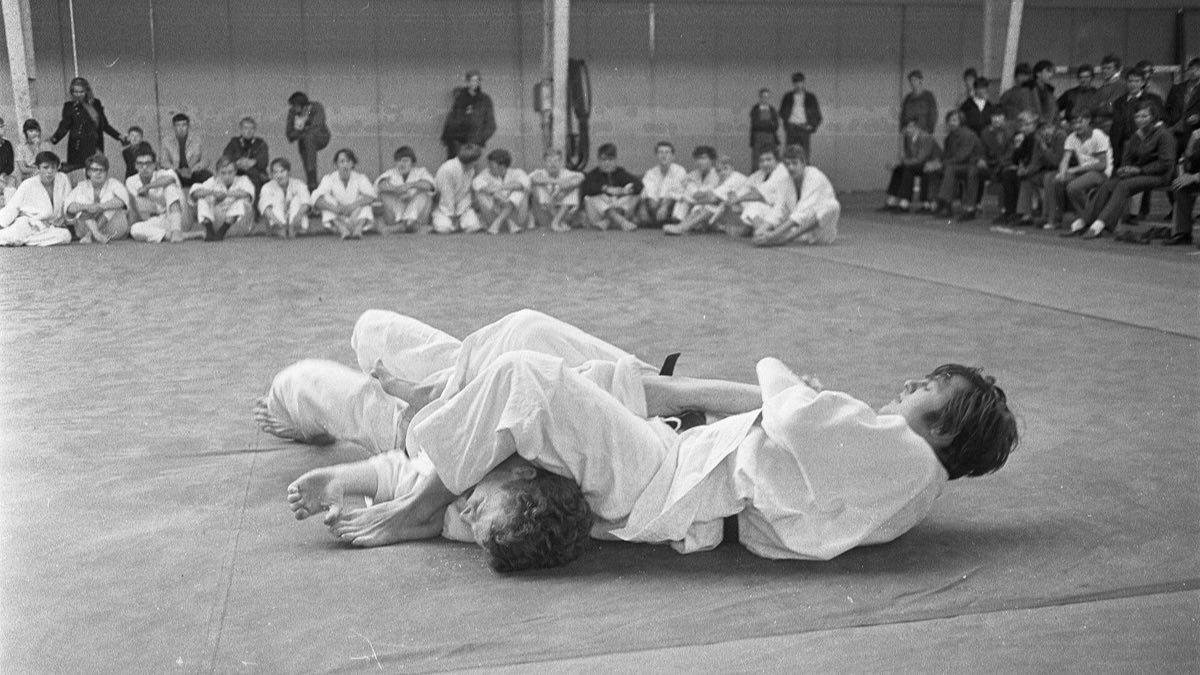

The art that dominated the first mixed-rules tournaments did not appear in Brazil out of nowhere. It arrived by ship, in the luggage of Japanese travellers, and then spent decades being taken apart and reassembled by people who were not interested in preserving it exactly as they had found it.
Jujutsu was not a single system. It was a loose family of Japanese schools, each with its own curriculum of throws, joint locks, strangles and strikes, developed in a society where an unarmed man might still need to deal with an armed one. By the late nineteenth century many of these schools were in decline, and their methods were scattered across small regional dojos.
Kano's reorganisation
In 1882 an educator named Jigoro Kano opened a school in Tokyo that he called the Kodokan, and the system he taught there he called judo. His contribution was less invention than editing: he kept techniques that could be practised at full effort against a resisting partner, set aside those that could not, and built a progression that a beginner could actually follow.
That decision had an enormous consequence. Because judo could be practised hard and safely, its students got very good very quickly, and when they met practitioners of older schools in contests, they tended to win. Judo spread, and with it spread the idea that live practice beats rehearsed practice.
The travelling demonstrators
Kano sent students abroad, and some of them never came back. They gave demonstrations, taught police forces, and accepted challenge matches against boxers, wrestlers and strongmen on theatre circuits across Europe and the Americas. These were part sport, part exhibition and part advertisement, and they were how most of the world first saw Japanese grappling.
One of those travellers settled in the north of Brazil in the 1910s. He taught locally, and among his students were members of a family named Gracie. What was passed on was essentially judo as it was practised at the time, which still contained a great deal more groundwork than the Olympic sport does today.
Why the ground took over
In Brazil the emphasis shifted. Throwing a bigger man cleanly is hard and requires timing, strength and a cooperative floor. Fighting him from the ground requires mainly patience and structure. For practitioners who were often the smaller party, the floor was simply the better place to work, and the curriculum drifted toward it.
Out of that drift came the art's signature idea: the guard. Being underneath, in most wrestling traditions, is a position you escape from. Here it became a position you attack from, using the legs as a second pair of arms to control distance, break posture and set up chokes and locks. That single reframing is what separates the Brazilian branch from its parent.
Every grappling tradition has an answer for being on top. This one built its whole identity on having an answer for being underneath.What changed in Brazil
Proving it in public
The family's teaching method came with a habit of open challenges. Rival gyms, boxers, capoeira players and wrestlers were invited to test the claim directly, sometimes in a gym and sometimes under the loose no-holds-barred rules that Brazilians called vale tudo. Win or lose, these encounters were the school's advertising, and they shaped what was taught next.
The feedback loop mattered more than any individual result. Techniques that failed under pressure were quietly dropped. Techniques that worked against a hostile stranger were drilled harder. Over decades, that produced a curriculum tuned specifically for a fight rather than for a demonstration.
The belt system now used worldwide in Brazilian jiu-jitsu descends from the one Kano introduced in Tokyo, which is why a Japanese word still names almost every technique taught in a Rio gym.
The sport grows its own rules
As the art spread, it developed competitions of its own, with points for passing the guard, for taking the back, for sweeping and mounting. Those rules made the sport legible to spectators and gave students a ladder to climb, but they also began to pull technique away from fighting and toward the scoreboard, exactly as had happened to judo.
Practitioners have argued about this ever since. Some train for the competition mat, some train without the jacket for mixed rules, and some keep teaching the self-defence sequences the family built first. The three versions share a vocabulary but increasingly reward different habits.
What the jacket is for
In a sport argued about constantly, the jacket is the oldest argument. Supporters say the grips teach control, patience and precision, and that a student who can hold a resisting opponent with cloth will hold one without it. Critics say the handles create habits that vanish the moment the uniform does.
Both are partly right, which is why most serious academies now train in both formats. The jacket slows exchanges and rewards technical detail. Training without it is faster, sweatier and closer to what happens in a fight. Students who only ever do one tend to be obvious to anyone who does the other.
The vocabulary travelled too
A visitor to a Brazilian academy hears Japanese technique names, Portuguese instruction and increasingly English shorthand learned from video. The layers are a map of the art's journey, and nobody has ever tried to tidy them up.
The same mixture appears in the positions themselves. Some are recognisably old judo, some were developed in Rio, and some were invented in the last decade by competitors in places neither tradition reached. The art has never had a central authority deciding what belongs.
A second export
From the 1990s the art travelled again, this time out of Brazil and into gyms everywhere, carried by the results of the early mixed-rules tournaments. Instructors emigrated, academies opened on every continent, and the technical conversation moved onto video, where a detail discovered in one country could be studied in another the same week.
The round trip is complete in an odd way. A Japanese system, edited in Tokyo, rebuilt in Rio and exported to the world, is now taught back in Japan alongside the judo it came from. The two arts look at each other across a century of divergence and still recognise the family resemblance.