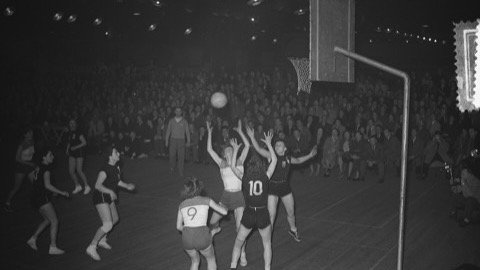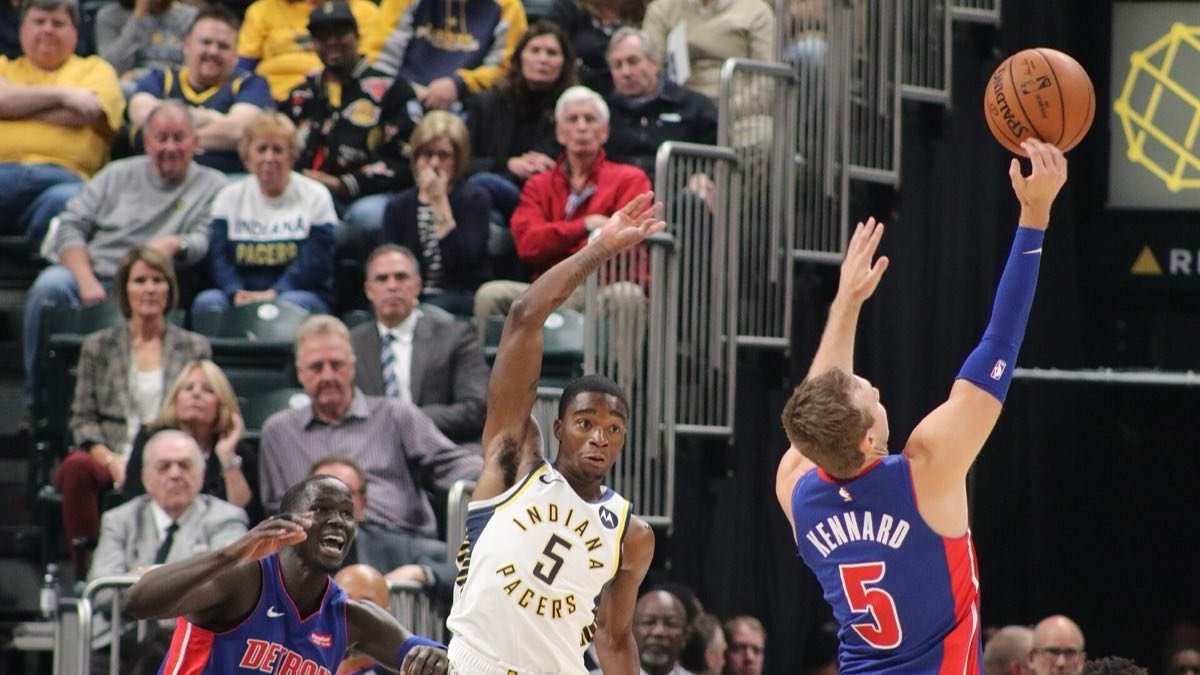

For most of basketball's history every made basket was worth the same two points, whether it was a dunk or a shot from near half court. The arc that now shapes every possession in the sport was treated, for years, as a sideshow invented to sell tickets. It took roughly half a century for it to win the argument.
The logic was always obvious: a longer shot is harder, so it ought to be worth more. The resistance was about tradition rather than mathematics. Basketball people felt that rewarding distance would pull players away from the basket, reduce passing and turn the game into a shooting contest. They were partly right, which is why the argument lasted so long.
The early experiments
Versions of a bonus for long shots were tried in American college games as far back as the 1940s, as one-off experiments that went nowhere. The first serious attempt came from a professional league founded by Abe Saperstein, the promoter behind the Harlem Globetrotters, which used a three-point line in the early 1960s. The league folded quickly, but the idea survived it.
It was the American Basketball Association, launched in 1967, that made the three-pointer part of basketball's furniture. The ABA needed to look different from the established league and leaned into anything that generated excitement: a red, white and blue ball, a dunk contest, and a line beyond which a shot was worth an extra point.
The NBA gives in
The older league resisted through the 1970s and finally adopted the line for the 1979-80 season, initially describing it as a trial. Early on it was used sparingly. Teams took a handful of three-point attempts per game, usually at the end of a quarter or when they were desperate, and specialists in the shot were treated as useful oddities rather than core players.
International basketball under FIBA added its own line in 1984, at a shorter distance, and college basketball in the United States followed shortly afterwards. Within a decade every serious competition in the world had an arc on the floor, and coaches everywhere were still telling players not to shoot from behind it.
The maths wins
The change came from arithmetic that anyone could do. A team that makes a third of its three-point attempts produces the same points per shot as a team that makes half of its two-point attempts, and open long shots turned out to be easier to generate than contested shots near the rim. Once front offices started measuring efficiency properly, the conclusion was unavoidable.
The style followed the numbers. Teams began spacing four or five players around the arc, which emptied the middle of the floor and made driving lanes wider. The mid-range jump shot, for decades the most admired skill in the sport, became the least efficient shot available and nearly disappeared from some teams' offences.
A third of your long shots is worth as much as half of your short ones. Everything else followed from that sentence.- The arithmetic that changed basketball
The shooters
Every era had marksmen, but the modern game produced a different animal: guards who pull up from several feet behind the line, off the dribble, with a defender close. Once that became a normal part of a player's repertoire, defences had to extend further from the basket than they had ever been designed to go, and the whole geometry of the sport stretched.
Youth coaching changed too, not always for the better. Children now practise shots from distances their bodies are not ready for, and plenty of coaches have warned that a generation is learning to shoot before learning to pass, dribble or finish near the rim.
The NBA briefly shortened its three-point line in the mid-1990s to boost scoring, then moved it back after three seasons when the experiment was judged to have gone too far.
The corner, and why it matters
The arc is not the same distance from the basket all the way round. In the professional game it runs closer to the hoop in the two corners, where a straight line would otherwise run off the court, and that shortened distance makes the corner three the most efficient long shot available. Teams now station a player there deliberately on almost every possession.
The consequence is visible even to a casual viewer. Watch any modern game and there will usually be someone standing almost motionless in the corner, apparently uninvolved. He is doing a job: occupying a defender who would otherwise be helping in the middle, and waiting for the pass that follows if that defender moves.
What it did to defending
Defences had to stretch, and stretching thinned them. A help defender who must stay close to a corner shooter cannot also protect the basket, so the same rule that produced long-range shooting also produced more easy baskets at the rim. The two things that modern analysis values most, shots from distance and shots from zero distance, grew together.
That is the part of the story that gets missed when the three-pointer is blamed for making basketball monotonous. The arc did not only move players away from the basket. It emptied the middle of the floor, and the players who exploit that space are doing something the sport has always valued.
Where the argument stands now
There is a real debate about whether the sport has gone too far. Some observers find a game of constant long-range shooting less varied than the one it replaced, and leagues have discussed adjustments ranging from moving the line back to changing the value of a corner shot.
What is not in dispute is the scale of the change. A rule introduced by a struggling rival league as a marketing device now decides how teams are built, how players are coached from childhood, and where almost everyone stands when the ball is in play.