
Every other piece of hockey equipment is there to protect somebody. The stick is the only one whose job is to do something, and it is the part of the sport that has been redesigned most often. The distance between what a nineteenth-century player carried and what a modern professional uses is greater than the distance between their skates, their rinks or their rules.
The first sticks were carved from a single piece of wood, and the craft was concentrated in Nova Scotia, where Mi'kmaq makers cut them from hornbeam and later yellow birch. The skill was in reading the tree: the blade and the shaft had to come from a section where the grain already curved, because a bend cut across the grain breaks under load.
These were sold across Canada and beyond for decades and were, by common agreement, the best available. The supply eventually ran into the limits of the material, as suitable hornbeam became harder to find, and manufacturing moved towards methods that did not depend on finding exactly the right tree.
Laminates and the end of the single piece
The replacement was lamination: thin layers of wood glued together under pressure, with the grain of each layer running in a chosen direction. A laminated stick is stronger than a carved one of the same weight, behaves more consistently, and can be manufactured in quantity from ordinary timber. By the middle of the twentieth century it was standard.
Manufacturers then began wrapping blades in fibreglass to stop them splintering, which extended the life of a stick considerably. Players of that era still expected to break sticks regularly, and clubs carried large numbers of them, but the economics had shifted from craft to factory.
The curve
For most of its history the blade was flat. The curve arrived properly in the 1960s, popularised by players in Chicago who discovered that a hooked blade made the puck rise and spin in ways goaltenders could not read. The early method was improvised, involving heat, water and a door frame, and the results were extreme enough that the league wrote a limit on blade curvature into the rules.
That limit still exists and is still enforced by measurement during games. A curve changes more than the shot: it makes forehand puck control easier and backhand control harder, which is one reason the backhand shot, once a standard weapon, is far less common at elite level than it used to be.
A stick is no longer a piece of wood that happens to bend. It is a spring, designed to store energy in a particular place and release it at a particular moment.
Aluminium, briefly
In the 1980s aluminium shafts appeared, fitted with replaceable wooden blades that slid into the end and were glued or heated into place. The advantage was consistency and durability: the shaft did not wear out, and a broken blade could be swapped rather than the whole stick discarded.
Aluminium had a short reign. It was stiff in a way that players found unforgiving, it transmitted vibration unpleasantly, and it was quickly overtaken by composites that could be tuned far more precisely. It survives now mainly as a stage in the story and in the memory of players who used one.
Composite, and the idea of flex
The modern stick is a hollow one-piece structure of carbon fibre and resin, light enough that the weight is no longer a meaningful constraint and engineered so that the shaft bends in a chosen place. This is the central insight of contemporary stick design: the shot does not come only from the arms, it comes from loading the shaft against the ice and letting it straighten.
Sticks are therefore sold by flex rating, a number describing how much force is needed to bend the shaft, and by kick point, which describes where along the shaft that bend concentrates. A player who takes long slap shots wants different behaviour from one who relies on a quick release in traffic, and the equipment is specified accordingly.
Modern composite sticks break far more often than the laminated wooden ones they replaced, usually without warning and sometimes on an ordinary pass. The trade is deliberate: the same thin, light construction that lets the shaft flex and snap back is what makes it fragile.
What a professional actually uses
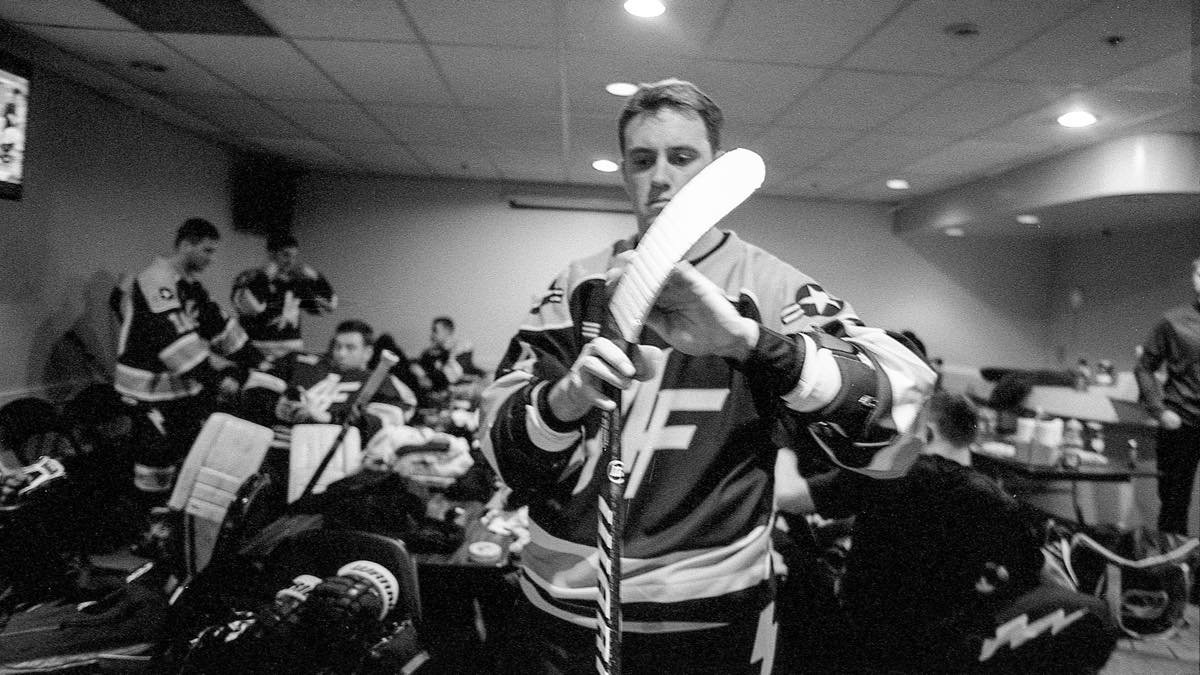
Elite players are extremely particular. Blade pattern, lie angle, shaft length, flex and grip texture are all specified individually, and many players cut a stick down from a longer blank to reach exactly the stiffness they want, because shortening a shaft makes it effectively stiffer. Sticks are prepared before games, taped in a personal pattern, and discarded at the first sign that something has changed.
The tape itself persists for reasons that have barely changed in a century. It protects the blade, it gives the puck something to grip, and it makes the blade harder for a goaltender to pick out against the ice. Every other part of the stick has been redesigned repeatedly; the cloth tape wrapped around the bottom of it has not.
Cost, and who pays it
The one genuine drawback of the composite era is price. A top-level stick costs a substantial amount and may last weeks, which is irrelevant to a professional whose equipment is supplied and significant to a family paying for a teenager who breaks two a season. It is among the reasons hockey is an expensive sport to enter, and manufacturers now produce tiered ranges specifically to address it.
The direction of travel is unlikely to reverse. Each change in the stick's construction has made the puck leave it faster, and the sport has adjusted around every one of them - larger goaltending equipment, better blocking technique and rules about blade curvature all exist because somebody found a way to make the stick do more.