
No position in team sport has changed as completely as goaltending. It began as an assignment given to whoever was willing to stand in front of the net without protection, and it has become a specialism with its own coaches, its own training methods and a technical vocabulary that the rest of the team does not use.
The earliest rules made the job deliberately harder. A goaltender was required to remain on his feet, and dropping to the ice to smother the puck brought a penalty. The thinking was that lying down would make scoring impossible, which tells you something about how little anybody understood the position at the time. The restriction was removed in the sport's early professional years.
What followed was the stand-up era, which lasted for decades. Goaltenders played upright, kicked out rebounds with their pads, and were judged largely on reflexes. They wore leather pads stuffed with horsehair that became heavier as they absorbed water, gloves barely different from a skater's, and nothing at all on their faces.
The mask
The face was protected only after a Montreal goaltender, Jacques Plante, was cut badly in a game in New York in 1959 and refused to return without the fibreglass mask he had been using in practice. The objection from his coach was not about safety but about appearance. Plante kept playing well, which settled the argument on the ice, though adoption across the league took another decade and a half.
Masks changed technique as well as safety. A goaltender who is not afraid of the puck can move towards it, and can stay down in traffic in front of the net instead of turning away. A great deal of modern positional play is only possible because the head is protected.
The butterfly
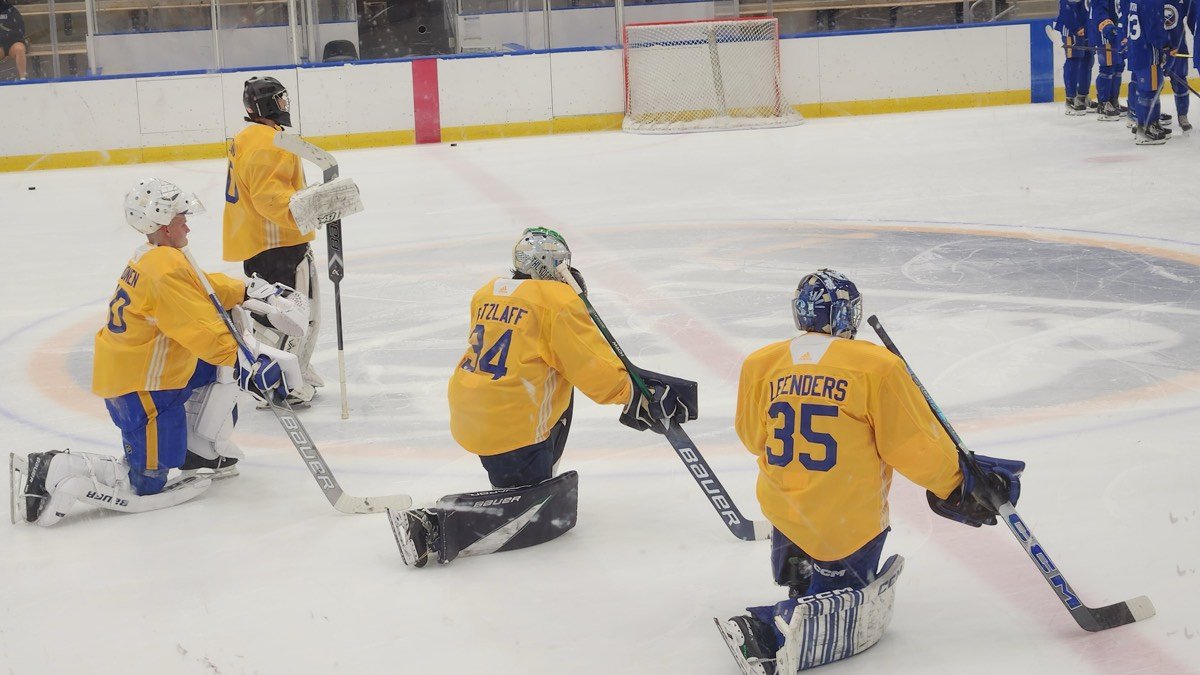
The most important technical shift was the butterfly: dropping to the knees with the pads flared outward to seal the ice across the width of the net. Glenn Hall is generally credited with developing it as a regular technique rather than a desperate measure, at a time when coaches still regarded going down as a failure of nerve.
It took hold properly in Quebec, where a generation of coaches taught it systematically, and it reached the rest of the world through Patrick Roy, whose success made it impossible to dismiss. The underlying logic is simple and powerful: most goals are scored low, and a technique that reliably covers the bottom of the net beats a technique that relies on reacting in time.
Reflexes win individual saves. Position wins seasons, and the modern position is built almost entirely on getting to the right place before the shot arrives.
Depth, and the geometry of the job
Alongside the butterfly came a much more careful understanding of depth - how far out of the crease to stand. Too deep and the shooter sees net on both sides; too far out and a pass across the slot leaves the goaltender stranded. Modern goaltenders are coached to specific positions for specific puck locations, and they get there by skating rather than by lunging.
This is why goaltending coaching now spends so much time on footwork. The skills that matter most are pushes, shuffles and the ability to rotate and reset after a save. A goaltender who is in the right place does not need to make a spectacular save, and the spectacular save is usually evidence that something earlier went wrong.
Equipment, and the argument about it
As technique became more positional, equipment grew. Pads became wider and lighter, chest protectors squarer, and the gloves larger, and at a certain point the governing bodies concluded that the goaltenders were being made artificially large rather than merely protected. Successive rounds of regulation have reduced pad height, trimmed chest and arm protection and specified how equipment must be fitted to the individual.
The league also restricted puck handling. A goaltender who could skate out and stop dump-ins for his defencemen - a habit Plante also pioneered - was so effective at killing the forecheck that a trapezoid was painted behind each net, outside which the goaltender may not play the puck. It is one of the few rules in the sport written specifically to make a position less useful.
The reverse-vertical-horizontal position, usually shortened to RVH, is a relatively recent technique in which the goaltender seals the post with one pad vertical against it. It spread through elite hockey in a few seasons and is now taught everywhere, which shows how quickly the position still changes.
Measuring the position
Judging goaltenders has always been difficult, because the raw numbers depend heavily on the team in front. Save percentage is better than goals against, but it treats every shot as equal, and a shot from the point is not a shot from the slot. Analysts now weight shots by the chance of scoring from each location, producing an estimate of how many goals a goaltender saved compared with what an average one would have conceded.
This has changed how clubs value the position. It has also confirmed what coaches long suspected: goaltending performance is more volatile from season to season than any other role, which makes paying a great deal for it a genuine risk even when the player is clearly excellent.
Where it goes next
Shooters have adapted to the butterfly by aiming high and by using passes across the crease to move the goaltender sideways before shooting, since a goaltender who is already down cannot travel laterally. Goaltenders have responded by staying on their feet longer and dropping later, which is a partial return to something older.
That cycle is the pattern of the position's whole history. A technique solves a problem, shooters find the gap it leaves, and the technique is refined. What has changed permanently is the assumption underneath it: goaltending is now understood as a coachable craft with correct answers, rather than a test of nerve given to the bravest person available.