
Some players are admired. A very small number become the property of the people who watch them. Maurice Richard scored goals for the Montreal Canadiens with a ferocity that nobody around him could explain, and in doing so he turned himself into something larger than a hockey player: a figure that an entire province used to measure its own worth.
Joseph Henri Maurice Richard grew up in a working-class corner of Montreal during the Depression, one of eight children in a family where money was counted carefully. He learned the game outdoors, on rinks flooded by hand, in the long Quebec winters that gave boys months of ice and nothing else to do with them. He was not an obvious prospect. He was strong but injury-prone, and he broke bones in each of his first seasons badly enough that one club official reportedly wondered aloud whether he was worth the trouble.
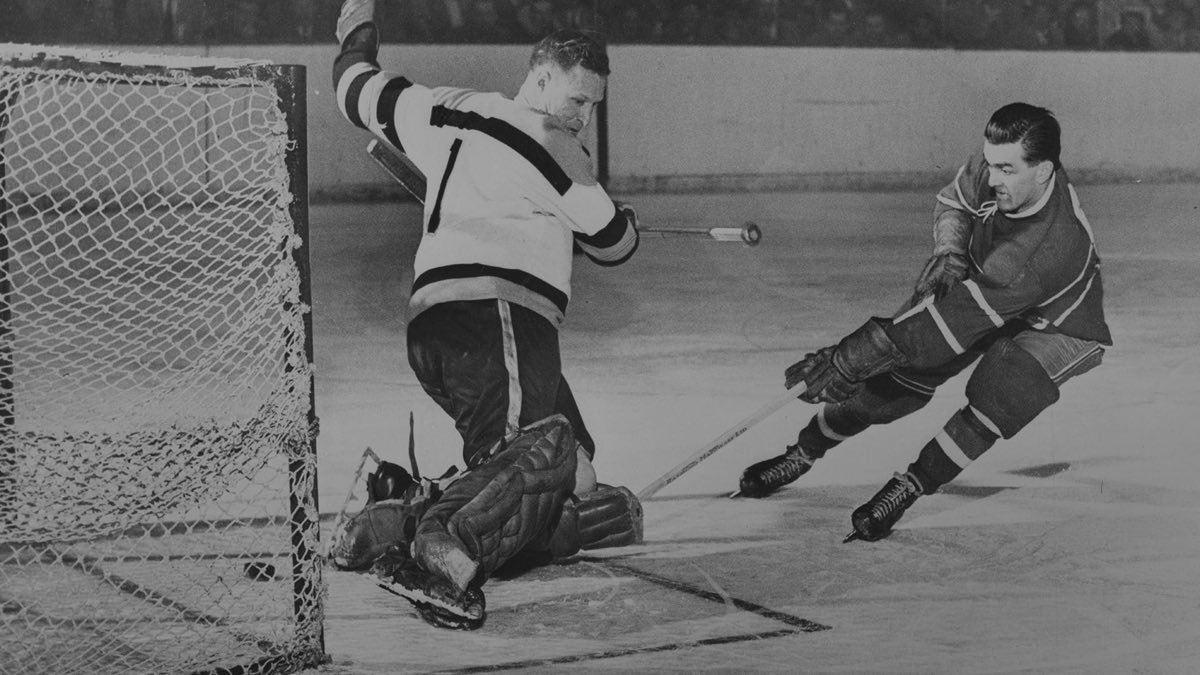
What he had instead was a quality that does not appear on a scouting report. From the blue line inward he became almost impossible to stop, dragging defenders with him, absorbing contact that should have knocked him off the puck, and finishing with either hand from angles that looked closed. Teammates and opponents alike described the same thing: the closer he got to the net, the more dangerous and the less reasonable he became.
Fifty in fifty
In the 1944-45 season Richard scored fifty goals in a fifty-game schedule. It is worth pausing on what that meant at the time. Goaltenders stood up, nets were defended by men without masks, and nobody in the history of the league had scored at that rate across a full season. The mark stood as the sport's definition of a scoring season for decades afterwards, and the phrase fifty in fifty entered the language of hockey as shorthand for the outer limit of what a forward could do.
He later became the first player to reach five hundred career goals, another threshold that had simply never been crossed. Numbers alone understate him, though, because Richard was at his most reliable when the stakes were highest. His reputation in Montreal rested on the sense, widely shared and rarely questioned, that if the team needed one goal in a game that mattered, he would find it.
The riot that bore his name
In March 1955, after an altercation during a game in Boston in which he struck an official, the president of the NHL, Clarence Campbell, suspended Richard for the remainder of the regular season and the entire playoffs. In English Canada the decision was defended as discipline. In French-speaking Montreal it was received as something else entirely: a punishment handed down by an English authority to the one man who represented them.
Campbell attended the next game at the Montreal Forum. He was pelted, a tear-gas canister went off inside the building, and the crowd spilled into the streets, where windows were broken along a long stretch of Sainte-Catherine. The disturbance has been studied by historians ever since as an early tremor of the social change that would reshape Quebec in the following decade. Richard himself went on the radio the next day and asked people to stop.
What he meant outside the rink
It is difficult now to convey how completely Richard was adopted as a symbol. He was a French-speaking man excelling in a league run in English, at a time when the senior positions in Montreal business and sport were held almost entirely by the English-speaking minority. He rarely spoke about politics and showed no appetite for the role, which only made it easier for others to assign it to him.
A celebrated short story by Roch Carrier, about a boy humiliated by being sent to the rink in the wrong sweater, is built entirely on the assumption that every child in Quebec wanted to be Richard and nobody else. That assumption required no explanation to readers. It was simply true.
He played every shift as though the result of the season depended on it, which is why a province that had learned to expect very little decided that he belonged to them.
A hard man in a hard league
Richard played in an era with six teams, which meant the same opponents over and over, and with none of the protections a modern forward takes for granted. Defencemen were permitted to hold, hook and cross-check, and the instruction given to them about Richard was straightforward. He responded in kind. He was penalised often, fought when provoked and sometimes when not, and carried feuds from one season into the next.
That temper is inseparable from the player. The same refusal to be moved that made him unstoppable near the crease made him a difficult man to referee. Those who played with him generally judged the trade worthwhile; the Canadiens won Stanley Cups with him, including a remarkable run of five consecutive championships as his career drew to a close.
Richard's younger brother Henri also played for the Canadiens and was nicknamed the Pocket Rocket, partly because he was smaller and partly because the family name already carried an expectation. Henri went on to win more Stanley Cups than any other player in the history of the league.
The end, and the trophy
He retired in 1960, at the end of that run of championships, and the sport struggled to work out what to do with him afterwards. He took a few front-office and ambassadorial roles that never quite fitted. The adulation did not fade. For the rest of his life he could not walk through Montreal without being stopped, and when he appeared at the closing of the old Forum the ovation went on so long that he had to ask the crowd, visibly uncomfortable, to let the ceremony continue.
The NHL now awards the Maurice Richard Trophy each season to the player who scores the most goals. It is the right memorial, because it measures the single thing he did better than anyone of his generation. Richard died in 2000, and the funeral in Montreal was attended on a scale normally reserved for heads of state.
Why he still matters
Modern hockey is faster, better coached and more evenly distributed than anything Richard knew. Plenty of players since have scored more goals, and the records he set have been passed. None of that has dislodged him, because what he left behind was not a statistical line but a standard of intent, repeated by broadcasters and coaches every time a forward drives the net with no regard for what is waiting there.
To watch grainy footage of him now is to see something slightly unfamiliar: a player who seems to be arguing with the game rather than playing it. That is the quality his contemporaries kept trying to describe and never managed to, and it is the reason his name is still the first one spoken whenever Montreal talks about its own history.