
For the first forty years of professional hockey, the men who stood in the net did so with nothing between their faces and a frozen rubber disc travelling at speed. They were cut, broken and concussed as a matter of routine, and the culture of the sport treated this as the price of the job. One stubborn, eccentric goaltender in Montreal decided it was not.
Jacques Plante was already the best goaltender in the world when the argument began. He had won championships with the Montreal Canadiens during the club's extraordinary run at the end of the 1950s, and he had collected the Vezina Trophy, awarded to the league's leading goaltender, repeatedly. None of that made his employer any more willing to listen to him about what he wore.
He was an unusual man by the standards of the dressing room. He suffered from asthma, kept to himself on the road, and knitted his own woollen hats, an eccentricity that teammates found funny and that sportswriters never tired of. He also thought about the position more carefully than anyone else playing it, and he had reached a conclusion that his coach regarded as close to insubordination.
The first of November
Playing in New York against the Rangers, Plante was struck in the face by a shot from Andy Bathgate. The puck opened his nose and he left the ice bleeding heavily. There was no backup goaltender dressed and waiting; teams of that era carried one, and if he could not continue the home club would supply an amateur from the stands. Plante was stitched up in the dressing room and told he was going back out.
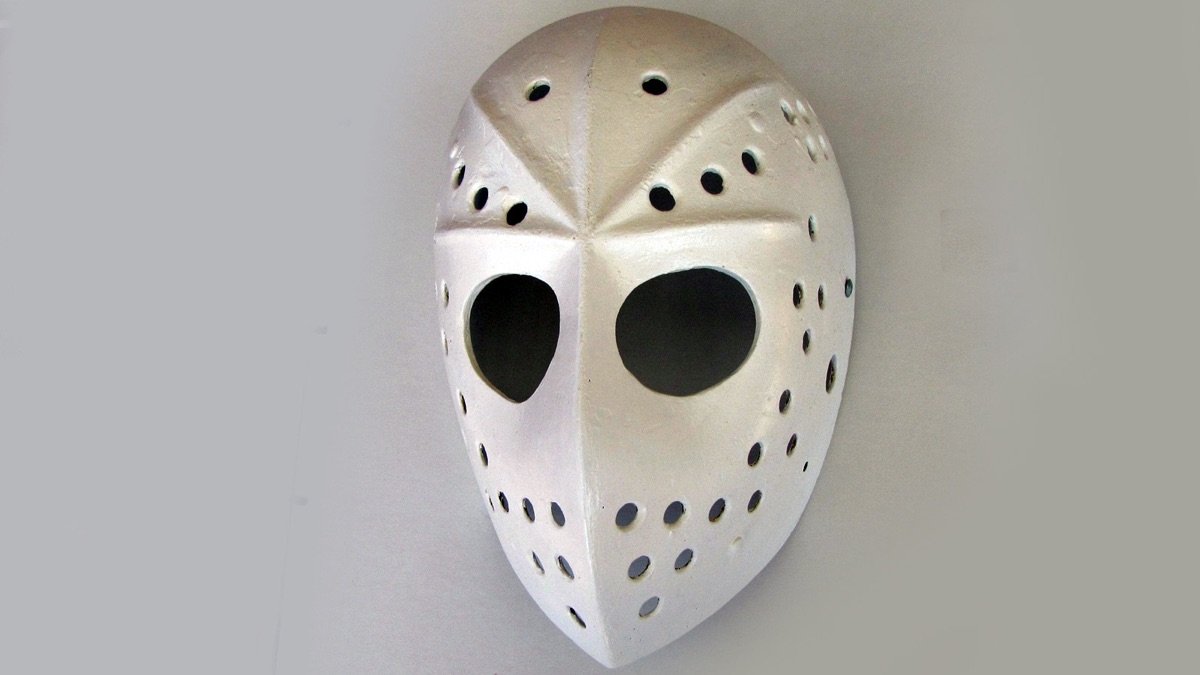
He agreed on one condition. He had been wearing a fibreglass mask he had made for himself during practices, and he would return only if he were allowed to wear it in the game. His coach, Toe Blake, objected on the grounds that it would obstruct his vision and, more pointedly, that it would look like fear. With no alternative goaltender available, Blake gave way.
Why it stuck
Montreal did not lose. The team went on an extended unbeaten run with Plante masked, which removed the practical argument that the equipment hurt his performance. Blake continued to dislike it and at one point persuaded Plante to play a game without it; the result went badly, and the mask returned permanently.
Adoption elsewhere was slow. The objection was rarely about safety and almost always about appearance, in a sport whose self-image rested on visible toughness. Goaltenders who wanted protection had to weather the suggestion that they lacked nerve, and it took the better part of a decade and a half before masks were worn by everyone. The last man to play in the NHL without one did so in the 1970s.
The puck did not care how brave anybody was, and Plante was the first goaltender willing to say so out loud.
The other thing he changed
The mask is the famous part, but Plante altered the position in a second way that has had just as much influence. Before him, a goaltender was expected to remain in or very near his crease. Plante left it. He skated out to collect loose pucks behind his own net and stopped them for his defencemen, removing the need for them to turn and chase with a forechecker arriving.
This was also unpopular at first, and also obviously correct. Within a generation it was standard, and the ability to handle the puck became part of how goaltenders were assessed. It worked so well that the league eventually restricted it, drawing a trapezoid behind the net outside which a goaltender may not play the puck, specifically to stop the practice from killing the forecheck entirely.
The masks that followed
Early masks sat flush against the face, moulded to the individual, and offered far less protection than they appeared to. They prevented lacerations more than they prevented concussions. Over time the design split: a moulded shell was combined with a wire cage in front of the eyes, which is the hybrid helmet-and-cage arrangement goaltenders wear today.
Somewhere along the way the mask also became the one piece of personal expression permitted in a uniformed sport. Goaltenders began painting them, first with simple stitching marks around the scars the mask had prevented, and later with elaborate artwork. A modern goaltender's mask is a commissioned piece, and the practice is a direct descendant of a plain cream-coloured shell worn by a man who was tired of being hit in the face.
Early painted masks sometimes featured stitch marks drawn on at the exact spots where the goaltender would otherwise have been cut. It began as a joke at the expense of the people who had insisted masks were unnecessary, and became one of the sport's most durable visual traditions.
A difficult, essential man
Plante was not easy to coach. He argued, he had firm theories about everything from travel to diet, and he moved between several clubs in the latter part of his career rather than settle quietly. He also kept playing well into an age when goaltenders were normally finished, and he spent his later years teaching the position and writing about it with a seriousness that had not previously been applied to it.
His insistence on thinking about goaltending as a craft rather than an act of endurance is arguably his largest legacy. Modern goaltending coaching, with its attention to angles, depth and recovery, begins from the assumption Plante made first: that the position can be studied and improved, rather than simply survived.
What the night of the mask really settled
It is tempting to tell the story as a single dramatic decision, and the drama is real enough. But what happened in New York was the end of an argument Plante had already been having for years in practice, not the start of one. He had built the mask, worn it, tested it and formed his view. The injury simply removed his coach's ability to refuse.
Every goaltender who has played since has done so behind equipment that exists because one man decided the convention was stupid and was prepared to be called a coward for saying so. It is among the clearest cases in sport of an individual changing a rule by refusing to obey a custom.