
For most of its history hockey was a game of wrist shots: controlled, accurate, released close to the body. Then a generation of players discovered that if you wound up and struck the puck the way a golfer strikes a ball, it travelled faster than a goaltender could react. Bobby Hull did not invent that idea, but he is the reason the rest of the sport had to take it seriously.
Hull grew up in rural Ontario and arrived in the NHL with the Chicago club as a teenager. He was built unusually for a winger of the era, with heavy shoulders and legs that generated genuine top-end speed, and the combination produced the nickname that followed him everywhere. The Golden Jet described the blond hair and the pace at which he carried the puck through the neutral zone, often with a defender hanging off him and making no difference at all.
Speed alone would have made him a star. What made him a problem was what happened when he stopped skating and started shooting. Hull would draw his stick back above his shoulder, bring it down into the ice behind the puck, and let the shaft flex and release. The sound was different from anything else in the building, and goaltenders of the period, many still without masks, described the experience in terms that had little to do with sport.
Where the shot came from
The slap shot was not new in the 1960s. Players had experimented with winding up for decades, and Bernie Geoffrion of Montreal, nicknamed Boom Boom for the noise, had been using a version of it earlier. What changed was the equipment and the willingness to use the technique as a primary weapon rather than an occasional flourish.
Sticks were still wooden, but they were being made with more flex, and players began to understand what that flex could do. The shooter was no longer simply hitting the puck; he was loading energy into the shaft by striking the ice first and letting the stick straighten through the shot. Once that was understood, the ceiling on puck speed rose sharply, and it rose fastest for the strongest men in the league.
The banana blade
The second half of the story is the curve. Hull and Stan Mikita, his Chicago teammate, are the players most associated with popularising hooked blades, which at first were produced more or less by accident and then deliberately, by heating and bending the wood. A curved blade imparts spin and lift, and it makes the puck behave unpredictably in flight.
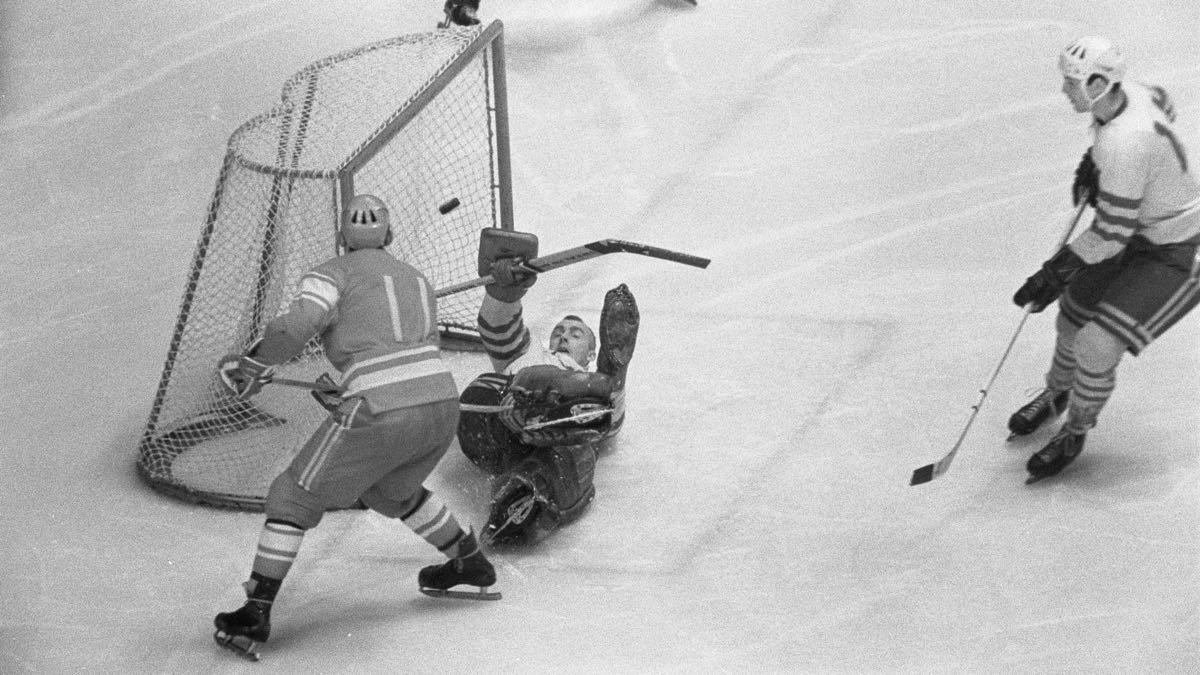
For goaltenders this was close to intolerable. A shot already arriving faster than they could track now also dipped and rose on the way in. The curves grew more extreme until the league intervened and wrote limits on blade curvature into the rulebook, a restriction that remains in force and is still occasionally the subject of an illegal-stick penalty at a critical moment.
A shot you cannot see is not a test of reflexes. It is a test of luck, and goaltenders spent a decade complaining that the sport had stopped being fair to them.
What it did to goaltending
The spread of the slap shot forced changes through every part of the position. Masks, which had been treated as an admission of cowardice, became first acceptable and then universal. Pads grew. Goaltenders began to play further out from the net to cut down angles, because reacting to the puck was no longer realistic against the hardest shooters. Positioning replaced reflex as the foundation of the job.
The style of defending changed too. Blocking shots, once a desperate measure, became an organised skill, and defencemen were coached to take away shooting lanes rather than attempt to strip the puck. A great deal of what a modern penalty kill does can be traced back to the problem of what to do about a player standing at the point with time to wind up.
Chicago, and a championship
Hull's Chicago years brought the club a Stanley Cup early in his career, and he spent the following decade as one of the most recognisable athletes in North America. He was approachable with supporters to an unusual degree, signing for as long as people were waiting, which did a great deal for the sport's popularity in American cities that were still learning it.
He was also durable in a period when the schedule was hard and treatment was rudimentary. He played through injuries that would now be managed with weeks of rest, and continued to produce the shot that defined him, which depended on a back and shoulders that were slowly being worn down by the act of using it.
Blade curvature is one of the few pieces of equipment regulated by exact measurement in the NHL rulebook. A team can ask officials to measure an opponent's stick during a game, and a stick found to be illegal brings a penalty - a rule that exists because of how far the curve went in the years after Hull popularised it.
Leaving for a league nobody believed in
In 1972 Hull signed with the Winnipeg Jets of the World Hockey Association, a new rival competition that most observers expected to collapse within a season. The contract was far beyond anything the NHL had been paying, and his decision to accept it transformed the WHA from a curiosity into a genuine competitor for talent.
The consequences reached further than one signature. Salaries across both leagues rose, players gained leverage they had never possessed, and the WHA's eventual partial absorption into the NHL brought several franchises and a generation of European players into the older league. Hull was not trying to reform labour relations in professional hockey, but his move did more to change them than any argument made at the time.
The inheritance
His son Brett became one of the most prolific goal scorers of a later era, playing a different style with a release that was quicker and less theatrical, and the two of them are among the very few father-and-son pairs to have both been elite scorers at the top level. The family name is attached to two distinct approaches to the same problem.
The slap shot itself has since lost ground. Modern players more often use a one-timer or a quick snap shot, because goaltenders are now so well positioned that the extra fraction of a second a full wind-up takes is usually fatal. What survives is the principle Hull demonstrated: that the puck can be made to travel faster than the eye can follow, and that everything about defending a net has to be organised around that fact.